

Do Growing Companies Need a Customer Success Department, and Why?
TL;DR:
- You should care because a customer success team (CS) proactively helps customers achieve their goals, driving retention and revenue growth.
- You’ll need the right team structure based on your business model and customer base.
- Core metrics to track: gross retention, net retention, time to first value, and expansion rate.
- Building a CS team starts with defining success specifically for your customers, mapping the customer journey, and hiring strategically.
Around 89% of marketers say that customer success has measurable impact on customer satisfaction and is directly linked to business growth. So, if you’re still considering building a customer success team, read on.
This guide breaks down what works and when it makes sense to invest. You’ll learn which CS model fits your business, what metrics matter, and how to build a team without overspending.
What Is a Customer Success Team and Why It Matters
A CS team helps customers get real results from your product — and makes sure those results turn into renewals and long-term growth. Unlike customer service, which reacts to problems, a customer success team takes a proactive approach to prevent issues before they happen. This way, they also improve CX.
Core responsibilities include onboarding new customers, monitoring usage patterns, identifying accounts at risk, and finding opportunities to expand relationships. When done right, they reduce churn and increase customer value.
This matters because acquiring a new customer costs 5-25x more than keeping one. That’s why smart companies invest in retention before they invest in more sales.
Customer Success Teams vs. Customer Support Teams
The difference comes down to timing and goals. Customer support reacts to problems after they happen. Customer success prevents problems before they occur.
Support roles handle tickets, troubleshoot issues, and answer questions. Their main metric is resolution time. Success teams build relationships, drive adoption, and grow accounts. Their main metric is retention and expansion revenue.
Support is transactional. A customer has a problem, support fixes it, conversation ends. CS is relational. Customer Success Managers (CSMs) check in regularly, run business reviews, and proactively reach out when usage drops.
Here’s the key distinction: a customer service department keeps the product working, CS makes sure customers achieve their goals when using the product. Both matter, but they serve different purposes in the customer journey. Most companies need both functions working together.

Customer Success Team Structure: Models That Scale
How you structure your team depends on your customer base, deal size, and business model. B2B companies with high contract values typically use dedicated CSMs. B2C companies with lower transaction values rely more on tech-touch and automation. Here are the main approaches and when to use each.
Pooled Model: All CSMs share responsibility for all accounts. No dedicated account owners. Works for B2C subscription businesses or high-volume B2B with simple products where individual account value is low. Fast to set up and easy to manage. Common in freemium SaaS or consumer subscription services with thousands of accounts where one-to-one relationships aren’t economically viable.
Segmented Model: CSMs own specific customer segments based on revenue, industry, or company size. Enterprise B2B accounts get white-glove treatment with dedicated CSMs. SMB customers get lighter touch or digital-first engagement with occasional check-ins. Most scaling B2B companies land here because you can match resource intensity to account value. High-revenue customers work with senior CSMs who understand complex use cases.
Pod Model: Small teams of specialists support a shared book of business. One pod might include a CSM, onboarding specialist, and technical account manager working together. This works for complex B2B products or those serving multiple personas within the same organization. Each specialist handles what they do best without overwhelming any single person.
Vertical Model: CSMs specialize by industry. Healthcare customers work with CSMs who understand HIPAA. Fintech accounts get someone who knows compliance. The CSM speaks the customer’s language and anticipates industry-specific needs. Best for B2B products that solve different problems across verticals, though hiring takes longer since you need people who know both your product and the industry.
Hybrid Model: Mix and match based on lifecycle stage or complexity. New customers go through structured onboarding with dedicated support. Mature accounts move to self-service plus quarterly business reviews. At-risk accounts get intensive support to prevent churn. Most mature B2B CS teams end up here because it’s the most efficient way to allocate resources as accounts evolve.
For B2C companies, customer success typically means automated journeys, in-app guidance, and community support rather than dedicated CSMs. The exception is products with subscription values high enough to justify human touch for top-tier customers.
How to Build a Customer Success Team From Scratch
Building a CS team from scratch means starting lean and scaling intentionally. In the early stages, a jack-of-all-trades CSM can cover onboarding, renewals, and customer check-ins. Just be careful not to overload them. As revenue grows, responsibilities should become more specialized.
So when deciding how to build and scale a customer success team — begin with a clear foundation before you hire anyone. This will ensure good results in the long-term perspective.
Define success for your customers. What does a successful customer look like? Is it daily active users hitting a threshold? Revenue generated? Get concrete. This becomes your north star.
Map the customer journey. List every touchpoint from signup to renewal. Identify where customers get stuck or disengaged. These friction points are your intervention opportunities.
Decide on your coverage model. Most early-stage companies can’t afford one-to-one relationships. Start with high-touch for your top 20% of accounts and digital touchpoints for everyone else.
Hire your first Customer Success Manager. Look for someone who’s done onboarding or account management. They need to be comfortable with data, proactive, and good at saying no to bad-fit customers.
Build your tech stack. You need a CRM, a customer success platform to monitor health scores, and a communication tool. Popular CS platforms include Gainsight, ChurnZero, and Totango. Setting up a customer success team requires the right tools from day one.
Set baseline metrics. Track gross retention, net retention, time to first value, and expansion rate from day one. Review weekly initially, then move to monthly once you stabilize.
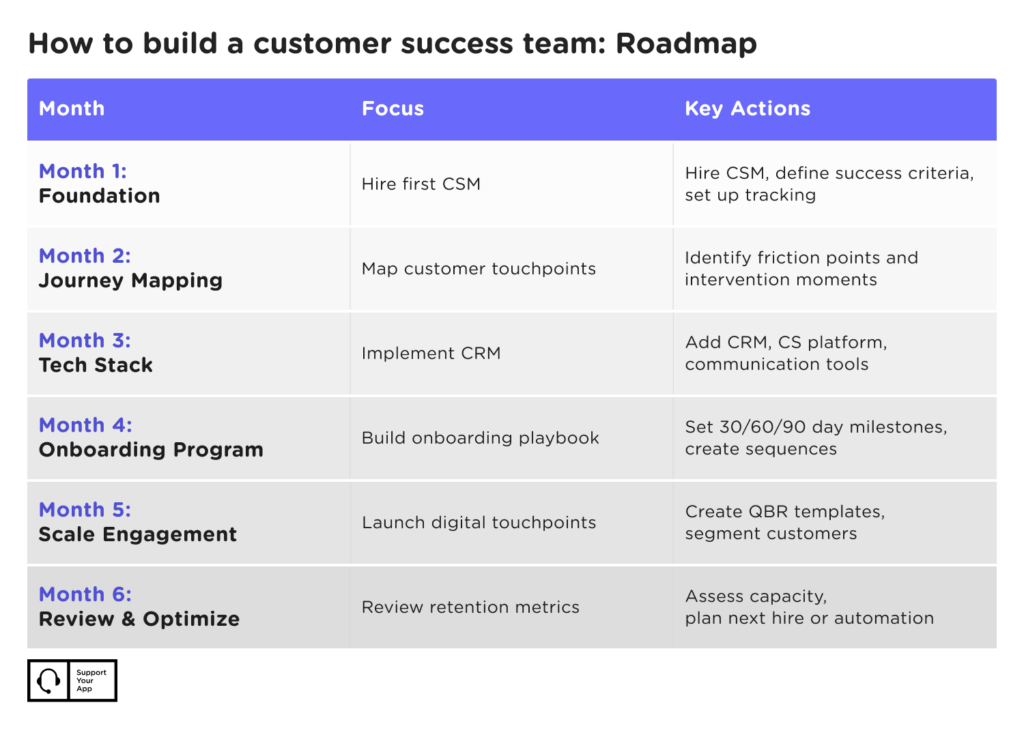
Here’s what a realistic 6-month buildout looks like:
Customer Success Team Strategy and Metrics
Strategy without metrics is guesswork. Customer success team metrics show whether your investment pays off. Here’s what to track.
Gross Retention Rate (GRR): Percentage of revenue you keep from existing customers, excluding upsells. In many subscription businesses, a gross retention rate above 90% is healthy. Enterprise companies often aim even higher. The key is steady improvement — not chasing a single number. Poor GRR means you have a product or fit problem.
Net Retention Rate (NRR): GRR plus expansion revenue. If you renew $900K and expand $200K from a $1M base, your NRR is 110%. Top subscription businesses hit 120%+. For transaction-based models like ecommerce or travel platforms, track repeat purchase rate and customer lifetime value growth instead.
Time to First Value: How long until a customer sees meaningful results? For SaaS, it’s first workflow completed. For fintech, first successful transaction. For healthcare platforms, first patient interaction. For ecommerce, second purchase. Faster time to value drives higher retention across all industries.
Customer Health Score: A composite metric based on engagement and usage patterns relevant to your business. SaaS tracks logins and feature adoption. Ecommerce monitors browse and purchase frequency. Fintech watches transaction volume. Healthcare tech measures provider utilization. Build your score from 3-5 inputs that predict churn in your specific industry.
Expansion Revenue: Dollar amount from upsells, cross-sells, and repeat purchases. Top performers generate 3-5x their salary in expansion. This looks different by industry: additional licenses for SaaS, product line expansion for ecommerce, premium features for fintech, expanded service packages for travel.
Customer Effort Score (CES): Measures how easy it is for customers to get value. Low CES predicts churn better than NPS.
Customer success team KPIs like these should be reviewed consistently. Most teams review GRR and NRR monthly, health scores weekly, and expansion pipeline in real time.
Best Practices for Customer Success in 2026
The CS landscape keeps evolving. Here’s what’s working now.
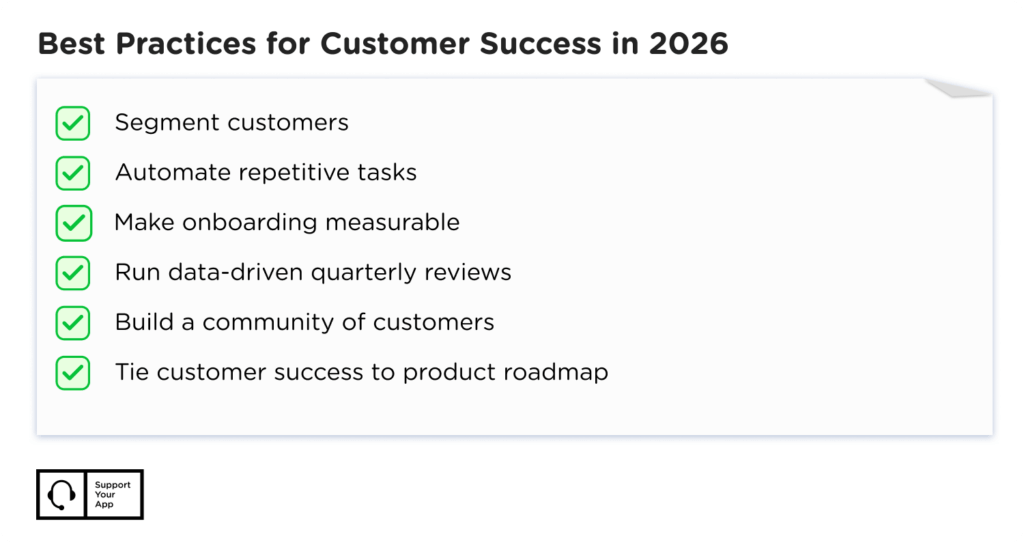
Segment aggressively. Break your customer base into at least three tiers based on revenue potential. High-touch for enterprise. Tech-touch for SMB. Hybrid for mid-market.
Automate the boring stuff. Health score calculations, renewal reminders, and at-risk alerts should run on autopilot. CSMs should execute strategy, not administrate.
Make onboarding measurable. Set clear milestones: account setup by day 3, first workflow live by day 7, team trained by day 14. Track completion rates.
Run data-driven quarterly reviews. Show business outcomes in quarterly sessions: revenue generated, time saved, problems prevented. Come with recommendations.
Build a community. Slack communities, user forums, or annual conferences reduce your support load and improve engagement.
Tie CS to product roadmap. Create a direct line from CS feedback to product planning with monthly syncs.
These practices separate CS teams that retain customers from those that just answer questions.
AI in Customer Success: Where It Actually Helps
AI won’t replace strong CSMs in complex accounts. But it will automate repetitive work — giving teams more time to focus on strategy and relationships. Here’s how:
Churn prediction: Machine learning spots usage drops and engagement changes before customers tell you they’re leaving.
Automated health scoring: Let AI calculate health scores in real time based on 20+ data points. Your CSMs see which accounts need attention.
Smart routing: AI routes customers to the right person or provides instant responses for simple questions.
Meeting summaries: Record customer calls and let AI generate summaries and extract action items.
The pattern is clear: AI handles repetitive tasks. Humans handle strategy and relationships.
What Most Companies Get Wrong About CS
Most teams treat customer success like glorified support. Managing a customer success team that actually moves numbers requires a different approach. Here’s what separates high-performing teams.
They own a revenue number, not just NPS. Great CS teams are measured on net retention and expansion revenue. When CS owns revenue, they prioritize accounts by dollar risk and opportunity.
They identify poor-fit customers early. And, they address it quickly, even if that means not pushing for renewal. A customer who can’t succeed with your product will cost more in the long run.
They treat onboarding like a product launch. High-performing teams run it like a 90-day sprint with clear milestones. First value in 7 days. Full adoption in 30. Business outcome by 90.
They use AI for the repetitive stuff. The smart ones automate health score updates and at-risk alerts. This frees CSMs to build relationships and run strategic conversations. SupportYourApp’s AI support solutions help you answer basic customer questions.

Key Takeaways
A customer success department is a revenue function. It keeps customers longer and grows accounts bigger. Without one, you’re competing with one hand tied.
Structuring your team around your business model is key. High-touch for enterprise. Digital-first for SMB. Hybrid for mid-market. Match your resources to where revenue lives.
Track metrics that matter: gross retention, net retention, time to first value, and expansion revenue. These tell you if CS is working. Everything else is commentary.
Building and scaling a customer success department starts with hiring your first CSM, mapping the customer journey, and building playbooks. Add people as revenue grows, not before.
Use AI to extend your team’s capacity. Automate health scoring, churn prediction, and routine support. Let humans focus on relationships and revenue.
The companies winning in 2026 treat customer success as a growth engine, not a cost center. They invest in the right people, tools, and processes. They measure what matters and iterate fast.
FAQ
What Is a Customer Success Team?
A customer success team is a group of professionals dedicated to helping customers achieve their desired outcomes with your product or service. Unlike traditional support that reacts to problems, CS proactively identifies customer needs and guides them through onboarding, adoption, and expansion to reduce churn and drive growth.
What Does a Customer Success Team Do?
Customer success departments handle onboarding new customers, monitoring product usage and engagement, identifying at-risk accounts before they churn, conducting business reviews to prove value, finding expansion opportunities within existing accounts, and gathering product feedback to improve the customer experience. The goal is maximizing customer lifetime value.
How to Build a Customer Success Team?
Start by defining what success looks like for your customers and mapping their journey. Hire your first CSM with account management or onboarding experience. Set up basic tools: CRM, customer success platform, and communication software. Create onboarding and renewal playbooks. Track core metrics like retention and expansion. Scale your team as revenue grows, adjusting your structure based on account complexity and volume.
How to Structure a Customer Success Team?
Choose a structure based on your business model. Pooled works for high-volume, low-complexity products where any CSM can help any customer. Segmented assigns CSMs based on account value or size. Pod groups specialists around shared accounts. Vertical specializes by industry. Hybrid mixes approaches based on lifecycle stage or account needs. Most scaling companies use segmented or hybrid models.
❤︎ Like it? — Share: Share on LinkedIn or Share on Facebook

Nader is an Integration Specialist with over nine years of experience in the customer support industry. Having started as a support agent, he developed a deep understanding of diverse client needs and service environments. He now specializes in building and optimizing helpdesk systems, creating workflows, and implementing tailored integration solutions. Outside of work, he enjoys watching anime, spending time with his family and friends, and is passionate about brewing and tasting great coffee.
Posted on LinkedIn