

Customer retention is your company's ability to keep existing customers buying from you instead of a competitor. This guide is for founders and support leads who watch sign-ups grow while revenue stays flat. If you've typed "what is customer retention" into a search bar after a rough churn report, you're in the right place. Let's fix that.
Key takeaways
- Retention is the cheapest growth you'll find, because the customers you already have are the easiest to sell to and the easiest to lose.
- Most companies compete on price or service alone, which makes them easy to replace. The brands people stick with build something deeper.
- You can't fix what you don't track, so start with one simple retention formula and check it every month before you change anything else.
- Support quality sits behind most retention wins, from fast answers to agents who remember what the customer said last time.
What Is Customer Retention?
Bad experiences cost more than most teams think. Qualtrics XM Institute estimates that poor customer experiences put nearly $3 trillion in global sales at risk in 2026. Its research also found that consumers cut spending after 47% of bad experiences. That money wasn't coming from strangers. It came from people who'd already picked you once.
So let's start with the basics. Customer retention is everything a company does to keep current customers coming back. That covers the product, the price, the support, and every message in between. The goal is to lower churn, which is the share of customers who stop buying. Repeat buyers then become loyal fans.
Retention and acquisition pull from the same budget, but they work differently. Acquisition fills the bucket. Retention plugs the holes. A company can spend heavily on ads and still shrink if customers leave as fast as they arrive. Growth needs both working at once, and most teams underfund the second one.
Why Is Customer Retention Important?
Keeping a customer usually costs less than finding a new one. You've already paid to win them. They also trust your product enough to keep using it, and every month they stay, that first investment pays back a little more. The value shows up in four places.
Retained Customers Cost Less to Serve
New customers need ads, demos, discounts, and onboarding before they spend a cent. Returning customers skip most of that. They know your product well. Over time, a loyal base needs less marketing spend per sale, which frees money for product work and better support. The savings add up fast.
Loyal Customers Spend More Over Time
People who trust a brand tend to buy more often and try new products sooner. They decide faster, too. They don't need to compare every option again before each order. The importance of customer retention grows with each year a customer stays, since a steady base of repeat buyers carries a business through slow quarters.
Happy Customers Bring in New Ones
Satisfied customers talk. They recommend products to friends and defend the brand online when someone complains. Brands like Wallpics rely on happy buyers to spread the word about their custom canvas prints. That word of mouth costs nothing. It also converts better than most ads.
Loyal Customers Give Better Feedback
Long-term customers feel like partners, so they share more honest opinions. They'll tell you which feature confuses them and what a competitor does better. That beats a cold survey. If you want the full breakdown of why customer retention is important, read our guide.
How to Measure Customer Retention
Good intentions don't show up on a dashboard. Numbers do. To see whether customers stay, you need a percentage you can track every month and compare over time. The most common way to get it is the customer retention rate formula below. It takes five minutes.
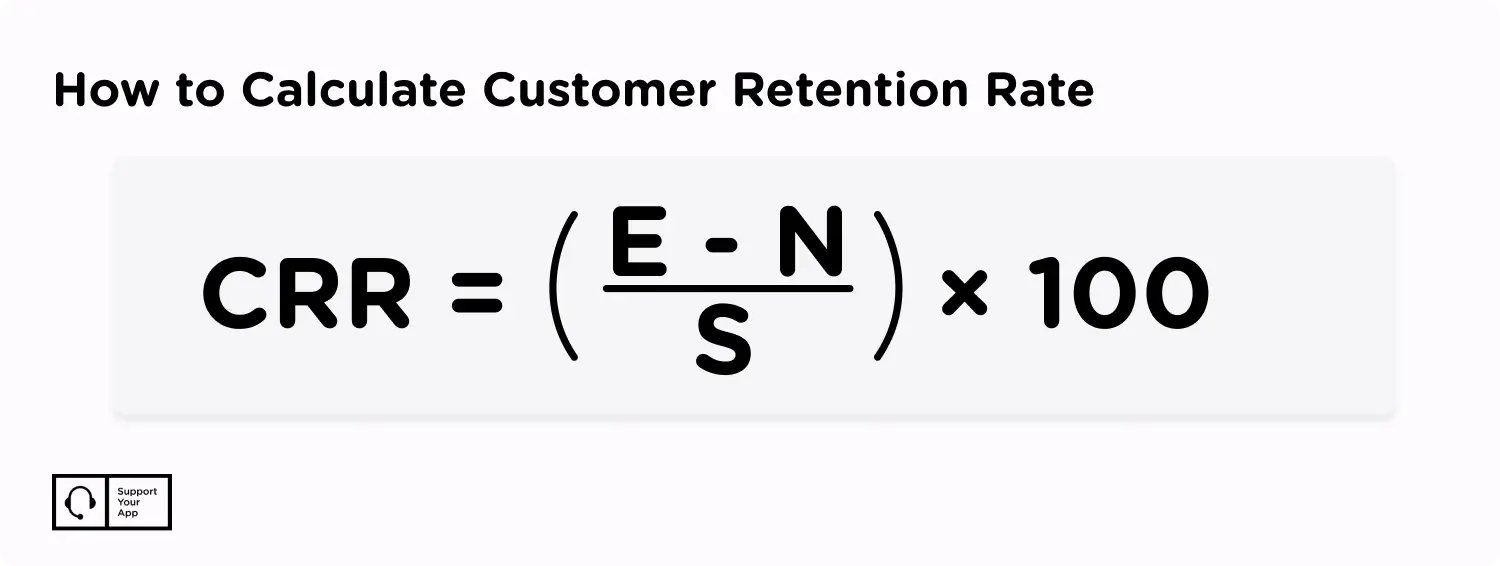
Take the number of customers at the end of a period and subtract the new customers you gained during it. Divide that by the customers you had at the start. Multiply by 100. Say you start a quarter with 200 customers, add 40, and finish with 210. Your retention rate is 85%.
Before you run the math, define customer retention for your own business. What counts as active? It might be a paid subscription or a purchase in the last 90 days. Then compare your result with past periods and with what counts as a good customer retention rate in your industry.
Retention rate tells you a lot, but not everything. Track it next to churn rate, repeat customer rate, purchase frequency, and customer lifetime value. Each one adds context. Together, they show how often customers buy and how much each one is worth over the full relationship.
A Short History of Customer Loyalty
Businesses used to be personal. If someone had asked "what's customer retention" a century ago, the answer would've been a handshake. People bought from a shopkeeper they knew, or from a friend at the company. Leaving meant letting down someone you cared about, so customers rarely switched.
That changed in the 1980s, when companies moved customer contact to computers and call scripts. It saved money. It also weakened the bond. Online ads in the early 2000s tried to win people back, but ad blockers dulled their impact. Technology can come close to that old personal trust, though it rarely replaces it.
The Customer Loyalty Pyramid
Loyalty and retention are close, but they're not the same thing. Loyalty is the goal: a customer who keeps choosing your brand without thinking twice. Retention is the route. Picture a pyramid, with retention as the wide base and loyalty sitting at the narrow top.
Most companies sit low on that pyramid. Customers don't hate them. They just don't care much. The question "what is customer retention" has a different answer at each level, so it helps to know where your brand stands. There are three tiers, and each one holds fewer companies than the one below it.
Service Tier
The base holds most businesses. These companies compete on what they offer and how much it costs, so customers see them as replaceable. The relationship rests on convenience. Any competitor with a lower price can pull customers away overnight. Geico is a classic example, since most people choose an insurer like it on price.
Value Tier
The middle tier belongs to companies whose values match what their customers care about. People prefer these brands and stay longer, even when cheaper options exist. Few companies get here. Southwest Airlines moved up from the service tier by standing for friendly service and fair fares, and its retention grew with it.
Interpersonal Relationship Tier
The top tier is rare. Customers feel a personal connection that goes beyond price or shared values, almost like a stake in the brand's success. Apple is the usual example. Here, the customer retention meaning shifts from keeping buyers to keeping a relationship. That bond survives the odd weak release.
Customer Retention Strategies That Work
Every lost customer takes the money you spent winning them out the door. Small daily decisions keep them. Pick the strategies below that fit. If you run a subscription business, our guide to SaaS customer retention strategies goes deeper on churn in recurring-revenue models.
Personalize the Experience
Generic messages work for some customers and miss the rest. Personalization closes that gap. Use names in emails and recommend products based on past orders. Amazon built a habit around this. Shoppers notice when it's missing. In eCommerce, consumer retention often depends on how relevant those suggestions feel to each person.
Give Customers Support They Remember
Great support is your most direct retention tool. Customers want quick replies from agents who solve the problem on the first try. Speed alone isn't enough. SupportYourApp builds outsourced teams for tech companies, and our omnichannel customer support meets customers 24/7 on the channels they already use, in 60+ languages.
Automation handles the repetitive part. SupportResponse, our autonomous AI agent, resolves routine tickets around the clock and passes complex cases to a human agent. People stay in charge. That mix shows up in loyalty, too. Clozemaster, a language learning app, used to rely on freelance agents, and support quality dropped every time one left.
After Clozemaster moved its email support to SupportYourApp, our team studied the incoming requests and rebuilt the processes around them. Response times fell. The CSAT score climbed, and frustrated users turned into advocates. You can read how it worked in the Clozemaster SaaS customer support case study.
Keep Every Conversation in One Place
Nothing pushes customers away like repeating themselves. According to Zendesk's CX Trends research, 74% of customers find it frustrating to tell their story again to different agents. The fix is simple. Keep one shared record of every interaction, with past issues and preferences visible to whoever picks up the next ticket.
SupportCRM handles this as a unified inbox. It pulls email, voice, and chat into one agent workspace, so nobody hunts across tools for context. Agents see the whole story. When the history sits in one place, a good conversation doesn't depend on one specific agent remembering a customer.
Build a Loyalty Program
Loyalty programs reward people for coming back. Points, tiered perks, milestone gifts, and member discounts all work. Starbucks is the classic case. It offers free drinks and personal discounts based on purchase history. Some programs let members turn points into charity donations. That gives customers a reason to stay beyond saving money.
Stay in Touch Between Purchases
Silence lets customers forget you. Regular, useful contact keeps the brand in mind without crowding inboxes. HubSpot does this well with webinars and free tools that help users succeed. Smaller teams can start small. An interactive flipbook can make a long guide easier to read than a static file.
Make Onboarding Easy and Engaging
First impressions decide a lot. If the first session feels confusing, customers look for a simpler option and never see your product's full value. Keep setup short. Some teams turn onboarding into small quests with progress bars, which gives new users a reason to finish setup instead of drifting off.
Offer a Free Tier or Free Tools
Free plans build habits. They let people feel the product's value before they pay. Slack's free plan is a well-known example. Its limits on message history and integrations nudge growing teams toward paid plans. Free calculators and templates work the same way, because they prove your expertise and keep users coming back.
Let Customers Customize the Product
People stick with products they've shaped to fit their needs. Custom dashboards, saved settings, design options, and add-on features give users a sense of ownership. That ownership matters. Once someone has spent time setting things up their way, switching to a competitor means starting again from scratch.
Simplify Signup and Payment
Every extra form field is a chance to lose someone. Offer social sign-in and autofill basic details. Make password recovery quick, for example through a phone number. Send reminders before billing. Accept digital wallets like PayPal and Apple Pay alongside cards, so customers can pay the way they prefer.
Make It Easy to Leave
A hidden cancel button frustrates people and turns a calm exit into an angry review. Ask most support leads what is customer retention, and few will mention the cancel flow. They should. A clear opt-out or one-click unsubscribe keeps the relationship friendly. Customers who leave on good terms are far more likely to return later, or to recommend you anyway.
Protect Customer Data
Trust breaks fast when people worry about their data. Use reputable payment providers and publish a clear refund policy. Add multifactor authentication to user accounts. Customers notice these details. For fintech and eCommerce brands in particular, security is part of the product people pay for, not an extra.
Give Key Accounts a Success Team
High-value clients need more than a ticket queue. B2B teams often ask what is client retention, and this is where it lives. A customer success manager helps clients use the product well and flags issues early. A dedicated customer service team gives those accounts people who know their history.
Invite Customers to Shape the Product
Customers who help build a product rarely walk away from it. Ask for feedback through surveys and reviews, and offer small rewards for taking part. Some companies run a public board where users submit feature requests and upvote ideas. Customers see you listen. Your roadmap gets a clear signal, too.
Reward Referrals and Repeat Purchases
Give both the referrer and the new customer a discount or credit for each successful referral. Limited-time offers and discounts on the next order bring people back sooner. Small gifts help, too. Suggest relevant upgrades or bundles at checkout, as long as they fit what the customer needs right then.
Study the Customer Journey With Data
Follow the path customers take from their first website visit to their latest purchase. Analytics tools and customer feedback show where people stall or drop off. Track patterns, not events. Once you know where the friction sits, fix the steps that cost you the most customers.
How Customer Retention Companies Help
Running all of this in-house takes time and trained people. Few teams have both. An outside partner can take on part of the load, from daily support to early warnings when churn risk rises. Your own team then has room to focus on the product and the roadmap.
SupportYourApp has supported tech companies since 2010, with 1,500+ supporters and 250+ clients worldwide. We combine human teams with AI tools. Customers get coverage 24/7 across 60+ languages. Knowing the theory is the easy part. Putting it into practice is where we can help.