
A customer service SLA is a written promise about how fast and how well your support team will help customers. This guide is for support leaders and CX managers. You need to set those promises without overcommitting. You'll learn the SLA types, the metrics worth tracking, and the practices that keep targets realistic as ticket volume climbs.
Key takeaways
- An SLA turns vague service promises into targets that your team and your customers can both check.
- The right SLA type depends on whether you support one client, one service, or several customer tiers.
- Response time gets the spotlight, but a few lesser-known metrics show whether your SLA holds up under pressure.
- The strongest SLAs start from your team's true capacity, not from the fastest number a competitor advertises.
What Is a Customer Service SLA?
Bad service has a price tag. Qualtrics XM Institute estimates that US organizations risk $973 billion in sales in 2026 because of poor customer experiences. Customers name service delivery issues as the most common cause. That's the exact area an SLA covers.
The SLA full form in customer service is Service Level Agreement. It gives support teams a measurable framework. It holds them accountable. It also keeps service delivery consistent from one shift to the next, no matter who is working the queue that day.
That consistency pays off quickly. An SLA gives customers clear service guarantees and helps you maintain high satisfaction and trust over time. Both sides know what good looks like before the first ticket arrives, which removes most of the guesswork from everyday support conversations. Nobody has to wonder what happens after they hit send on a request.
What does SLA stand for in customer service beyond the acronym? It's the ground rules for case resolution and quality standards that both sides agree on in advance. Each type of SLA sets those rules a little differently, depending on who the customer is. Structure matters here. Here's how the three types compare.
Types of SLA in Customer Service
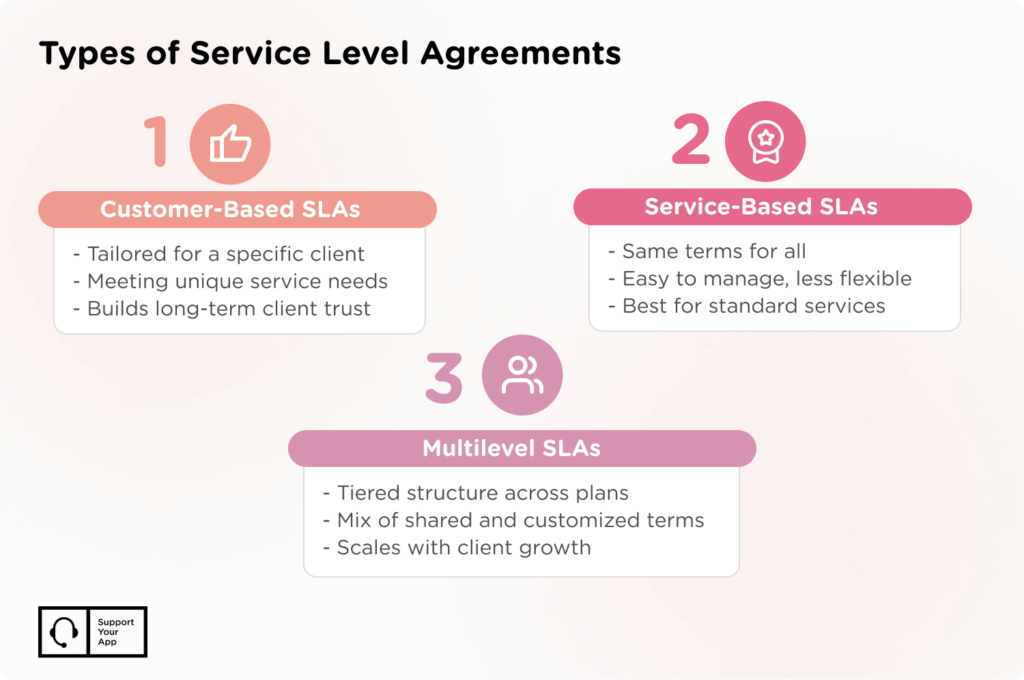
There are three different types of SLAs. Each one fits a specific kind of service expectation. The right choice depends on how you sell and deliver support. That could mean one large client, one standard service, or several segments on different plans.
Customer-Based SLA
This type of SLA fits one specific client. It outlines all the services they receive and the agreed performance standards for each one. It's a one-to-one agreement. It reflects the customer's unique needs and priorities. Two clients can sign very different terms.
This kind of customer SLA works well for businesses that sell personalized service packages. Both sides get clear expectations, like dedicated support hours or custom response times. Take a hospital. It might get a 30-minute resolution time for critical issues, with a clear path to escalate urgent cases to senior agents.
Service-Based SLA
A service-based SLA applies the same service standards to all customers. Delivery stays consistent and compliant. Key performance indicators (KPIs) keep service desk operations organized and service quality steady. A cloud provider, for example, may guarantee 99.9% uptime and a 2-hour response time for all users, regardless of their individual contracts. Nobody gets special treatment.
Multilevel SLA
A multilevel SLA works in tiers. It breaks a standard SLA into layers that fit specific customer groups or service components. Each tier gets its own performance metrics and service parameters. The result is more control. Tiers can follow subscription plans, usage patterns, or business priorities, which makes support more competitive and personal.
A SaaS company shows how a tiered customer service SLA works. It may offer basic support with longer response times to all users. Premium subscribers get more. They receive priority assistance and faster resolutions. The diagram below summarizes the three types of SLAs and how they differ in scope.
Key Customer Service SLA Metrics
Metrics give an SLA teeth. Defining and documenting them is one of the key steps in service level management. Many overlap with the customer satisfaction KPIs used to measure service quality. Specific metrics vary by industry. Each one tells you something different. Together, they show whether your promises hold up in daily work.
Resolution Time
Resolution time is the total time it takes an agent to resolve a ticket once it's opened. It sounds simple. In practice, it isn't. Several other metrics shape it:
- First Response Time: how long it takes to respond to a request.
- One-Touch Resolution Rate: the percentage of tickets resolved by the first responding agent.
- Hold Time: the time customers wait on the line for an active agent.
SLA response time is a key metric across both B2C and B2B industries. It states the average amount of time customers can expect to wait after they flag an issue. Staying within that timeframe matters. It keeps service performance strong and protects customer trust, especially during busy periods.
Customer Satisfaction (CSAT)
CSAT stands for Customer Satisfaction Score. It measures how satisfied customers are with a specific interaction or the overall service experience. Teams usually collect it through post-interaction surveys. A typical question is "How satisfied were you with the support you received?" The math is easy. You divide satisfied responses by total responses.
CSAT is also one of the metrics to measure customer engagement across the whole experience. The bar keeps rising. According to Nextiva, acceptable CSAT benchmarks used to hover around 75%, but most businesses should now aim for 85% or higher.
Average Handling Time (AHT)
AHT is the average amount of time an agent spends handling a customer interaction from start to finish. It's a workload metric. For teams that sell SLA support, it also feeds straight into staffing plans and pricing. It typically includes:
- Talk or chat time: the time spent directly communicating with the customer.
- Hold time: the time the customer spends on hold during the interaction.
- After-call work (ACW): the time the agent spends wrapping up the case, such as writing notes or updating systems.
First Contact Resolution (FCR)
FCR shows the share of issues your team solves in a single interaction. The customer never follows up. The ticket never reopens. It's stricter than one-touch resolution. The customer's view of the case counts here. A high FCR usually means fewer repeat contacts and lighter queues for everyone on the team.
Average Speed of Answer (ASA) and Service Level
ASA tracks how long it takes an agent to pick up a call or chat. Service level builds on it. It measures the share of contacts answered within a set window. Nextiva describes the classic call center SLA target as the 80/20 rule: 80% of calls answered within 20 seconds. It's a starting point, not a law.
Abandonment Rate
Long queues push people away. Abandonment rate is the percentage of customers who hang up or leave a chat before they reach an agent. A rising rate often points to understaffed shifts or a confusing IVR menu. Always track it next to ASA. Together, the two show exactly where long waits start costing you conversations and, eventually, customers.
SLA Compliance Rate
This metric ties everything together. SLA compliance rate shows the percentage of tickets that met every agreed target in a given period. Teams that report to business clients usually put this number at the top of their monthly reports. When it dips, the other metrics tell you why.
Best Practices for Effective SLAs
Good SLAs come from steady habits, not clever wording. Here are some help desk SLA best practices to consider when you set expectations and define performance standards. Each one keeps your targets honest, easier to hit, and easier to explain to the customers who rely on them every day.
Match SLA Targets to Team Capacity
Clear objectives aren't enough on paper. They also need to be achievable. Otherwise, you set yourself up for failure before anyone signs the contract. Unrealistic targets lead to mistrust, so test every one thoroughly before you put it in writing. Start with current volume and staffing. Then add a buffer for seasonal peaks.
Make SLAs Customer-Focused
Internal KPIs only tell half the story. An SLA for customer service also has to put the customer experience first. Focus on satisfaction metrics like CSAT and monitor customer churn, which shows how well you retain customers. Happy customers rarely leave. That makes churn a key long-term signal.
Speed plays a big part here. A first reply that feels fast sets a positive tone for the whole conversation, even when the full fix takes a little longer. Silence is what customers hate. They forgive a longer resolution far more easily. That's why many teams set a tight first response target and a looser resolution target.
SLA Transparency
Transparency builds trust fast. It also shapes a positive customer experience from the first contact. One of the best ways to get there is to publish your SLA expectations clearly. Put them on your support portal, in your FAQs, and in your contract documentation. The image below highlights three core practices that define a strong SLA agreement.

You don't need to do all of this yourself. SupportYourApp offers help desk outsourcing with hand-picked teams of experienced consultants. You get long-term or short-term contracts, flexible service packages, regular KPI tracking, and QA reports. Clear targets come built in.
That setup held up for Measure Protocol. The company was growing fast. Its expansion into a new market doubled ticket volume overnight. A one-person support setup couldn't keep pace. SupportYourApp scaled the team early and met every agreed SLA throughout the surge, with no dropped tickets or missed deadlines. Planning ahead made the difference.

Examples of SLA for Customer Service
SLAs fit into many parts of customer support operations. Here are three common ones. They show how SLA call center metrics work in practice, from the first reply to the final escalation. Each example below can go straight into your own agreement with only small changes for your industry, channels, and team size.
1. Average Response and Resolution Times
Your SLA should state clearly how long customers can expect to wait for a response after they submit a ticket. That reduces anxiety. Include estimated resolution times too, and note any changes during peak periods. Warnings beat surprises. Customers handle a longer wait well when they know about it in advance. Silence causes the frustration.
2. Business Hours and Support Availability
Make sure your SLA and website clearly show when support is available. Customers then won't expect replies outside working hours. Self-service covers the remaining gaps. A knowledge base handles the basics. For round-the-clock coverage, an AI customer support agent like SupportResponse resolves routine tickets 24/7 and hands complex cases to a human agent.
3. Escalation Procedures
Define the escalation path within the SLA based on issue severity. Tickets then reach the right support tier from the start, with fewer unnecessary handoffs along the way. Customer support SLAs with clear escalation rules improve first contact resolution rates. They also cut frustration. Customers stop repeating their story to three different agents.
Summary
SLAs in customer service define the service expectations between the support team and the customer or client. They set clear protocols for case resolution, response times, and quality standards. These agreements work as guarantees. Customers can hold you to them. Over time, they build trust that lasts well beyond a single ticket or contract term.
Key SLA metrics typically include resolution time, CSAT, and AHT. FCR, service level, abandonment rate, and SLA compliance rate add depth. To make SLAs effective, set measurable goals and match targets to customer needs. Stay fully transparent. A well-built customer service SLA lays the foundation for consistently high-quality support and puts you in a strong position to exceed expectations.