Your phone queue doesn't stop at 6 p.m., and neither do your customers. This guide is for support leads at SaaS and fintech companies comparing the best AI voice agents for customer support. You'll see where each platform fits and what it takes to run one well.
TL;DR
- Pick by use case first, because inbound support and outbound campaigns point to very different tools.
- Managed services take setup and staffing off your plate, while developer platforms give you control and more work.
- Human handoff matters more than voice quality once callers bring billing disputes or angry complaints.
- Per-minute prices look small, but model and telephony fees stack on top.
AI now answers routine calls. Gartner predicts agentic AI will autonomously resolve 80% of common customer service issues on its own by 2029, cutting operational costs by 30%. That still leaves the unusual and high-stakes calls for people to handle. The best AI voice agent for your team is the one that clears routine calls and hands the hard ones to a human agent cleanly.
What Makes a Good AI Voice Agent for Customer Support?
A good AI voice agent handles routine calls alone and passes hard ones to a person. Callers judge it within seconds, mostly on how natural it sounds and how fast it replies. Buyers judge it later, on handoff quality and whether the pricing still makes sense once call volume doubles in peak season. Seven criteria listed below cover both.
Naturalness: The agent should handle interruptions, accents, and half-finished sentences without restarting the flow. Ask each vendor for unedited call recordings from your industry. Your callers ring from cars, train stations, and noisy kitchens on weak signals. Studio demos usually hide that.
Latency: Slow replies trigger hang-ups. Vendors advertise response times under a second, measured in ideal lab conditions. Your own number depends on the language model and the telephony route you pick. Run test calls during your busiest hour and time the gap between the end of a question and the first word of the answer.
Languages: Language counts on a pricing page rarely match production quality. An agent can list dozens of languages and still stumble over regional accents. If you support customers in Germany and Brazil, test each market with native speakers before you commit to annual minutes. Check mid-call language switching too.
Handoff: Callers hate repeating themselves. When the AI hits its limit, it should transfer the call with a summary attached. 95% of service leaders in a 2025 Gartner poll plan to keep human agents. Clear rules for what the AI may decide alone are part of AI governance in customer service, and they belong in the contract.
Integrations: A voice agent is only as useful as the data it can reach. It should read account data from your CRM and write tickets back to your helpdesk. Native connectors for Zendesk, Salesforce, or HubSpot save weeks of custom API work. Without them, your engineers own every new lookup the agent needs.
Pricing: Headline rates exclude extras. Developer platforms often bill the platform fee, language model, voice, and phone line separately. Managed services usually quote one bundled rate, which makes costs easier to forecast but leaves you less room to tinker with the stack. Model your cost at three times today's call volume before you sign.
Inbound or outbound: Support teams need an agent that answers calls and routes them by intent. Outbound tools focus on dialing speed and voicemail detection instead. A platform tuned for sales campaigns can still run support calls, but you'll spend more time building escalation paths and knowledge lookups yourself. Buy for inbound first.
How We Evaluated These 7 AI Voice Agents
We scored the best AI voice agents for customer support on seven criteria, weighted toward what breaks support calls. Handoff quality and integrations carry the most weight, because a fluent agent that can't reach your data still fails callers. Naturalness and latency come next, since callers notice them first.
| Criterion | Weight |
| Human handoff | 20% |
| Integrations | 20% |
| Naturalness | 15% |
| Latency | 15% |
| Languages | 10% |
| Pricing model | 10% |
| Call direction | 10% |
We drew on public pricing pages and product docs, plus independent reviews from 2026. Prices in this guide reflect vendor pages from mid-2026 and change often. For SupportVoice, we used SupportYourApp's own product specs and a published client case, so treat that entry as a first-party view. Confirm current prices with sales.
Best AI Voice Agents for Customer Support in 2026
These seven platforms split into managed services and self-build tools. SupportYourApp runs SupportVoice as a managed service and can staff the human team behind it. The other six on this best AI voice agents for customer support 2026 list are software you configure and run yourself.
1. SupportYourApp (SupportVoice)
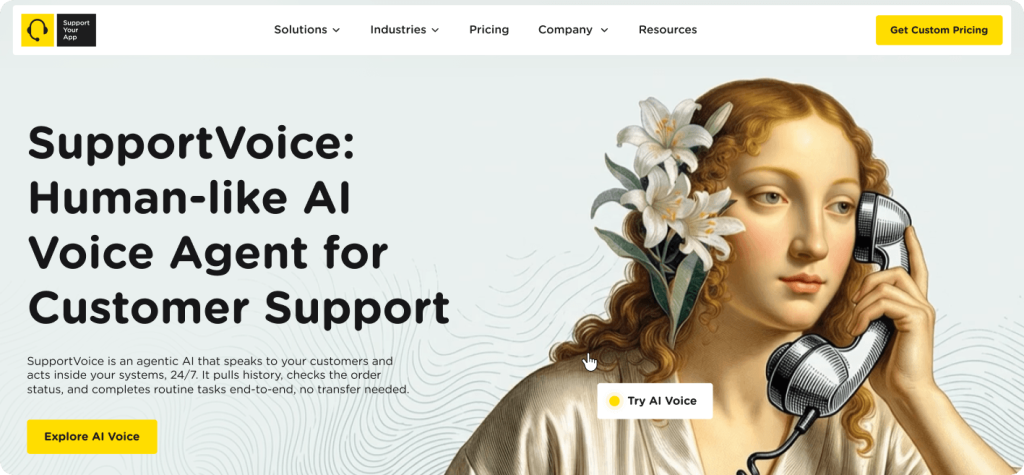
SupportVoice is SupportYourApp's AI voice agent for inbound and outbound calls, available 24/7 in 30+ languages. It routes calls by intent, looks up account data, and updates records during the conversation. Complex calls go to a human agent, and SupportYourApp can supply that team from its 1,500+ supporters across 8 international hubs and handles the setup.
Key features
- Inbound and outbound calls 24/7, routed by caller intent.
- Account lookups and record updates during the call.
- Escalation to a human agent, with SupportYourApp's team available to take those calls.
- Runs on SupportCRM, with Zendesk and Freshdesk integrations and custom CRM work on request.
- ISO/IEC 27001, PCI DSS Level 1, GDPR, CCPA, and HIPAA compliance.
Pros
- Managed rollout, so your team doesn't build or tune the agent.
- Human backup from the same provider, under one contract.
- Strong fit for SaaS, fintech, and travel and hospitality support lines.
Cons
- Voice only. Chat and email automation need a separate product.
- Quote-based pricing, scaled by call minutes.
Best for
- Support teams that need 24/7 phone coverage and trained people on escalations, without building in-house.
Softorino needed phone support overnight. The app developer's users kept asking for voice help, especially after hours. SupportYourApp built an AI voice agent on Softorino's product knowledge base that handles license lookups and creates tickets in its CRM. Softorino saw 95% faster first replies and 70% faster resolution, while CSAT climbed from 3.5 to a perfect 5.0 out of 5.0, according to the Softorino case study.
2. CloudTalk
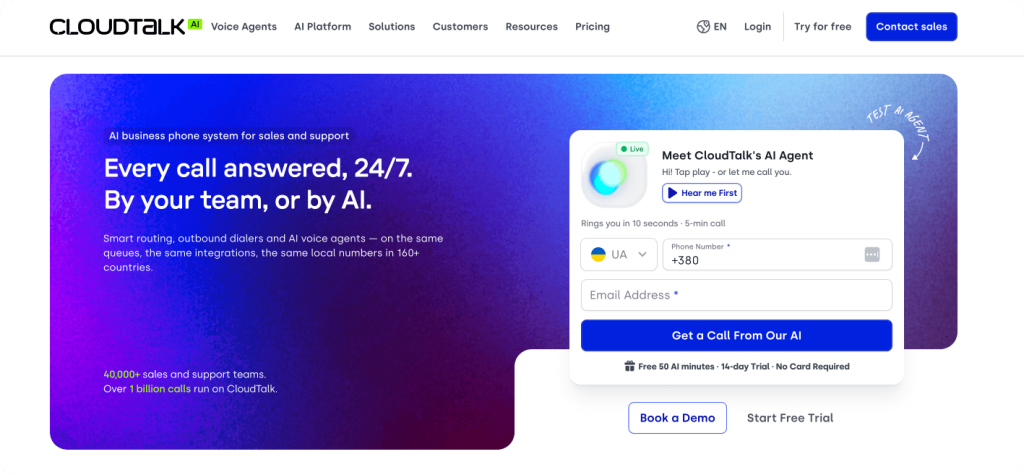
CloudTalk is a cloud phone system for sales and support teams, with an AI voice agent sold as an add-on. The agent lives inside the phone system, so routing and call analytics stay in one place. Seat licenses come on top.
Key features
- AI voice agent that answers and places calls 24/7.
- 100+ integrations, including major CRMs and helpdesks.
Pros
- No-code setup inside a phone system your team may already use.
- Published pricing makes budgeting easier.
Cons
- The AI agent costs extra on top of per-seat plans.
- Voice-first, so chat and email automation need another tool.
Best for
- Teams that want the phone system and AI agent from one vendor.
3. Synthflow
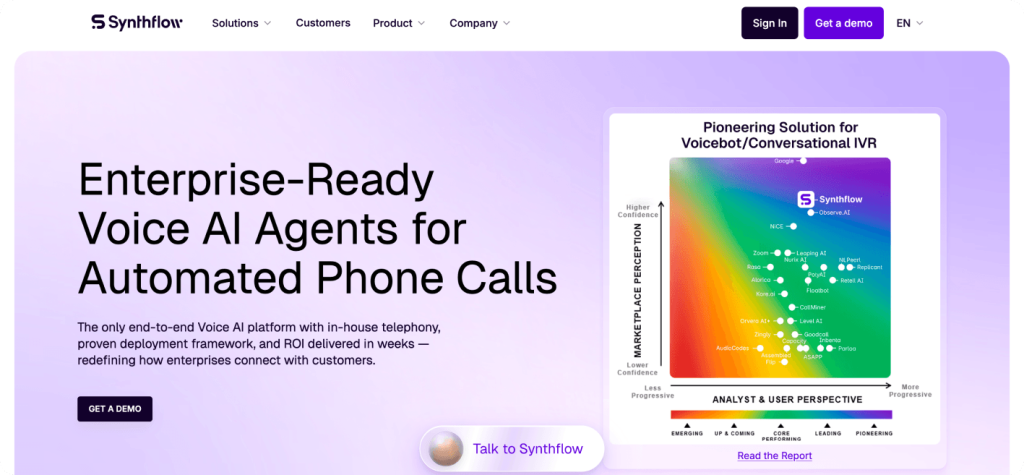
Synthflow is a no-code builder for AI phone agents, popular with agencies that resell voice automation. You design call flows visually and choose the language model behind the agent. Model and telephony fees sit on top of the base per-minute rate. Enterprise deals go through sales.
Key features
- Visual flow builder for inbound and outbound calls.
- White-label options for agencies.
- Call transfer to human agents.
Pros
- Fast to prototype without engineers.
- Flexible for agencies running many client agents.
Cons
- Stacked add-ons make costs hard to forecast.
- Enterprise pricing now runs through sales.
Best for
- Agencies and ops teams that can manage a no-code agent themselves.
4. Bland.ai
Bland runs a closed stack. Its speech and language models run in-house, so call data doesn't pass through outside AI vendors. Conversational Pathways let teams script call logic as a node graph. Reviews favor it for outbound campaigns.
Key features
- Conversational Pathways for structured call flows.
- Managed telephony for large outbound campaigns.
Pros
- Predictable per-minute pricing for the AI layer.
- Fewer third-party data hops for teams in regulated industries.
Cons
- The lower per-minute rates require a monthly subscription tier.
- Inbound support needs more custom work.
Best for
- Large outbound programs, such as appointment reminders and renewals.
5. Retell AI
Retell AI targets developer teams. Its managed platform handles speech, telephony, and model orchestration so engineers can focus on call logic. Pricing depends on the model and voice. Independent 2026 reviews often call Retell the fastest developer platform to ship for inbound support, citing its strong out-of-the-box defaults.
Key features
- Conversation flow builder plus a full API.
- Bring-your-own language model support.
- Built-in telephony, call transfer, and post-call analytics.
Pros
- Quick path from prototype to a live inbound line.
- Wide model choice keeps costs flexible.
Cons
- You still need engineers to build and maintain the agent.
- Costs climb with premium models and voices.
Best for
- Engineering teams that want to own an inbound voice agent without building infrastructure.
6. Vapi
Vapi is voice infrastructure for engineering teams that want control over every layer. You bring your own language model, voice, and telephony, then connect them through Vapi’s API. That flexibility rewards teams with time to tune latency and prompts.
Key features
- Bring-your-own models, voices, and phone numbers.
- Tool calling to reach your APIs during a call.
Pros
- Maximum flexibility for custom call logic.
- Large developer community and documentation.
Cons
- The full bill depends on every provider you plug in.
- Production quality depends on your team's tuning work.
Best for
- Engineering-led companies building custom voice workflows.
7. Voiceflow
Voiceflow is chat-first. Its visual canvas lets product and support teams design chat and voice agents without code. Usage runs on credits: voice calls burn roughly 10 credits per minute (compared to 1 credit per chat turn). Concurrent calls are capped at 5 on Pro and 15 on Business, and agents stop responding immediately once monthly credits run out without top-ups.
Key features
- Drag-and-drop canvas for chat and voice flows.
- Support for several model providers.
- Phone deployment through telephony integrations.
Pros
- One builder for chat and voice journeys.
- Easy for non-engineers to edit flows.
Cons
- Pro allows only five concurrent voice calls.
- Human handoff on calls takes extra setup.
Best for
- Chat-first teams adding a simple voice line.
Comparison Table
This table compares the seven platforms on pricing model, setup effort, and human handoff. Pricing shows the model rather than exact rates, because vendors change them often. The best AI voice agent for customer service on paper can still lose if it takes your team three months to launch. Setup time differs most.
| Platform | Pricing model | Setup effort | Best fit | Human handoff |
| SupportYourApp (SupportVoice) | Quote, by call minutes | Low, managed | 24/7 inbound and outbound support | Built in, plus human team |
| CloudTalk | Minute bundles plus seats | Low | Teams already on CloudTalk | Transfer to CloudTalk agents |
| Synthflow | Per minute, enterprise contracts | Medium | Agencies, no-code teams | Configurable transfer |
| Bland.ai | Per minute, subscription tiers | Medium to high | High-volume outbound | Configurable transfer |
| Retell AI | Per minute, by model and voice | Medium | Developer-built inbound support | Configurable transfer |
| Vapi | Platform fee plus provider costs | High | Custom voice workflows | Built by your team |
| Voiceflow | Monthly plan plus credits | Medium | Chat-first teams adding voice | Extra setup |
How to Choose the Right AI Voice Agent for Customer Support
Choose by the calls you get most, not by the demo that sounded best. Pull last quarter's call logs and tag each reason as routine, complex, or sensitive. If most calls are password resets and order status checks, a self-build tool or phone add-on can cover them cheaply.
Sensitive calls need people. Customers still lean on people for recommendations, with 54% trusting human agents more than AI in a Gartner survey. Billing disputes, fraud reports, and cancellations need a fast route to a trained person. The best AI voice agents for inbound customer support plan that handoff first.
Your team's engineering capacity matters as much as your call mix. Developer platforms like Vapi and Retell AI reward companies that can spare engineers for weeks. If nobody owns the agent after launch, the best voice AI for customer support is a managed service that monitors and updates it. Agents drift without upkeep.
Run a two-week pilot on one queue before any annual contract. Track containment, transfer rate, and repeat calls against your current human baseline. If you only need calls answered and messages taken, compare AI answering services for business first. They cost less than an AI voice agent customer service teams use for full resolution.
Finding the Best AI Voice Agent for Your Team
Self-build platforms fit teams with engineers and mostly routine calls. Managed services fit teams that need 24/7 phone coverage and trained people on hard calls, without adding new hires. SupportYourApp builds and runs SupportVoice for you, with human supporters ready when a caller needs one.