

This guide is for founders, support managers, and ops leads who are tired of watching calls roll to voicemail. Picking the best AI answering service depends on your call volume, your compliance needs, and whether you still want a human backup on tricky calls. We compared seven options so you can match the tool to your actual use case.
Key takeaways:
- Some tools are pure AI. Others blend AI with human backup for high-stakes calls.
- Pricing models vary a lot: per minute, per call, per unique caller, or a flat monthly rate.
- The right pick depends on your call volume, your industry, and how much risk you can carry.
- A comparison table below breaks down languages, integrations, and pricing side by side.
Here's what the data shows: 74% of consumers now expect round-the-clock service because AI made it possible, according to Zendesk's 2026 CX Trends report. Every missed call is now a missed expectation. That shift is exactly why an AI phone answering service has moved from "nice to have" to a real line item on the budget.
What to Look for in an AI Answering Service for Business
Every vendor claims to "handle calls automatically," but that phrase covers a wide range of products. Not every AI phone answering service solves the same problem. Before you compare vendors, get clear on five things that actually decide whether the tool fits.
- Languages. If your customers call in more than one language, check whether the AI switches automatically or if you need separate phone numbers per language. English-only caps your growth fast.
- Human-in-the-loop (HITL) coverage. Pure AI is fine for routine questions. A payment dispute or an angry customer is different. Those calls need a live person. Look at how each vendor handles human-in-the-loop AI customer support, and whether escalation is built in or bolted on.
- Integrations. Your automated phone answering service should sync with your CRM, calendar, and helpdesk. If call notes and bookings don't land where your team already works, someone still has to do the manual copy-paste.
- Pricing model. Per-minute pricing punishes long calls. Per-caller pricing punishes high-traffic months. Flat-rate pricing is predictable but can cap features. Know your call patterns first. Match the model to how your call volume really behaves.
- Scalability. A tool that works for 50 calls a month might buckle at 5,000. Test it under load. Check concurrency limits, uptime guarantees, and what happens during a traffic spike before you commit.
Key takeaway: Voice quality gets the attention, but it's not what decides fit. The best AI phone answering service is the one built around your pricing pattern, your tools, and your real call volume.
How We Evaluated These 7 Services
We looked at seven AI answering services for business options through the same lens. Language coverage, human backup availability, integration depth, pricing transparency, and real-world use case fit.
We also checked verified reviews on G2 and Capterra, recent 2026 product releases, and published pricing pages rather than relying on sales pitches or vendor marketing claims. Where a vendor keeps pricing behind a “contact sales” wall, we noted it, since that’s a real buying friction point.
Best AI Answering Services for Business in 2026
Here are the seven services, ranked against those criteria. Each one takes a different bet on where AI should end, and a human should start.
1. SupportYourApp (SupportVoice)
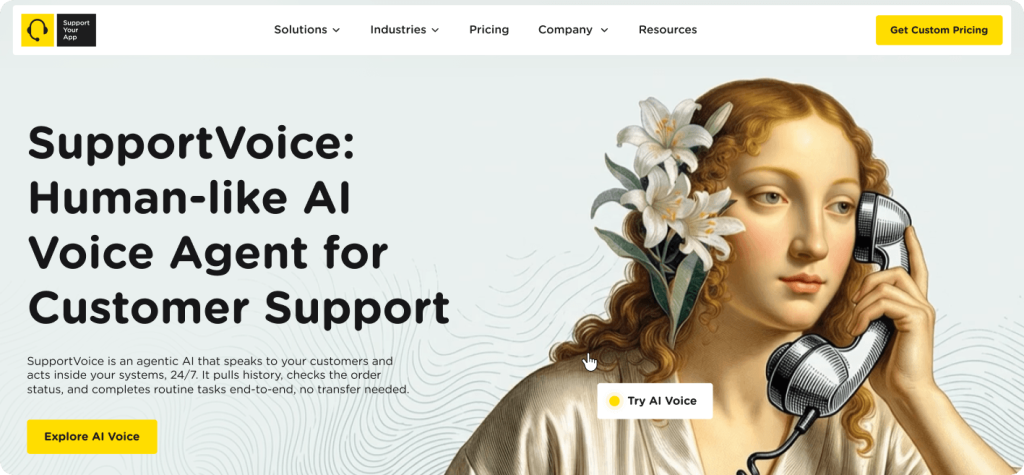
SupportVoice is SupportYourApp's AI voice agent, built for companies that want automation without losing human judgment on complex cases. It handles inbound and outbound calls around the clock in 30+ languages, backed by live agents who step in when a call needs a person. Callers shouldn't hit a dead end or get stuck cycling through the same robotic menu options without a way forward.
Key features:
- Native and near-native coverage across 60+ languages company-wide
- Live escalation to trained human agents
- PCI DSS Level 1 and ISO 27001 compliance
- Fits into existing AI customer service solutions, CRM and helpdesk included
Pros: Strong fit for regulated industries (fintech, healthcare) that can't risk a bot mishandling a sensitive call. Human-in-the-loop is a real design principle here.
Cons: Custom pricing. No instant quote. Best suited to businesses that want a managed partner.
Best for: Growing companies in fintech, SaaS, or eCommerce that need multilingual coverage plus compliance, and don't want to build the AI-human handoff themselves.
"Response times dropped 95% and resolution time fell 70% after SupportVoice took over first-line call handling," reports SupportYourApp's voice AI customer support case study with Softorino.
2. Smith.ai
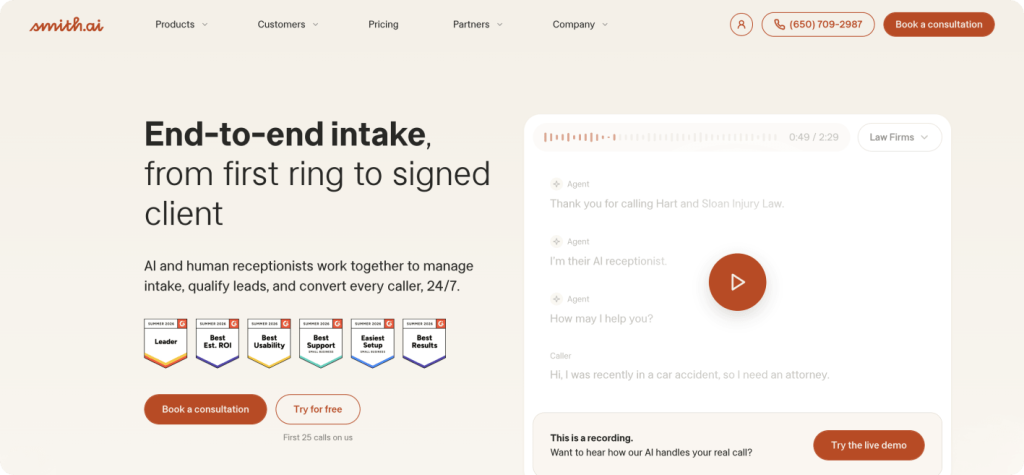
Smith.ai built its name on human receptionists. AI answering came later, layered on top for businesses that still want a live safety net.
Key features:
- Standalone AI Receptionist plan alongside a hybrid Virtual Receptionist plan that blends AI with live agents
- Live agents available for calls that need a human touch, not only automated responses
- Lead qualification built into the call-handling process
- CRM sync through thousands of Zapier-connected apps
Pros: Real human backup for complex calls. Strong track record in legal and professional services.
Cons: Per-call overage fees add up quickly once you exceed your plan's cap. Read the fine print. Add-ons like Spanish support and payment collection cost extra.
Best for: Law firms, medical practices, and other professional services where a missed nuance on a call is expensive.
3. Synthflow.ai
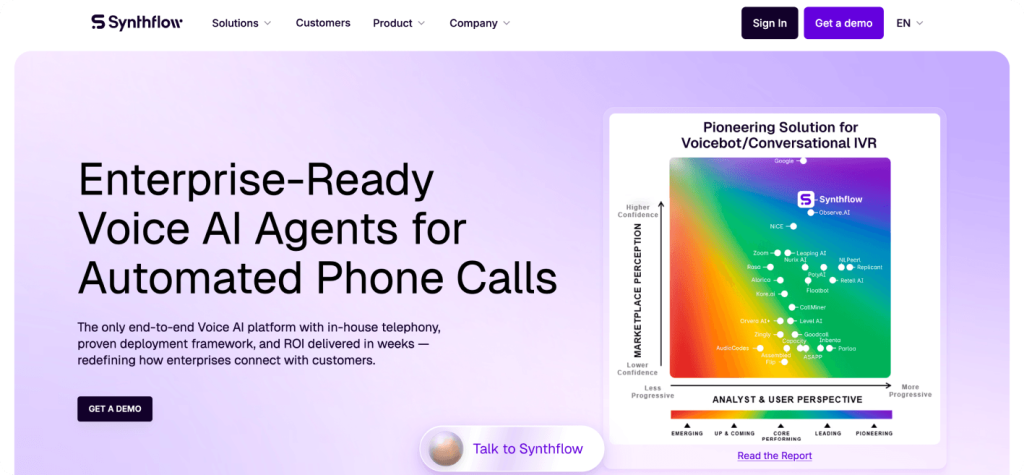
Synthflow is a no-code platform for building custom AI voice agents, aimed at agencies and businesses that want to design their own call flows. No developer required.
Key features:
- Drag-and-drop Flow Designer for building conversation logic
- Prebuilt templates for HVAC, dental, legal, and real estate
- White-label option for agencies reselling the platform
Pros: Full control over conversation logic without writing code. No dev team needed. Strong fit for agencies managing several client accounts.
Cons: Pricing is usage-based and can climb quickly at volume. Some users report the agent can feel scripted once a call goes off the happy path.
Best for: Agencies and tech-comfortable SMBs that want to build a custom automated phone answering service rather than adopt one out of the box.
4. Bland.ai
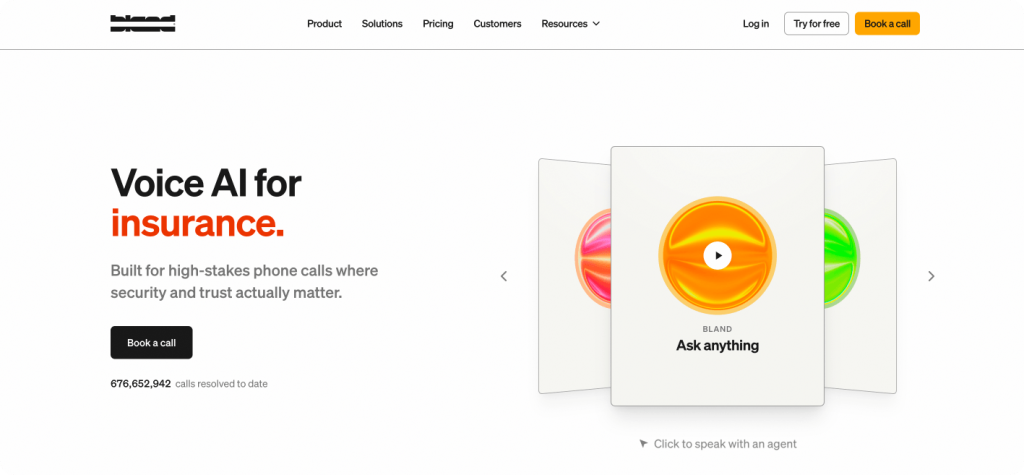
Bland.ai is a developer-first platform built for programmatic control over voice agents at serious scale. The platform works more like raw infrastructure that engineering teams assemble into a finished solution than something you'd open and start using immediately.
Key features:
- Custom voice cloning
- High concurrency built for outbound campaigns
- SOC 2 and HIPAA-ready infrastructure
Pros: Built for volume, plain and simple. Enterprise teams running tens of thousands of calls a month get predictable per-minute economics and dedicated support.
Cons: This is a platform built for engineers to configure. You'll need engineering resources on hand to set it up properly and keep it maintained as your call flows and use cases change over time.
Best for: Enterprises with in-house developers who want full ownership of their voice AI stack.
5. Goodcall
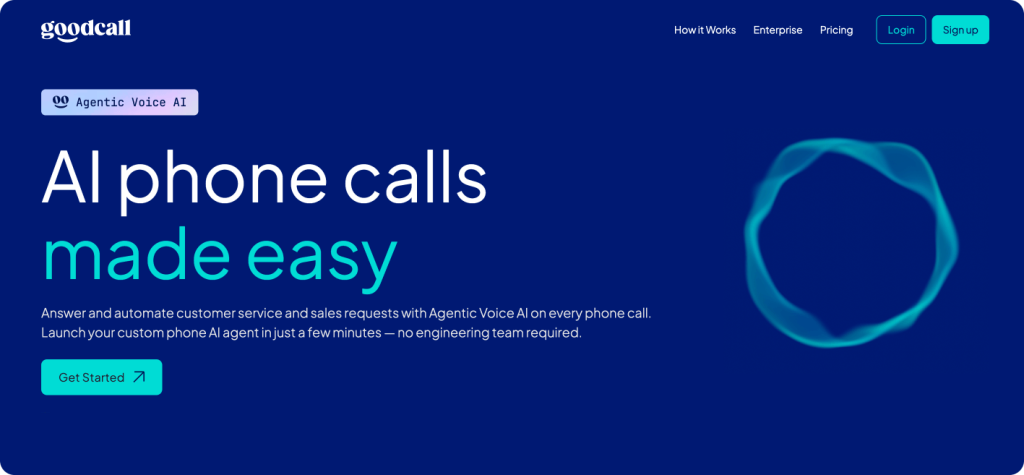
Goodcall is a straightforward AI receptionist built for small service businesses like salons, contractors, and clinics. It's meant to stay simple, both to set up and to use day to day.
Key features:
- Appointment booking plus calendar and CRM integrations
- Billing based on unique callers, not minutes
- Tiered plans that scale with business size
Pros: Fast setup. No engineering required. Per-caller billing means long calls don't inflate your bill.
Cons: Fewer deep vertical integrations than specialized tools. Costs can rise quickly if a marketing push brings in a wave of new callers.
Best for: Small, owner-run teams that want a working AI phone answering service for small business live in an afternoon.
6. Allo
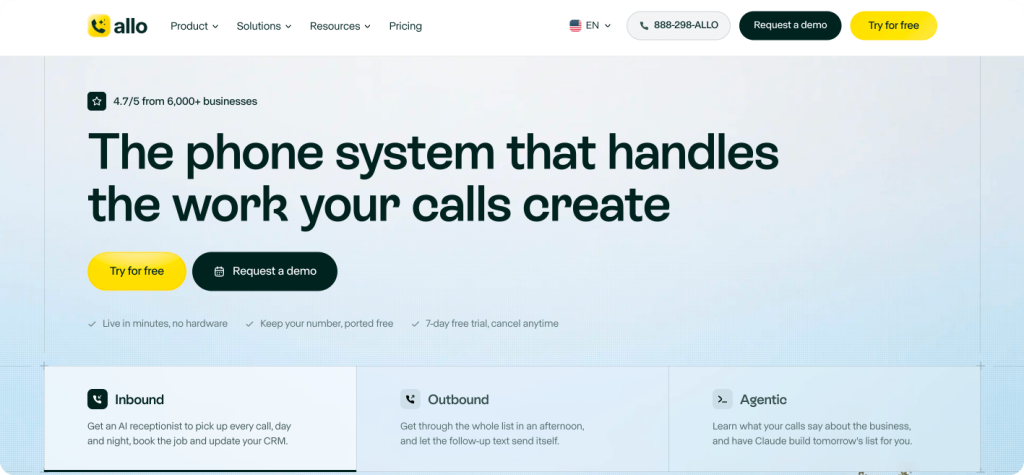
Allo is a mobile-first phone system built for small teams who work from their phones rather than a desk. Everything you need is handled right in the app, without switching to another tool.
Key features:
- Flat per-user pricing structure, with no per-call charges
- AI receptionist included, not an add-on
- Call summaries, transcripts, and Zapier or native CRM sync
Pros: Transparent, all-inclusive pricing with no per-call surprises. Strong fit for teams already running their business from a mobile app.
Cons: Newer to the market than some competitors, with fewer features for multi-location operations.
Best for: Realtors, contractors, and small sales teams who want an AI voice answering service without a desktop-first setup.
7. RingCentral (AI Receptionist)
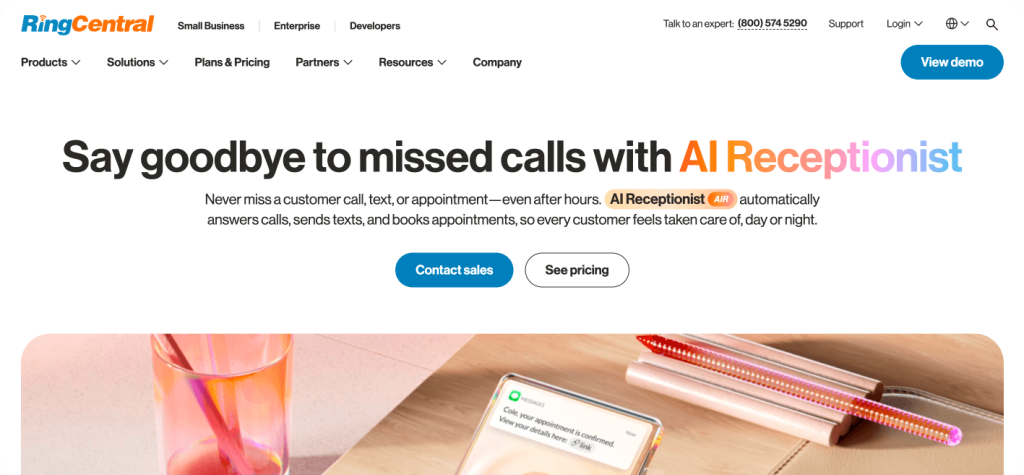
RingCentral AI Receptionist (AIR) is a generative AI phone agent built directly into RingCentral's business phone system. That means you're not stitching together a separate AI tool on top of the phone service you already use.
Key features:
- Out-of-the-box setup, no IT project required
- Smart call routing and SMS follow-ups
- 2026 updates that let AIR absorb call queue overflow and end calls naturally
Pros: No separate platform to manage if you already run RingCentral. Straightforward setup for businesses of any size.
Cons: Best value shows up if you're already a RingCentral customer. Standalone adoption is less common.
Best for: Existing RingCentral users who want AI answering added to a phone system they already trust. There's no need to onboard a new vendor or learn a separate tool just to get AI call handling.
Comparison Table
| Service | Type | Languages | HITL | Integrations | Best For | Pricing Model |
| SupportYourApp (SupportVoice) | AI + human hybrid | 30+ | Yes | CRM, helpdesk | Regulated, multilingual businesses | Custom, quote-based |
| Smith.ai | AI + human hybrid | English, Spanish | Yes | 7,000+ via Zapier | Legal, medical | Per-call, tiered plans |
| Synthflow.ai | No-code AI builder | Multiple | No | 200+ apps | Agencies, custom builds | Usage-based, scales with minutes |
| Bland.ai | Developer platform | Multiple | No | API-based | Enterprise, high volume | Per-minute, volume discounts |
| Goodcall | AI receptionist | 20+ | No | Calendar, CRM | Small service businesses | Per unique caller, tiered plans |
| Allo | AI phone system | Multiple | No | Zapier, CRM | Mobile-first small teams | Flat rate per user |
| RingCentral AIR | AI + phone system | Multiple | No | RingCentral suite, CRM, Calendars | Any business phone system or RingCentral users | Add-on or standalone |
How to Choose the Right AI Answering Service for Your Business
The right fit depends less on features and more on which constraint matters most for your business right now. Here's how to narrow it down based on what you're optimizing for.
- High call volume. If you're routing thousands of calls a month, prioritize per-minute economics and concurrency limits. Volume changes everything. Bland.ai and SupportVoice both scale here, though SupportVoice adds human escalation for the calls that shouldn't go fully automated.
- Multilingual support. If your customers call in more than a handful of languages, narrow your list. Most SMB-focused tools cap out at English and Spanish, while SupportVoice's 30+ language coverage targets global teams.
- Tight SMB budget. Goodcall and Allo both keep costs predictable for small teams. No surprises at renewal. Pick Goodcall if per-caller billing fits your traffic, and Allo if you want one flat price with no add-on math.
- Enterprise compliance. In fintech or healthcare, the wrong AI answering service is a compliance incident waiting to happen. Look for named certifications. A Forrester Total Economic Impact study found a composite enterprise voice AI deployment delivered 391% ROI over three years. Payback landed in under six months, once the compliance and integration work was done right the first time.
Key takeaway: Match the tool to the constraint that limits you today, whether that's volume, language, budget, or compliance. Chasing every feature means paying for capacity you won't use.
Summary
Picking the best AI answering service for business isn't about finding the tool with the longest feature list. It's about matching call volume, language needs, and compliance risk to the vendor built for that job. If your business needs multilingual coverage with a human safety net built in, SupportYourApp's AI voice agent is worth a look as your next step.