

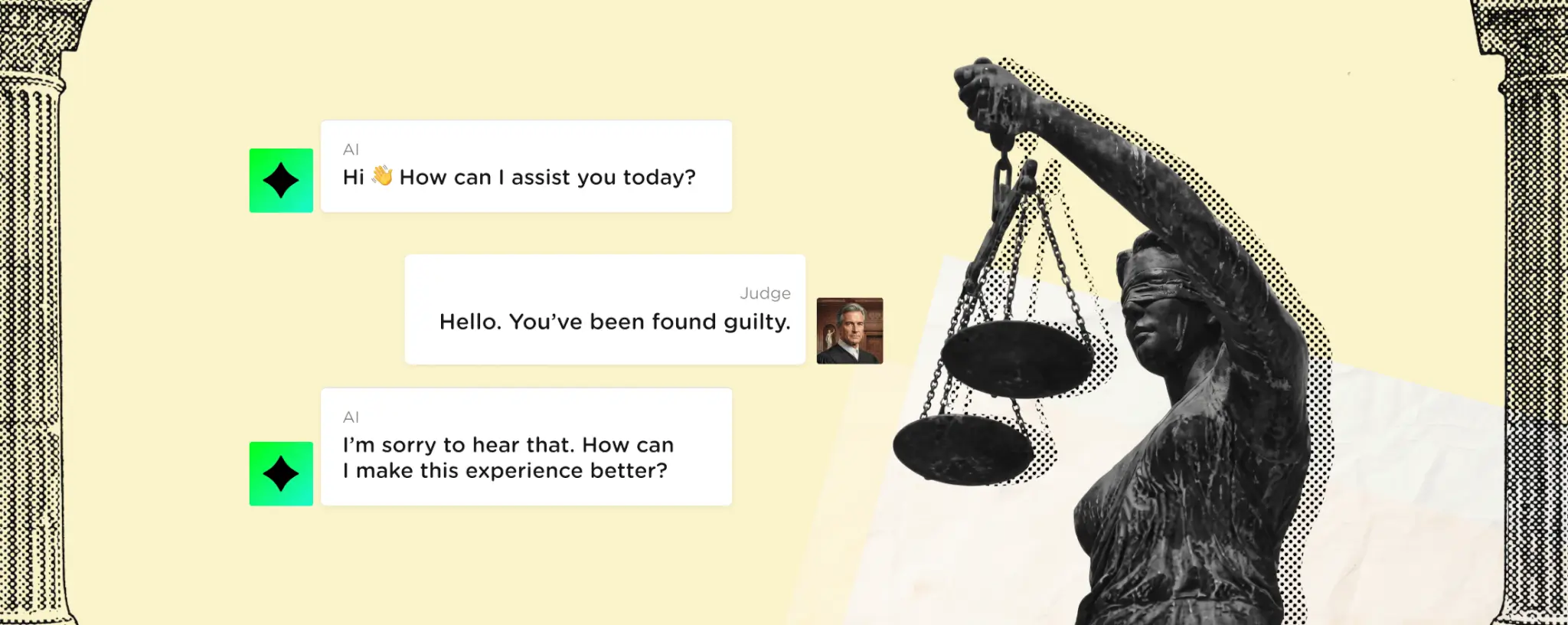
A fast chatbot without oversight is a fast way to break GDPR. This guide covers what accountable AI use looks like in customer service, and what changed after new EU rules took effect.
TL;DR
- Clear rules govern how AI systems handle customer data, decisions, and conversations.
- A real person stays accountable for outcomes a model cannot judge alone.
- New EU transparency rules now require customer-facing chatbots to disclose that they are AI, with real penalties for silence.
- Providers who build governance into daily workflows earn more trust than providers who bolt it on after a problem hits.
What Is AI Governance in Customer Service?
According to the Zendesk CX Trends Report 2026, 83% of CX leaders say memory-rich AI agents are key to personalized journeys. But customers don't just want AI to work. They want to understand how it works.
Governance is the set of policies, checks, and human oversight that decide how AI handles tickets, calls, and chats. It covers what data a model can see, when a person must step in, and how decisions get logged for audit. Skip it, and a fast chatbot becomes a fast way to break GDPR or EU AI regulation.
Support teams feel this first. They handle personal data, payment details, and sometimes health information, often through channels the customer never notices. Regulators hold companies responsible for how that automation behaves.
Getting this wrong isn't just a compliance headache. A biased chatbot response or an undisclosed AI agent can trigger a public complaint fast. A mishandled data request can turn into a regulator's letter just as quickly.
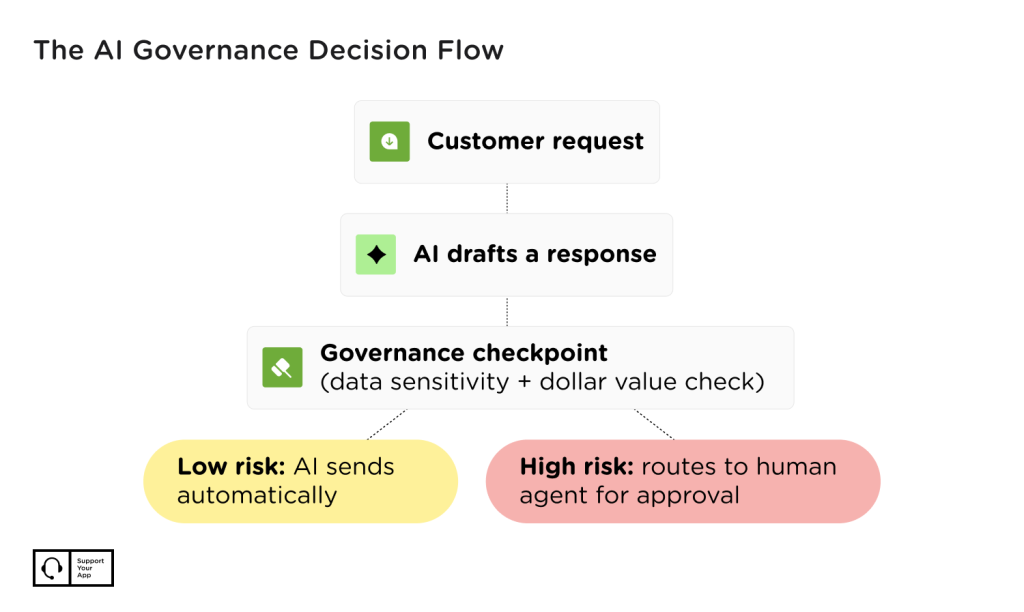
Picture a support bot handling a refund that touches a customer's stored payment method. Whether it sends the resolution alone, without a person confirming the amount, is a governance question, not a technical one.
Key takeaway: This discipline separates a fast support tool from a legal liability. It defines what data AI can touch, when a human steps in, and how decisions get logged. Getting it wrong turns a small error into a regulator's letter.
Core Principles of AI Governance in Customer Service
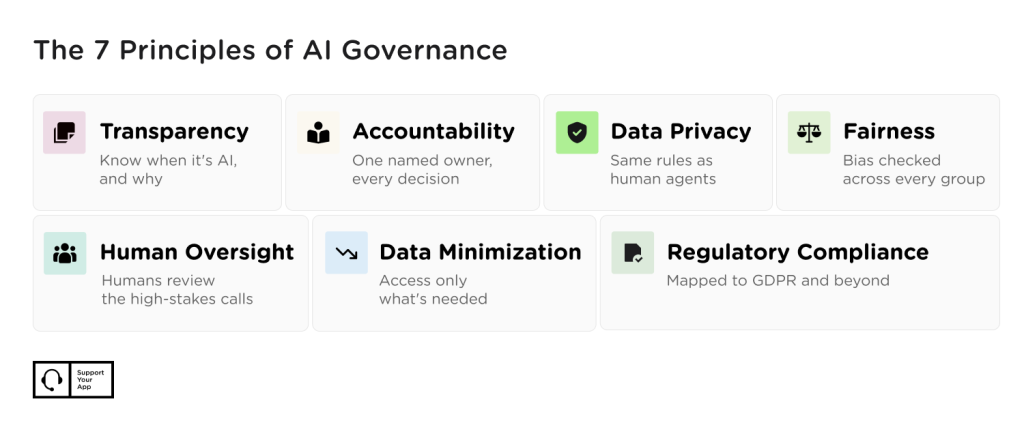
A handful of principles hold any credible framework together. They apply whether the AI handles a password reset or an account cancellation tied to real money.
- Transparency. Customers deserve to know when they're talking to AI and why it reached a given answer. AI transparency turns a black-box bot into something a customer can question.
- Accountability. A named person owns every AI-driven decision, automated or not. This is AI governance and accountability in practice: assigning clear responsibility for each model and workflow.
- Human oversight. A person reviews decisions the AI can't judge alone, especially anything involving money, health, or account access.
- Data privacy. AI tools follow the same data-handling rules as human agents: consent, retention limits, encryption.
- Data minimization. AI systems access only the fields a task needs, not the customer's entire history by default.
- Regulatory compliance. Policies map to GDPR, current transparency law, and relevant standards.
- Fairness. Teams monitor AI outputs for bias across language, region, and customer type, and correct patterns that skew unfairly.
Skip any one, and the framework weakens fast. A transparent bot with no human oversight is just a faster way to make the same mistake at scale.
A growing number of companies formalize these principles under ISO/IEC 42001, the first international standard for AI management systems. It gives support teams a shared structure for documenting AI risk, much like ISO 27001 does for information security.
Key takeaway: No single principle carries a governance framework alone. Transparency without oversight, or fairness without accountability, still leaves gaps a regulator will find. ISO/IEC 42001 gives teams a formal structure to tie these principles together.
Human-in-the-Loop AI: The Foundation of Responsible Customer Support
Automation handles volume well. Judgment is a different problem. This is where a person stays in the loop: reviewing or intervening before approving decision that reaches the customer.
In practice, this means an AI drafts a refund response, but an agent approves it before it sends. Human-in-the-loop AI customer support works this way because it treats AI as a tool for speed, not a replacement for judgment.
This also solves a trust problem. Customers forgive a slow human far more easily than a wrong machine. Keeping a person in the loop turns AI from a liability into a genuine efficiency gain.
Making this work at scale is harder than it sounds.The AI needs to draft fast and accurately, and agents need clear context, so approving or correcting a suggestion stays quick. Most teams get there by refining how the AI presents its drafts, flagging confidence, sensitivity, or edge cases, so the human review step stays fast without ever being skipped.
Key takeaway: Human-in-the-loop AI works because it pairs machine speed with human judgment on every decision. The hardest part isn't adopting the model, it's making the review step fast enough that it never becomes a bottleneck.
AI Compliance and Regulatory Context
AI compliance in customer service now means more than checking a GDPR box. Since August 2, 2026, Article 50 of the EU AI Act has required customer-facing chatbots to disclose that customers are talking to AI. Not a person. That disclosure has to be clear at the start of the conversation, not buried in terms and conditions.
The Act also splits responsibility between the company that builds an AI system and the company that deploys it. A support team running a vendor's chatbot still carries deployer obligations. Fines for transparency violations can reach €15 million or 3% of global annual turnover, whichever is higher.
ISO 27001 and GDPR still matter alongside this, covering data security, consent, and now AI-specific transparency. The picture extends past Europe too, with US states like Colorado building their own AI rules for high-risk automated decisions.
| Framework | Scope | Applies To | Key Requirement |
| GDPR | Data privacy (EU) | Any company handling EU resident data | Consent, retention limits, data minimization |
| EU AI Act, Article 50 | AI transparency (EU) | Deployers and builders of customer-facing AI | Disclose AI use, effective Aug 2, 2026 |
| ISO 27001 | Information security | Any organization (voluntary certification) | Data security management system |
| ISO/IEC 42001 | AI risk management | Any organization (voluntary certification) | AI-specific management system |
| Colorado AI Act | High-risk automated decisions (US) | Companies serving Colorado residents | Bias/impact assessment, disclosure |
Investment in governance pays off in effectiveness too, not just avoided fines. Gartner surveyed 360 organizations in Q2 2025. Companies with a dedicated AI governance platform in place were 3.4 times more likely to reach high governance effectiveness. Structure beats good intentions.
Key takeaway: Disclosure isn't optional anymore. The regulation requires it, and deployers carry liability even for vendor tools they didn't build. Compliance frameworks overlap by design, so treating them as one system is what drives governance effectiveness.
Best Practices for AI Governance in Customer Service
Daily practice doesn't come from a long policy document nobody reads: it comes from a short, concrete list.
- Disclose AI at the first point of contact, in plain language a customer would actually notice.
- Log every automated decision, so a human can review it if a customer disputes the outcome.
- Set clear escalation rules for what AI can decide alone and what always needs a person.
- Audit AI outputs regularly for bias, accuracy, and tone.
- Train support staff to recognize when an AI recommendation looks wrong and override it.
- Review vendor contracts for AI clauses, since a vendor's disclosure failure can still become the deploying company's liability.
These examples of AI in customer service show what this looks like in practice. Faster resolution, with the accountability a regulator or customer would still expect.
Key takeaway: The checklist works because each item answers a specific question a regulator or customer might ask: was this disclosed, is it logged, who reviewed it, who's liable. Small teams can run all of them without a compliance department.
How SupportYourApp Approaches AI Governance
SupportYourApp treats AI governance in customer experience management as a daily operating discipline, not a document in a shared drive. Every AI interaction discloses that it's AI, and every decision involving real stakes routes through human review.
The company runs its AI customer service solutions on ISO 27001-certified infrastructure. GDPR, CCPA, and HIPAA compliance are built into how client data moves through the system. Its AI customer support agent and AI voice agent tools handle routine volume, while trained supporters own anything involving judgment or sensitive data.
The same applies to internal tools. An assistant drafting a reply sends nothing without an agent approving it first, keeping a person accountable even when AI wrote the first version.
As Zendesk CEO Tom Eggemeier put it, "AI is not the differentiator anymore. How intelligently you apply it is."
Key takeaway: Governance only works when it's operational, not just documented. Disclosure and human review have to run on every interaction by default, so accountability never depends on someone remembering to check.

Summary
Getting this right is not a legal formality. It decides whether a company's automation earns customer trust or slowly wears it down. Providers who build transparency, human oversight, and compliance into daily workflows are better positioned for what comes next than those treating governance as an afterthought.