

A potential client calls at 8 p.m. after a car accident, hears voicemail, and dials the next firm on the list. This guide helps office managers and managing partners decide whether an AI receptionist for law firms can catch those calls without new hires.
TL;DR
- An AI receptionist answers intake calls the moment they ring, gathers case details, and passes them to your team.
- It handles routine intake well, while urgent and sensitive calls still belong with people.
- Answering services and AI receptionists differ most on pickup speed and on how costs grow with call volume.
- A short checklist before you sign separates a useful tool from an expensive voicemail box.
Law firms miss a large share of the calls they pay marketing budget to get. CallRail's call insights research puts the legal industry's missed call rate at 28%, second only to healthcare. Someone looking for a lawyer after an accident or an arrest usually wants help that day, so they keep dialing until a person answers.
After-hours gaps make the problem worse. Accidents and arrests don't keep office hours, so plenty of intake calls land after the front desk has gone home. Voice AI can cover that gap, as long as the firm sets clear limits on what it handles.
What an AI Legal Receptionist Does for a Law Firm
An AI receptionist answers incoming calls, talks with callers in natural speech, collects intake details, and routes each request to the right person. Unlike a phone menu, it lets callers explain the situation in their own words. Then it asks follow-up questions drawn from the firm's own intake script. Typical tasks include:
- Picking up every call within seconds, including nights, weekends, and holidays.
- Collecting the caller's name, contact details, practice area, and a short description of the matter.
- Answering common questions about office hours, locations, and how consultations work.
- Passing a structured summary to the right attorney or intake coordinator.
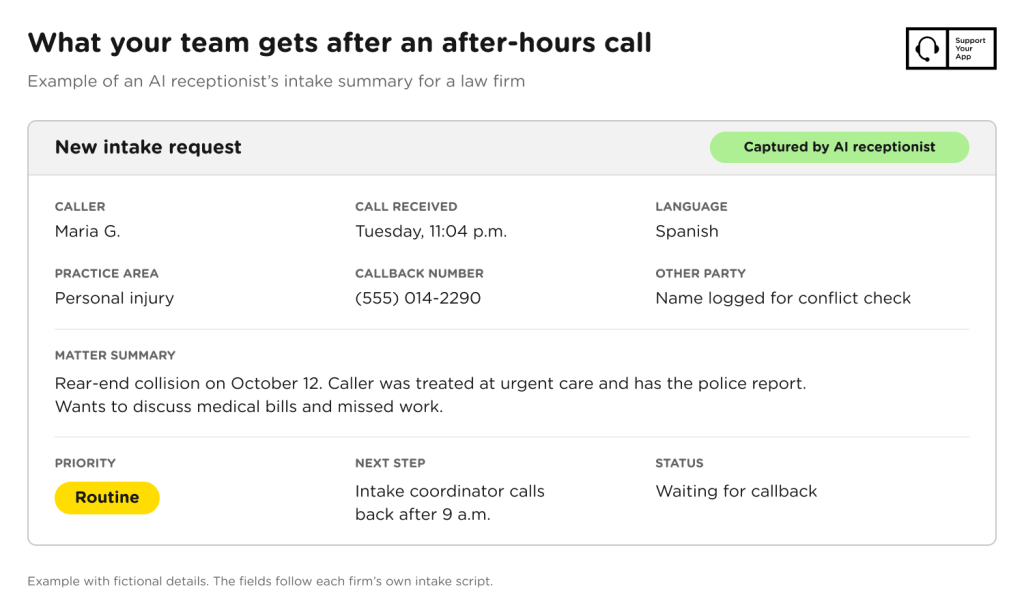
The strongest setups work only from documents the firm supplies: practice areas, fee policies, intake questions, and conflict-check fields. A legal AI receptionist that improvises answers about the law is a liability for the firm. The useful ones stay inside the firm's script and tell the caller plainly when a question needs an attorney.
Language matters for immigration and personal injury practices, where many callers prefer Spanish or another first language. The best multilingual AI receptionist for law firms answers in that language on the first ring. For tools outside the legal field, see this roundup of the best AI receptionist for small business.
Where It Stops: When Staff Step In
An AI receptionist should hand a call to a person whenever the stakes or the questions go past what the firm's documents cover. Setting these limits on day one keeps callers from feeling brushed off at the worst possible moment.
An urgent call is the clearest signal for the AI to step aside. Someone calling about an arrest, or a client with a hearing the next morning, needs a person now. The system should recognize those signals and transfer the call live to an on-call attorney, or send an immediate alert when nobody can pick up.
Sensitive calls need a human voice even when they aren't urgent. Domestic violence and child custody disputes call for judgment and tone that software shouldn't try to fake. A good setup flags these conversations, keeps the AI's part brief, and connects the caller with staff as fast as the firm's schedule allows.
Questions outside the firm's documents are the other trigger. If a caller asks whether they have a case, the AI should say an attorney will answer and log the question. Giving legal advice is off the table for any AI answering service for law firms, however good the voice sounds.
The handoff itself usually works one of two ways. During office hours, a warm transfer puts the caller through to staff with a summary already on screen. After hours, an AI legal receptionist logs the request, tags it as urgent or routine, and the team calls back in priority order.
AI Receptionist vs Answering Service for Law Firms
An AI receptionist answers instantly and handles many calls at once. A traditional answering service puts a human operator on the line, working from a script. The table compares the two on the points law firms usually weigh before switching.
| Factor | AI receptionist | Traditional answering service |
| Pickup speed | First ring, every time | Depends on operator queue |
| Call spikes | Takes many calls at once | Callers wait when operators are busy |
| Intake detail | Follows the firm's full intake script | Often a message plus basic fields |
| Languages | Many languages on one line | Limited to operators on shift |
| Sensitive calls | Hands off to staff | A person responds, usually without legal training |
| Cost model | Scales with call minutes | Billed per minute or per call of operator time |
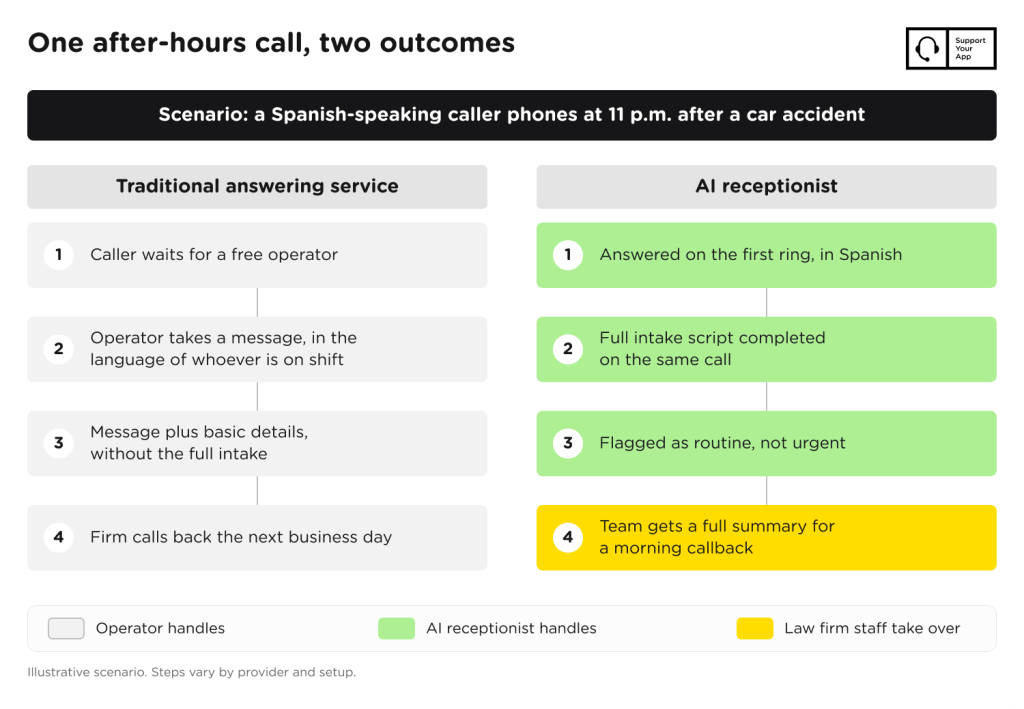
Neither option wins for every firm. Practices with heavy after-hours volume or bilingual callers tend to get more from AI. A firm that wants a trained person on every call may prefer an outsourced receptionist service staffed by dedicated agents.
Many firms end up with a mix. An AI answering service for law firms covers nights and overflow, while people handle daytime calls and every handoff. That split keeps payroll steady and puts a human voice where tone decides whether a client signs.
How an AI Receptionist Improves Intake Efficiency
An AI receptionist improves intake by answering every call immediately and handing staff complete, structured requests instead of voicemails to decode. Clio's 2025 Legal Trends Report found that firms with wide AI adoption are nearly 3x more likely to report revenue growth than firms without AI.
A US multi-practice firm covering personal injury, immigration, family law, and traffic matters saw the intake problem up close. Three people handled inbound calls, and a new campaign brought more volume than they could manage, especially after business hours. The firm needed a backup for evenings and for spikes the team couldn't absorb.
SupportYourApp built a multilingual AI voice agent for the firm on SupportVoice and SupportCRM. The agent draws only on documentation the firm provided. It picks up calls from people seeking representation, answers simple questions, notes each request, and passes it to the team.
1 second average call pickup time with voice AI.
100% after-hours coverage, with no requests missed.
The three-person team stays in place and handles calls during business hours. SupportVoice is a Human+AI voice agent that resolves routine calls alone, escalates complex ones to people, and runs 24/7 in 120+ languages. Firms weighing an AI receptionist for lawyers can borrow the same split, with AI on nights and overflow and people on daytime calls.
What to Check Before You Choose an AI Receptionist
Test any AI receptionist on your own intake script and your hardest calls, instead of a polished vendor demo. A demo shows the happy path, while your after-hours line brings panicked callers and unscripted questions. Run these checks before you sign:
- Ask the vendor to load your intake questions and conflict-check fields, then call in as three different client types.
- Define urgent keywords, name who gets alerted, and test the live transfer after hours.
- Confirm where the vendor keeps recordings and transcripts, who can access them, and which data protection laws the vendor follows.
- Have native speakers test each language your callers use.
- Check whether summaries land in your case management system or CRM, or only in an inbox.
- Ask how pricing works during a call spike, since per-minute plans can jump in a busy month.
- Make sure the agent tells callers they're speaking with an AI at the start of the call.
When you compare an AI voice receptionist with other options, ask for a two-week trial on your own after-hours line. The right AI receptionist for lawyers proves itself on your calls, at your volume, with your staff reviewing the results.
Summary
An AI receptionist for law firms closes the gap between client calling and staff being available. It answers instantly, follows the firm's intake script, and passes clean summaries to the team. Urgent, sensitive, and off-script calls still go to people, and the best setups make that handoff fast and predictable.
Choosing an AI Receptionist for Law Firms: Next Steps
If after-hours calls keep slipping through, start by measuring how many arrive after your office closes. SupportYourApp builds voice agents and receptionist teams around a firm's existing intake workflow, and a short conversation can show which mix fits your call volume. Talk to an Expert when you're ready to compare options.