
Knowing when to outsource comes down to a few clear signals. Your team can't keep up with demand, hiring lags behind growth, or specialists cost more than the work they cover. This guide is for founders and operations leads at growing tech companies who feel stretched thin. It walks through the seven signs, the trade-offs, and the functions companies hand off most often.
Key Takeaways
- Outsourcing works best as a planned decision made before overload forces it, and that timing shapes how smooth the handoff feels.
- Burnout, growth that outruns hiring, skill gaps, and slipping KPIs are the clearest signs your internal setup has reached its ceiling.
- Customer support is one of the most common functions to hand off, because it needs round-the-clock coverage across languages and channels.
- The right partner pairs trained agents with AI for routine work, which keeps costs flexible without giving up control of quality.
Nearly three in four employers (74%) report trouble finding the skilled talent they need, according to ManpowerGroup's 2025 Global Talent Shortage Survey. That shortage changes the math on every open role. When a hire takes months to find and train, an outside team is often the faster way to get the work done.
As a company grows, leadership has to decide which functions stay in-house and which go to outside specialists. Done well, outsourcing moves routine, high-volume work to a team built for it. Your own people get their time back for product and strategy work, which is where their expertise pays off most.
Why Do Companies Outsource?
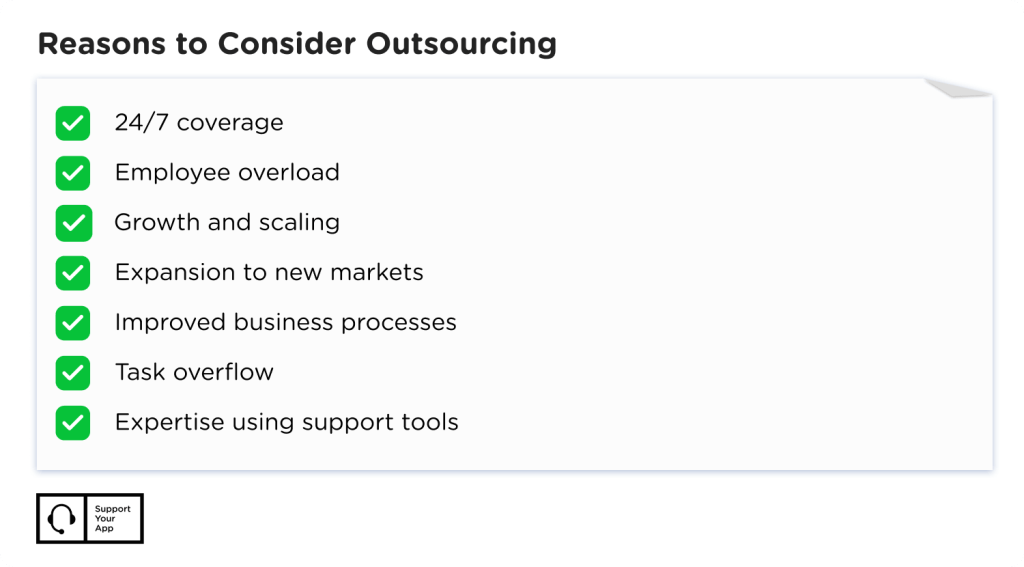
Companies outsource when it makes strategic or financial sense, and capacity is often the first trigger. Internal teams take on more than they can handle, and tasks pile up faster than anyone can clear them. An outside partner absorbs that overflow. It can also scale up or down faster than you can recruit during growth spurts and seasonal spikes.
Reach is the second driver. Entering a new market brings new languages and time zones, and covering customers around the clock would push most in-house teams past their limits. Outsourced teams already have that coverage in place. You can launch in a new region without building a local team from scratch.
The third driver is know-how. Specialized providers bring tested workflows and people who already know support tools like Zendesk and Freshdesk. Building that experience internally takes years. A good partner brings it from the first week, so your processes improve without a long learning curve for your own staff.
7 Signs It's Time to Outsource
Choosing between outsourcing and hiring more people rarely comes down to one metric. The signals below tend to show up together. When two or three of them describe your team, it's time to compare the full cost of each option side by side.
Your Team Is Overwhelmed
More than half of U.S. workers (55%) say they're burned out, according to Eagle Hill Consulting's 2025 Workforce Burnout Survey. The same research links burnout to weaker customer service and higher turnover, which makes it a business problem as much as a people one.
If your team spends every day putting out fires and still falls behind, more pressure won't fix it. The problem is structural. Handing the high-volume work to a partner gives your people breathing room before burnout turns into resignations and a hiring backlog you can't close.
Growth Is Outpacing Your Hiring
Fast growth is good news until demand climbs faster than you can hire and train. Delivery slows, customers notice, and your team absorbs the chaos. An external partner adds capacity without the months of recruiting, onboarding, and ramp-up that each new in-house hire takes.
Measure Protocol, a privacy-first data platform, hit this point after expanding into India. A surge of new users doubled the ticket load on its single SupportYourApp agent. We added a second agent early, and the original agent built a training program to bring the newcomer up to speed quickly.
The team kept resolving 60-70 tickets a day throughout the surge without missing a single SLA deadline. Measure Protocol rated the team and service delivery 10 out of 10. The Measure Protocol case study shows how early scaling kept quality steady while volume doubled.
You Can't Find the Right Expertise
Some skills are hard to hire for anywhere, and the talent shortage makes them harder still. Native speakers for multilingual customer support, engineers for complex tickets, and people with niche domain knowledge can take months to recruit. A partner that already employs them gets you that expertise now.
Costs Keep Climbing
Full-time staff come with salaries, benefits, training, equipment, and office space. That's a lot of fixed overhead for demand that rises and falls through the year. With an outsourcing partner, you pay for the capacity you use and scale it down when volume drops. Our breakdown of in-house vs outsourcing customer service costs shows how the numbers compare.
Senior People Are Stuck on Non-Core Work
When senior experts spend their days on tasks that don't need their skills, the business pays twice. It pays their salary for low-value work, and it loses the projects they aren't doing. Outsourcing non-core functions moves that work to a team built for it and frees your experts for the work that grows the company.
Compliance Is Getting Harder to Track
Regulations change, and SLAs change with them. Keeping an internal team current on data protection and payment security rules takes time and budget. Established providers track these changes as part of their daily work and hold the certifications to prove it. For you, that's one less risk to carry on your own.
Your KPIs Keep Slipping
Slipping KPIs often mean internal capacity has hit a ceiling. When the cause is structural, one more hire only delays the next dip. Outsourcing partners work within agreed SLAs and run quality assurance from day one, so performance stays measurable and someone owns the result.
PayBump, an AI-powered career marketplace, saw this play out. SupportYourApp took over its email and chat support and set up clear internal processes around them. Responses got 40% faster and resolution 50% quicker. The PayBump case study explains what changed in the workflow.
Advantages and Disadvantages of Outsourcing
Outsourcing solves capacity and cost problems, but it comes with trade-offs worth weighing before you sign anything. You give up some direct control, and the first weeks need clear documentation and close communication. The comparison below lays out both sides so you can judge which ones matter for your business.
|
Advantage |
What It Means |
Disadvantage |
What It Means |
|
Cost efficiency |
Lower operational costs, salaries, and infrastructure. |
Loss of direct control |
Less oversight over how outsourced tasks are handled. |
|
Access to specialist expertise |
Trained professionals with advanced tools and industry knowledge. |
Communication challenges |
Time zones and language differences can cause delays. |
|
Focus on core activities |
Free your internal team for strategic, high-value work. |
Security risks |
Sharing data with third parties requires careful vetting. |
|
Scalability and flexibility |
Scale up or down as demand changes, without hiring or layoffs. |
Dependence on third parties |
If your provider drops the ball, your customers feel it. |
|
Increased efficiency |
Specialized workflows and technology built for the job. |
Extra costs |
Contract changes or transition periods can add up. |
|
Faster implementation |
Established providers hit the ground running. |
Integration difficulties |
Matching external processes to internal ones takes time. |
Most of the downsides shrink with good preparation. A detailed knowledge base and regular performance reviews keep an outside team close to your product and your brand voice. Start with a clear scope, then expand once the partner has proven it can hit your targets.
Common Functions to Outsource
Non-core functions, the work your business needs but that isn't central to the product, are the easiest to hand off. Common candidates include IT services, accounting, digital marketing, HR, legal support, and recruiting for hard-to-fill roles. They share predictable workflows and clear success metrics. Customer support gets outsourced across industries more than almost any other function.
Why Customer Support Outsourcing Makes Sense
Customer support never clocks out. Customers don't care whether it's a holiday or 3 a.m., and they expect fast answers in their own language on the channel they chose. Building an in-house team that covers every time zone and channel is expensive and slow to scale.
An external partner brings trained agents, tested workflows, and quality assurance, plus the infrastructure to grow without new overhead. You can start with one channel or one support tier and expand once the setup proves itself. That makes the first step smaller and easier to reverse if it doesn't work out.
What Customer Support Outsourcing Covers
Handing off support means more than passing along a phone line. Providers today cover several layers of the operation, and you can outsource one of them or all of them:
- Front-line customer support (Tier 1) handles general questions, account issues, and FAQs. It's the highest-volume layer and usually the fastest to pay off.
- Technical support outsourcing covers Tiers 1-3, from basic troubleshooting to engineering-level problem solving. Your product team keeps building instead of debugging tickets.
- Omnichannel support spans email, live chat, social media, voice, and in-app messages. One team keeps the conversation consistent no matter where the customer starts it.
- Social media customer service covers live replies on social platforms. It rarely fits a 9-to-5 schedule, so it pairs well with a team that already works around the clock.
- AI-powered support pairs human agents with AI for repetitive questions. SupportResponse, our autonomous AI agent for chat, email, and messengers, delivers 80% autonomous resolution on routine tickets and passes complex cases to a person.
- Back-office work and system setup round things out, from data entry and content moderation to configuring and integrating your helpdesk tools.
What to Look for in an Outsourcing Partner
Look for multilingual coverage, proven SLAs, compliance certifications, and direct experience in your industry. These 10 criteria for choosing a support outsourcing partner give you a checklist for comparing providers before you sign a contract. Ask for references from companies your size, and check how each provider reports on SLAs every month.
SupportYourApp has supported tech companies since 2010, with 1,500+ supporters working in 60+ operational languages across 8 international hubs. We're a PCI DSS Level 1 certified service provider and ISO/IEC 27001 certified. Our teams are also GDPR, CCPA, and HIPAA compliant, so sensitive customer data stays protected.
Summary
Every growing company eventually has to decide what stays in-house and what an outside partner handles better. The seven signs above give you a working framework for when to outsource. Overwhelmed teams, growth that outruns hiring, skill gaps, rising costs, and slipping KPIs all point in the same direction.
Customer support is where outsourcing tends to show results fastest. A reliable provider takes on your highest-volume, most time-sensitive work around the clock. Your internal team then gets back to the projects it was hired for, and customers get answers without waiting for your next hire.