Support leaders are planning 2027 budgets right now, and the old playbook of more agents for more tickets doesn't add up anymore. This guide covers the customer service trends shaping tech and eCommerce support. Each trend ends with what it means for your team.
TL;DR
- AI is moving from answering questions to closing tickets, and human agents are taking over the harder work.
- Generative AI now helps agents write faster and helps customers solve simple issues on their own.
- Customers expect context, mobile-friendly help, and outreach before problems hit.
- Outsourcing is turning into a search for partners who can run AI and people together.
The shift is already measurable. Salesforce found that AI resolved 30% of service cases in 2025. Service teams expect that share to climb to 50% by 2027, which changes how you staff and measure support next year. Here are the customer service trends 2027 will reward teams for spotting early.
Trend 1: AI Agents Move From Answering to Resolving
AI agents in 2027 will close routine tickets on their own, not hand customers a link to a help article. Order tracking and password resets are usually the first workflows to go. Gartner expects agentic AI to resolve 80% of common service issues without humans by 2029. Plan for that volume shift.
Pick one ticket type first. Most customer support automation trends point the same way, toward narrow launches that expand later. Use this guide on customer service automation to sort tickets by volume and risk, then launch where policies rarely change. Track resolution quality weekly, because a wrong answer at scale costs more than a slow one.
Agentic AI tops most AI customer support trends lists. SupportYourApp's SupportResponse handles this layer as an autonomous AI agent on live chat, email, and messengers. It answers from your knowledge base 24/7 and auto-closes resolved chats. Anything outside routine work and custom flows goes to a human agent, so complex cases never get stuck with a bot.
Trend 2: Generative AI for Agent Assist and Self-Service
Generative AI now works on both sides of the conversation, drafting replies for agents and answering simple questions for customers. In Salesforce's research, 89% of service professionals say conversational AI raises self-service resolution rates. Agent assist tools cut the time spent searching old tickets and policy pages. Handle time usually drops first.
Stale help articles cause errors. Drafts built on outdated help articles repeat outdated answers, only faster. Teams that get value from generative AI for customer service clean their knowledge base first and set rules for when a human reviews output. That review step matters most in fintech and healthcare, where a wrong answer carries legal weight.
Among AI customer support trends, agent assist is the safest place to start. SupportYourApp's SupportBrain drafts replies, pulls knowledge base answers, and summarizes long threads in a few lines. A human agent reviews and sends every reply, so tone and accuracy stay under your control. Teams using it see 40% faster first replies on average.
Trend 3: Human Agents Shift to Complex, High-Stakes Work
Humans keep the hard cases. Gartner expects 50% of companies planning deep support headcount cuts to drop those plans by 2027. AI handles routine requests well, but it struggles with policy exceptions and upset customers, especially when money or health data is at stake. Those cases now land on human agents, and they take longer to resolve.
Of all the customer service trends 2027 brings, this one changes hiring the most. Agents need product depth and the authority to make exceptions. If your team is asking will AI replace call center agents, the practical answer is that the role changes before it shrinks.
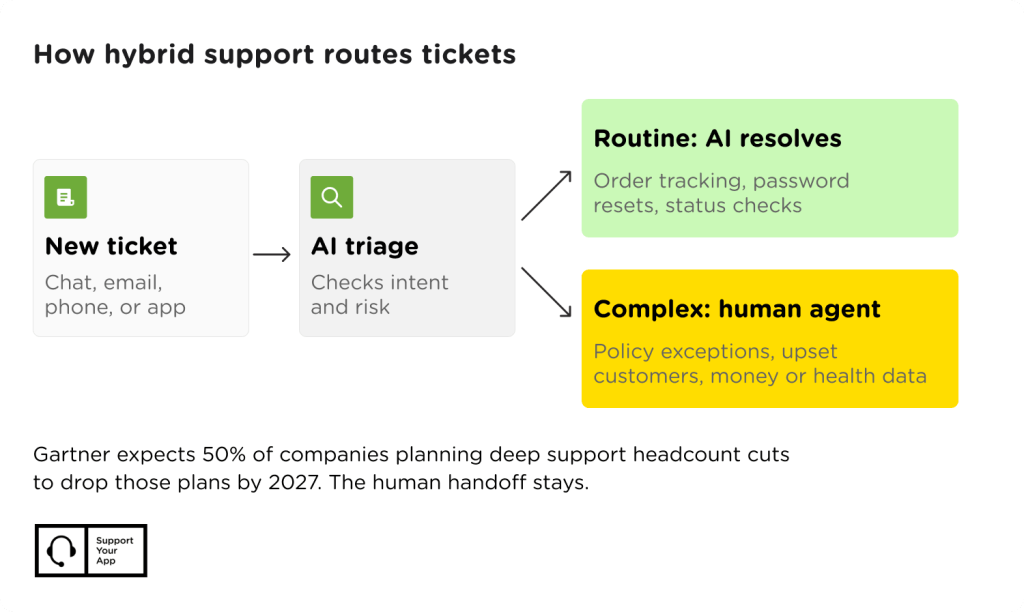
Map your escalation paths before you launch any customer-facing AI agent. Customers should reach a person in one step, and that person should see the full conversation history without asking the customer to repeat anything. Repeated questions are where customer trust breaks down in hybrid support models. Test the handoff weekly.
Trend 4: Context-Rich Support Across Every Channel
Customers in 2027 expect every agent and bot to know their history before the conversation starts. Zendesk found 85% of CX leaders see memory-rich AI as essential to personalized experiences. Memory only works when data lives in one place, which is why customer service technology trends keep pointing toward unified inboxes and connected CRMs.
Audit your channels first. Count how many tools an agent opens to answer one ticket. Every extra tab adds handling time and raises the odds of a wrong answer. If chat, email, and phone each keep separate records, AI tools will give customers different answers depending on where they ask. Fix the data before scaling.
Give agents a single view of every past order and previous conversation. Then connect your AI agent to that same record instead of a separate copy. Customers notice the difference right away when nobody asks for their order number twice.
Trend 5: Mobile Customer Service Trends Favor AI Assistants
More customers will start support requests inside their phone's built-in AI assistant, not on your website. Gartner predicts 70% of service journeys will begin and get resolved in these assistants by 2028. That means your help content has to be readable by machines, with clear policy pages and no key facts buried inside PDFs. Rewrite old PDFs first.
Mobile users send pictures. A screenshot or a photo of a damaged item often explains the issue faster than text. Agents should be able to see that media inside the same thread. If a customer has to switch from chat to email to attach a file, most of the speed gained on mobile disappears.
Test your full support flow on a phone the way a customer would. Check how many taps it takes to reach a human from your app. Fix the slowest step this quarter, before adding any new channel to the mix.
Trend 6: Proactive Support Replaces the Waiting Queue
Proactive support means contacting customers about a problem before they notice it or open a ticket. Salesforce found that 61% of service professionals say their company already does this. Only 33% of customers agree, which suggests most outreach still lands after the customer has already spotted the problem on their own. Earlier alerts close that gap.
A short outbound call often settles a delivery delay faster than an email thread. SupportYourApp's SupportVoice answers inbound calls and makes outbound calls 24/7 in 32 languages. It looks up account data, updates records, and hands complex calls to a human, which fits proactive outreach without new night-shift headcount.
Start with events you can predict, such as shipping delays and failed payments. Among the trends in customer service, this one is easiest to measure, because each early warning should remove a ticket you can count. Pair those alerts with AI customer service solutions that can answer the follow-up questions they trigger. Measure contact rates afterward.
Trend 7: Outsourcing Gets Re-Evaluated Around AI
Customer support outsourcing trends point to one shift: buyers now shop for capability. Companies want partners who can run AI tools and human teams as one operation. A 2026 SupportNinja survey of US CX leaders found 79% are considering changes to their outsourcing setup, even though most report higher satisfaction. Hitting SLAs alone no longer keeps an outsourcing contract safe.
Expect questions about AI to come up early in every vendor evaluation. Buyers now ask which tickets the AI resolves and how fast a human agent steps in. Compliance matters too, since an outsourced team handling card payments needs PCI DSS, and one handling patient data needs HIPAA compliance.
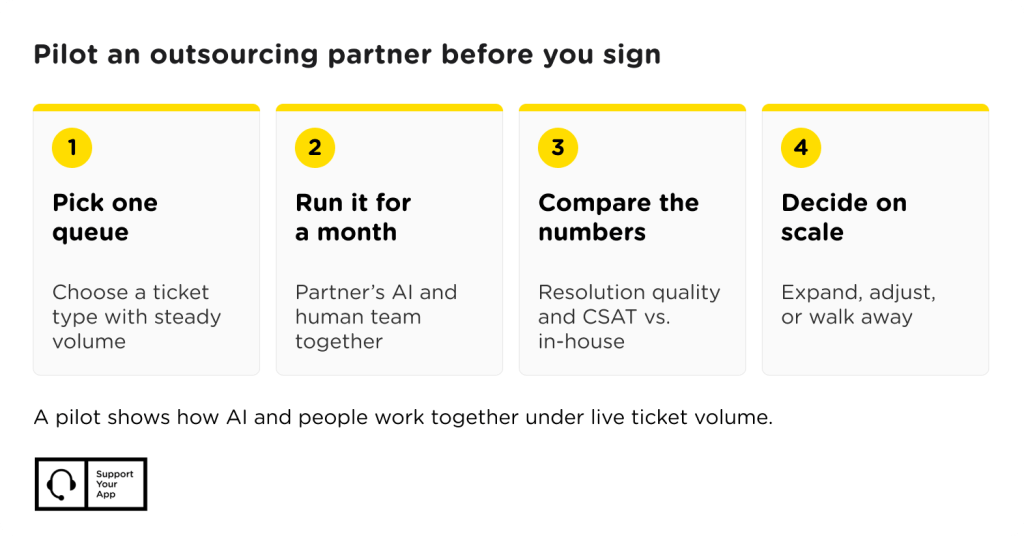
Ask for a pilot. Run one queue with the partner for a month before signing a long contract. Measure resolution quality and CSAT against the numbers your in-house team posts today. A pilot shows whether the partner's AI and human teams work together under live ticket volume, which a sales deck can't prove.