

If you run support for an online store, late November is the week you plan the rest of the year around. Here's how eCommerce companies handle Black Friday customer support in 2026. They spread demand across longer sale windows and let AI answer routine questions, while trained people take the tricky cases. This guide breaks down five brands' playbooks and turns them into steps for scaling your team and cutting wait times.
Key Takeaways
- The biggest retailers don't bet everything on one Friday. They stretch deals across weeks, so ticket volume never hits a single brutal peak.
- AI shopping and support assistants now take a big chunk of pre-purchase questions, yet every brand on this list keeps humans within reach.
- Wait times grow when nobody watches the queues. Teams that cope best check channels hourly and move people before backlogs form.
- The work doesn't stop on Cyber Monday. How you handle returns and follow-ups decides whether a deal hunter ever buys from you again.
Why Black Friday Customer Service Overwhelms Support Teams
Adobe Analytics tracked $44.2 billion in US online spending during Cyber Week 2025, the five days from Thanksgiving to Cyber Monday. Each of those orders can turn into a question about a delivery date, a failed payment, or a discount code that didn't apply. Spread that across a busy store's order list, and the inbox looks very different by Friday afternoon.
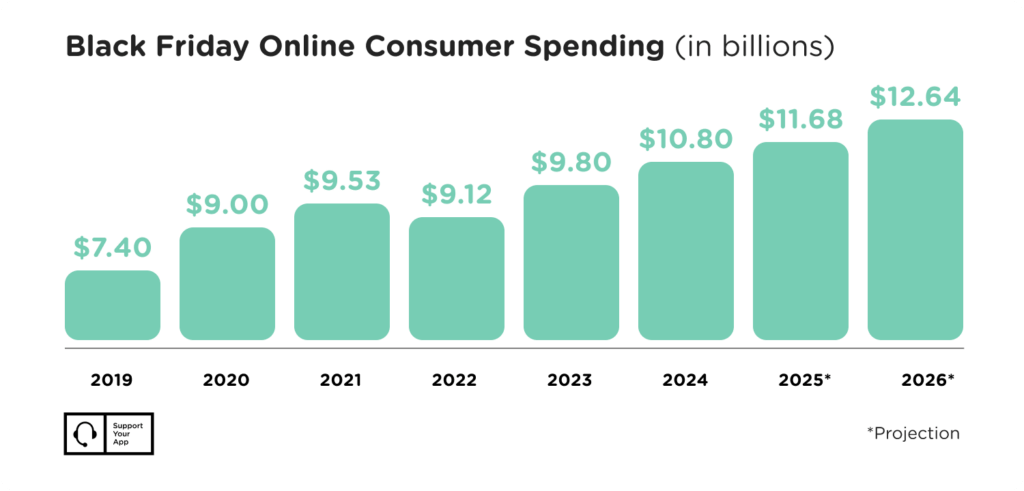
The National Retail Federation counted a record 202.9 million people shopping over the 2025 Thanksgiving weekend, online and in stores combined. The chart below tracks how Black Friday spending has grown over recent years.
If your support team can't keep up, Black Friday is where it shows first. A queue that clears in an hour on a normal Tuesday can take half a day when chat and email spike at the same time. Customers chasing a late parcel don't care that it's your busiest week. They expect the reply speed they got in October.
Each brand below solved a different part of that problem. Some changed the sale calendar, others put AI in front of shoppers, and one went back to hiring people. It's worth looking at what each of them changed before your next sale.
How eCommerce Companies Handle Black Friday Customer Support in 2026
We picked five companies that faced the 2025 rush at very different scales. Two are US retail giants and one is an electronics chain. The other two are a European fashion platform working across 25 markets and a buy now, pay later provider that many shoppers meet at checkout.
Amazon
Amazon opened its 2025 Black Friday Week on November 20, giving shoppers well over a week to buy before the Friday itself. A longer window spreads out orders, and with them the "where is my order" messages that follow. Its AI shopping assistant, Rufus, took a front seat during the sale and answered product questions right inside the app.
That's the part smaller stores can copy. Questions about sizes, compatibility, or delivery dates pile up fast during a sale. An assistant that answers them on the product page keeps them out of your queue. A damaged item or a missing refund still needs a person, so the assistant works best on discovery while human agents handle the exceptions.
Walmart
According to Walmart's 2025 Black Friday announcement, the retailer split its sale into three deals events. The first ran November 14 to 16, the second November 25 to 30, and Cyber Monday deals followed on December 1. Walmart+ members got five hours of early online access before each event.
For a support team, that calendar matters more than the discounts. Three smaller peaks are far easier to staff than one giant spike over a single weekend. Walmart also promoted Sparky, its generative AI shopping assistant, which helps shoppers compare products and find gift ideas. If you control the sale calendar, you also control the shape of your support load.
Best Buy
Electronics buyers send a specific kind of ticket after a sale, mostly setup help and delivery changes. Best Buy planned for that with Google Cloud and launched a generative AI virtual assistant for customers. Shoppers can use it to troubleshoot products and reschedule or combine deliveries on the website, in the app, or on the phone line.
The second half of the setup gets less attention. Best Buy also gave its customer care agents AI tools that summarize calls and suggest next steps while the conversation is still going. The agent still decides what to do. Self-service for simple fixes plus AI-assisted humans for everything else is a model any eCommerce brand can scale down to its own size.
Zalando
Zalando sells fashion across 25 European markets, which turns Cyber Week into a language problem as much as a volume one. Its Zalando Assistant answers shoppers in their local language, and a 2025 update connected it to customer accounts for more personal suggestions. In 2026, Zalando also built customer care into the Assistant, bringing shopping advice and order help closer together.
For smaller brands selling across borders, BFCM customer support starts with language coverage. A German customer with a missing parcel at 11 p.m. won't wait politely for your English-speaking team to log on Monday. Native-language support, human or AI, has to be live before the first discount email goes out.
Klarna
Klarna isn't a store, yet many holiday shoppers meet it at checkout, so its support load climbs alongside every retailer's. In 2024 the company leaned hard on an AI assistant built with OpenAI. In May 2025, CEO Sebastian Siemiatkowski said Klarna was hiring human agents again so customers would always have the option to talk to a person.
Klarna still runs its AI assistant at scale and keeps praising its results. What changed is the promise that a human is available whenever a customer asks for one. During a payment dispute on Cyber Monday, that promise counts for more than any response-time record.
Put side by side, the five approaches show how eCommerce companies handle Black Friday customer support at very different budgets.
| Company | What they did | Lesson for your team |
| Amazon | Ran a multi-day Black Friday Week and put Rufus in front of shoppers | Answer pre-purchase questions where customers shop |
| Walmart | Split the sale into three deals events and promoted Sparky | Spread demand to flatten ticket peaks |
| Best Buy | Paired AI self-service with AI tools for care agents | Automate simple fixes, give agents AI help on the rest |
| Zalando | Runs a local-language AI Assistant across 25 markets, now with customer care | Cover every language before the sale starts |
| Klarna | Kept its AI assistant and promised access to a human | Always offer a clear path to a person |
How to Scale Customer Support During BFCM
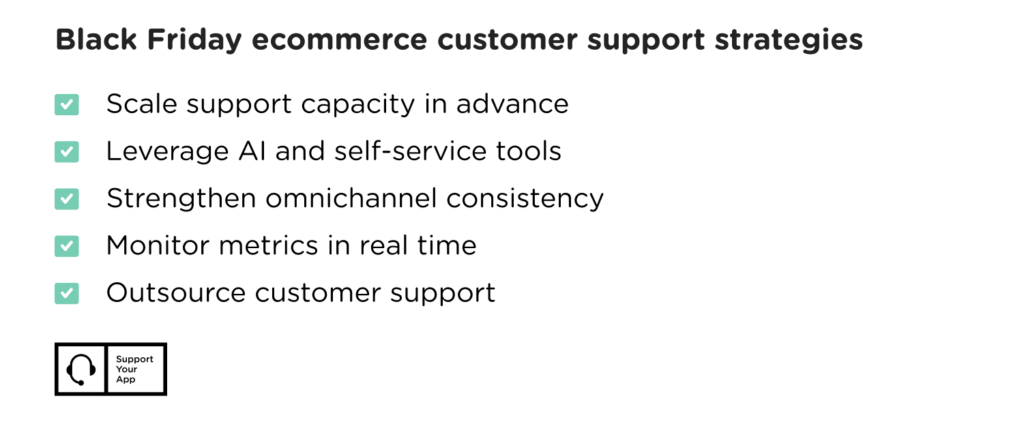
Big retailers have budgets most stores don't. Most of their playbook still works at a smaller size, as long as you start planning in September rather than the week before the sale.
Forecast Volume From Last Year's Data
Pull ticket counts by hour from last year's sale week, then add your expected order growth. Break the forecast down by channel and by topic. Delivery questions tend to peak a few days after the sale, while discount and payment problems land on the day itself. Your staffing plan should shift as the week goes on, so the right people are online for each wave.
Add Flexible Capacity Before You Need It
Seasonal hires need time to learn your order system and return policy, and that training has to finish before the sale starts. If the timeline won't fit, on-demand customer support can add trained agents for the sale weeks only. You keep your core team on complex cases and let the extra agents absorb the routine volume.
An outsourced team also helps when growth outpaces hiring. When Kurzgesagt's customer base grew, SupportYourApp onboarded agents trained on its products, set up Gorgias, and built an FAQ section from past customer conversations. As the Kurzgesagt case study shows, email response time dropped to 12 minutes and CSAT reached 4.95.
Prepare Answers Before Customers Ask
Update your help center with holiday-specific articles on shipping cutoffs, gift return windows, and how stacked discounts work. Knowing how to handle Black Friday customer service starts with this kind of prep work. Then write macros for the questions that came up most last year. Every answer a customer finds on their own is one less ticket for your agents.
Test Your Tools Two Weeks Out
Run a mock sale day a couple of weeks before Black Friday. Push test tickets through your help desk and phone routing. Then check that automations fire and that escalation rules send payment issues to the right people. Fixing a broken macro in early November takes ten minutes. Fixing it at noon on Black Friday means hours of angry messages while the fix goes in.
Customer Service Wait Times: Black Friday, Cyber Monday, and How to Cut Them
Long waits hurt more during a sale, because the customer's next tab is a competitor offering the same discount. Qualtrics XM Institute found that 47% of bad customer experiences lead to lower spending. For a store that has already paid for holiday ads, that's revenue walking out the door.
Set Targets for Each Channel
Decide your reply targets per channel before the rush and share them with the whole team. Chat needs answers in minutes, while email can stretch to a few hours. Our guide to customer service SLAs covers how to set achievable targets and track them during busy weeks.
Triage by Urgency, Then by Arrival Time
A failed payment blocks a sale right now. A question about gift wrapping can wait an hour. Tag tickets by topic as they arrive, and move payment and checkout problems to the front of the queue. That way you don't lose orders while agents work through easy questions.
Watch Queues Live During the Sale
Assign one person per shift to watch queue length and first response time on every channel. When chat backs up, pull agents from email for an hour, then move them back. Learning how to manage customer service during high-volume hours is mostly about moving people quickly and without long debates.
Phones need their own backup plan, since a caller stuck on hold for too long often hangs up and buys elsewhere. Overflow call handling picks up the calls your team can't answer in time, so customers reach a person instead of voicemail.
Tell Customers What to Expect
Show expected reply times in your chat widget and in email auto-replies. Customers who aren't sure you got their first message send a second one, and those duplicates pile up fast. A clear "we'll reply within two hours" message cuts that noise and keeps the queue honest.
AI Support for Black Friday: What to Automate and What to Keep Human
Every company in this guide used AI during the 2025 sale, and none of them used it alone. Klarna's change of course shows what happens when customers can't find a human path.
The best candidates for automation are repeat questions with clear answers, such as order status, delivery dates, and return steps. Leave refund disputes and payment errors to human agents, at least until your AI has a track record on them. That split lets AI absorb the first wave of a Black Friday support surge while people handle the cases that need judgment.
SupportResponse, SupportYourApp's AI customer support agent, handles ticket spikes like these. It answers routine tickets on live chat, email, and messengers around the clock. It also runs custom flows set up for your business and escalates complex cases to a human agent.
Mailcheck, an email verification platform, faced the same kind of spike before a big promo campaign. SupportYourApp fed its knowledge base, past tickets, and product docs into SupportResponse, then paired the AI agent with one human agent. The setup went live in seven days, ahead of the expected jump in sign-ups.
In the Mailcheck case study, the AI agent resolved 81% of routine requests without human help. First replies came in 3 seconds, and resolutions got 51% faster across the board.
If your customers call more than they chat, SupportVoice answers inbound and outbound calls 24/7. It routes callers by intent and escalates complex cases to a person. For sensitive replies like refund decisions, SupportBrain drafts answers for your agents, and a human agent approves every reply before it goes out.
After the Rush: Returns, Follow-Ups, and Lessons for Next Year
Cyber Monday ends the sale, but not the support season. Refund questions keep coming well into December, and gift returns often arrive in January, long after your seasonal agents have gone.
Let Customers Start Returns Without a Ticket
A self-service return portal with prefilled labels and automatic status emails keeps most return questions out of your inbox. Give agents clear refund rules too, so they can approve standard cases without asking a manager each time. Returns are the overlooked half of peak season customer support, and they often run longer than the sale itself.
Review What Broke
Pull the week's tickets by topic and look for the questions your help center didn't answer. Feed those answers into your FAQ and your AI agent's knowledge base before the next big sale. Our list of common holiday support mistakes is a useful checklist for that review.
Follow Up With New Customers
A short thank-you note or a product care tip turns a one-time deal hunter into someone who remembers your brand. Keep it personal and skip the hard sell, since the customer has already spent money with you. A good holiday relationship ends with a message like this, not with a closed ticket.
Getting Your Team Ready for Holiday and Black Friday Support
The brands in this guide prove you don't need Amazon's budget to get through BFCM. You need a forecast, extra capacity lined up early, and a clear split between what AI handles and what people handle.
Start with last year's ticket data this month, then fill the gaps in coverage and language before November. If your team is already stretched, planning with a partner beats scrambling for temps the week before the sale.
SupportYourApp's eCommerce customer support teams work 24/7 in 120+ languages and blend human agents with AI for the busiest weeks of the year. That's how eCommerce companies handle Black Friday customer support without burning out their own people.