

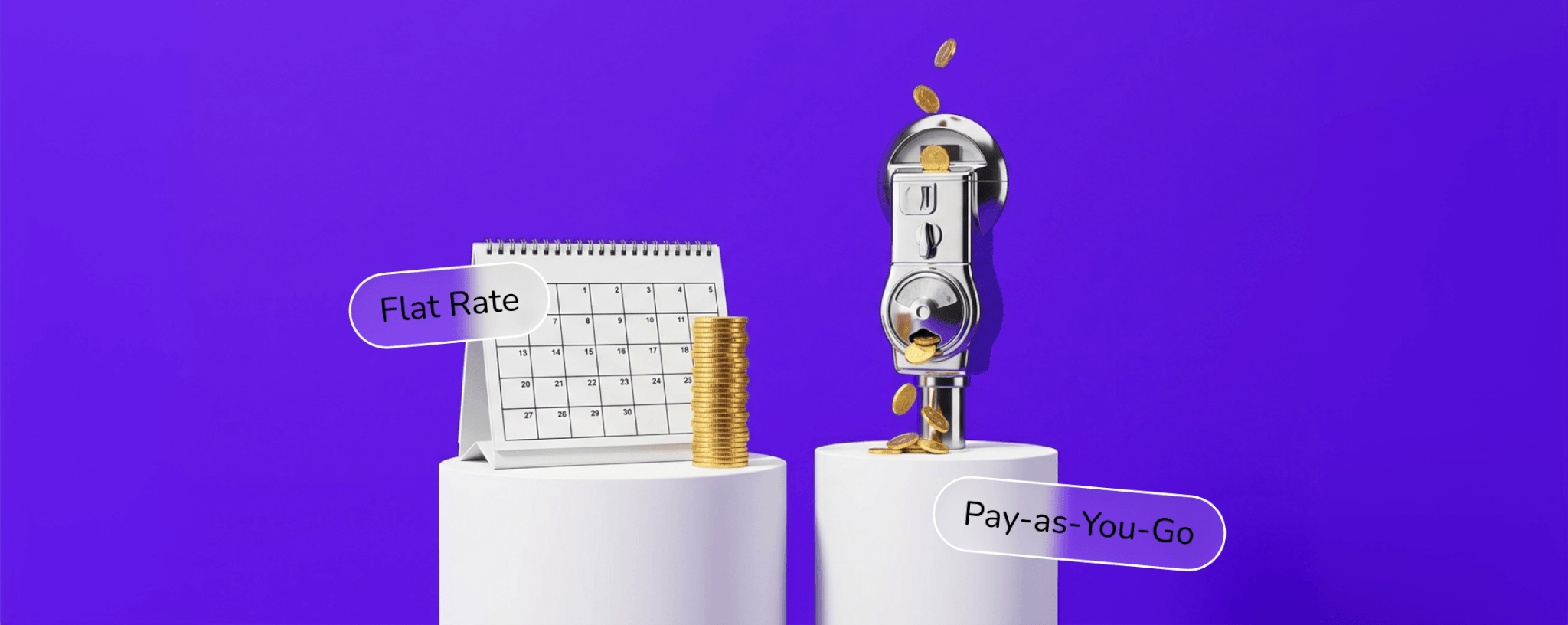
If you're a founder or support lead comparing outsourcing quotes, the pricing line is often the hardest part to read. Call center pricing usually comes down to two options. You pay a fixed monthly fee for a set team, or you pay for each call or minute you use. Each one suits different teams. This guide shows which fits.
Key Takeaways:
- Your call volume pattern decides most of this choice. Steady demand points to flat rate, while seasonal swings favour pay-as-you-go.
- Flat-rate billing gives you a predictable bill and a dedicated team, but you keep paying for idle hours when calls slow down.
- Usage-based billing follows what you use and scales fast, though costs can jump during a surprise spike or a PR crisis.
- Hybrid plans mix a fixed core team with usage-based overflow, and they often solve the problem neither model handles alone.

Why Call Center Pricing Shapes Your Whole Support Operation
What if the model you picked to save money is the reason your support costs keep climbing? It happens more than you'd think. A pricing structure looks simple on a proposal. Then it shapes every staffing decision for the next year or two. Here's what it touches:
- Cost efficiency and how easily your support operation scales.
- SLA performance, and whether you want demanding KPI targets (AHT, FCR, CSAT) that change often or steadier ones.
- The staffing model you end up with, outsourcing or outstaffing.
- Agent expertise, since flat rates usually cover highly skilled roles and variable rates suit basic support tasks.
- Contract terms, from long-term partnerships to seasonal, short-term, or trial engagements.
In the BPO industry, two contact center pricing models come up in almost every proposal: flat rate and pay-as-you-go (PAYG). They sound like opposites. Plenty of teams combine them anyway. This article breaks down how each one works and where it struggles, so you can pick the right fit for your support workload.
How Call Centers Charge: The Billing Units Behind Every Quote
Before you compare models, it helps to know what a provider is counting. The unit changes everything. Some vendors bill per agent or per agent hour, which buys you a fixed block of capacity. Others bill for each unit of work, such as a call or a minute on the line, and your invoice moves with demand.
Voice work is where usage-based billing shows up most. With per minute call center pricing, you pay an agreed rate for talk time, and sometimes for after-call work too. Per-call billing charges one amount for each conversation, whatever its length. Chat works the same way. So do tickets, if your provider bills digital channels separately.
A newer option bills per resolution, which is common with AI agents. Watch this one closely. Gartner predicts that by 2030, generative AI will cost over $3 per resolution in customer service, more than many offshore B2C agents. Rising data centre costs are one reason. Vendors chasing profit are another.
Whichever unit a vendor uses, it sits inside one of two call center cost models. Flat rate bundles capacity into one fixed fee. Pay-as-you-go bills each unit. That single difference drives almost everything else in this guide, from agent quality to contract length. Here's how each works.
What Is a Flat-Rate Phone Answering Service?
It's a billing model where you pay a fixed monthly fee for support from an outsourcing partner. The fee usually depends on the number of agents or hours in your plan. It stays the same no matter how many calls come in. The invoice doesn't move.
A flat-rate setup usually means a long-term dedicated or semi-dedicated team. That shapes quality and SLA reliability, because the same people learn your product over months. For the provider, it demands accurate forecasting and minimum staffing. Downtime still needs cover. That idle coverage is a major cost driver in flat-rate call center pricing.
How It Works
The provider charges a fixed fee in exchange for a defined package of people and tooling. That package covers far more than agent time. Knowing its parts helps you compare quotes line by line, and spot gaps early. Here's what's usually included:
- A dedicated team of support agents
- A set number of agent hours per month
- A fixed coverage schedule (for example, 8 hours a day, 7 days a week)
- Quality assurance workload, handled by a dedicated QA specialist or shared across the team
- Workforce management tools for scheduling, coverage forecasting, and planning
- Shrinkage and minimum productive time (PTO, breaks, coaching, and non-support meetings)
- Tools and licences, including your CRM and any extra integrations, apps, or extensions
- Compliance requirements such as KYC, background checks, ISO 27001, GDPR, HIPAA, and PCI DSS, plus corporate devices, MDMs, and VDIs
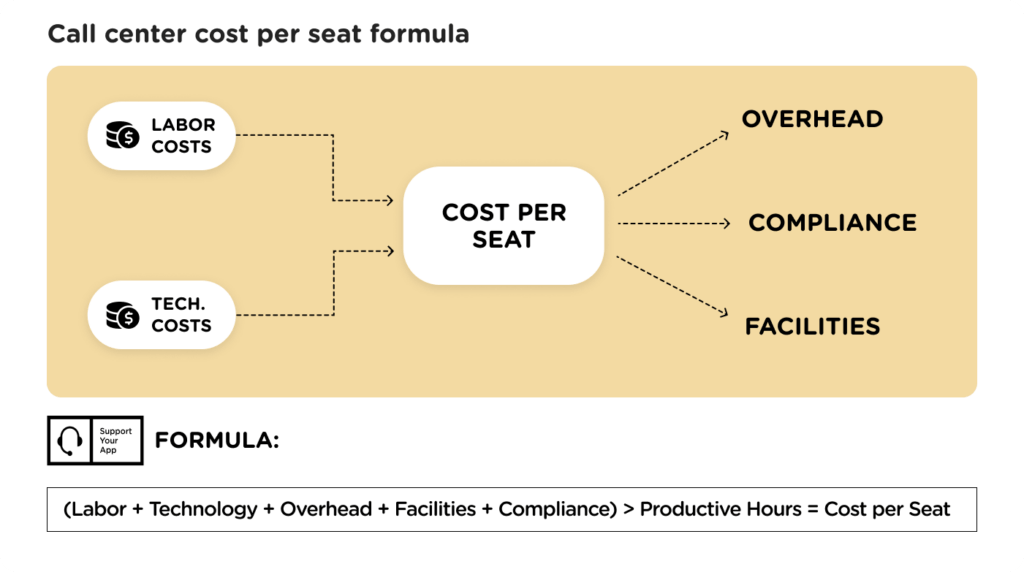
Providers don't pull the fixed per-agent price out of thin air. It's built from several layers. Each one shows up somewhere in your monthly fee, even when the proposal lists a single number. Here's the breakdown. The diagram below sums up the costs that typically go into that calculation, so you know what you're paying for.
The biggest operational upside of the flat rate answering service model is agent consistency. Agents usually stay on one account. Over time, they build deep product mastery and learn how your customers think. That matters most in regulated industries and anywhere the workflows run deep, where a new face on every call costs you trust. Familiarity pays off.
Advantages of the Flat-Rate Answering Service
- Predictable pricing: budgeting gets easier because you know exactly what you'll spend each month.
- Stability: a sudden jump in calls won't inflate your bill.
- Consistent availability: coverage holds steady whatever happens to volume.
- Better fit for stable call patterns: it works well when your volume is regular and doesn't swing much.
Disadvantages of Flat-Rate Pricing
Flat-rate pricing can turn inefficient when:
- Call volume swings a lot from month to month
- You go through long stretches of low call activity
- You need to scale fast during busy seasons
- Average handling time (AHT) is hard to predict or workflows are very complex, which leads to under- or overstaffing because headcount can't change quickly
The flat-rate answering model suits teams that want a steady, simple approach to support costs. You won't need constant adjustments or variable invoices. Finance teams love that. It's why many prefer flat rate pricing call center contracts, since they're easy to plan around. We'll cover exactly when this model works best later in the article.
Key Takeaway
A flat-rate setup gives you a clear, upfront cost for a defined level of support. You can plan without worrying about usage spikes. It works best when demand stays roughly flat. Steadiness is the point. If your volumes swing widely or you need fast changes, it can fall short.
Flat-rate deals also come with longer commitments. Expect minimum commitment clauses and set notice periods for changes to service scope or staffing. Read those terms carefully. They decide how quickly you can adjust if your call volume drops or your product roadmap shifts direction halfway through the contract.
What Is a Pay-as-You-Go Answering Service?
This is the flexible option. You pay usage-based fees for the support interactions you have, and nothing for idle time. Pick a pay-as-you-go call answering plan, and you'll pay per call or per minute instead of a fixed monthly fee for a team. Costs follow demand.
How It Works
Under a PAYG model, every charge ties back to logged activity. You pay no fixed salaries. You pay for the workload your agents handle, and that's it. Providers track calls and chats in their systems, so the invoice matches the activity report and you can check every line against your own data.
Say your business gets occasional customer questions. You might pay for 500 minutes of support in a month rather than commit to full-time agents. When a seasonal peak or a campaign hits, you scale up without paying for idle staff. That's the appeal of usage-based call center pricing for smaller teams. Your financial risk stays low.
Advantages of PAYG Pricing
- High scalability: add or cut capacity as seasons get busy or slow down.
- Cost efficiency: if you expect low volume, this is usually the cheaper option.
- Fast deployment: plug into a shared agent pool without a long setup.
- Minimal risk: it suits startups and pilot programmes in new markets.
The model fits simple, transactional work like password resets and warm transfers. Start small, then decide. It also suits companies still testing product-market fit. You get coverage now and decide on a bigger commitment later, once the numbers make sense. SupportYourApp offers pay-as-you-go customer support for teams at exactly this stage.
Disadvantages of the Pay as You Go Pricing Model
This billing style gets harder to manage once support becomes a big, steady part of your operation. Volume is the tipping point. Businesses usually run into trouble with it if they have:
- Consistently high ticket volume
- Complex products or services that need time-intensive training
That's why PAYG rarely suits complex Tier 2 and Tier 3 support. Shared agent environments also tend to limit a few things you'll miss later:
- Training depth
- The ability to hold strict KPIs over long periods
- Consistent escalation handling, since agents shift with demand
Key Takeaway
A pay-as-you-go telephone answering service lets you pay only for what you use. That makes it a strong pick when volume is light or seasonal. It's flexible and quick to ramp up. Heavy demand changes that. For teams with complex workflows or high volume, it can get expensive or impractical fast.
Costs can also spike hard during an unexpected outage or a PR crisis that floods your lines. That's a realistic risk. Build a buffer into your budget, or agree on a spending cap with your provider. One bad week shouldn't wreck the quarter.
Flat Rate vs Pay-as-You-Go: Comparison
Side by side, the differences get clearer. Each model shapes your overall customer service outsourcing cost and the experience your customers get. Choosing between call center pricing models is one of the biggest support decisions you'll make. Compare them before you sign.
The table below highlights the key differences between flat-rate and PAYG models. Use it to check which approach fits your support workload and growth pattern. Bring your own numbers. Last year's busiest and quietest months tell you more than any average does.
Comparing the Call Center Billing Models
Flat-Rate vs PAYG Pricing at a Glance
| Category | Flat-Rate Pricing | PAYG Pricing |
| Cost structure | Fixed monthly or per-agent cost, regardless of volume | Variable, billed per minute, per call, or per chat |
| Budgeting | Same cost every month | Cost varies based on usage |
| Agent type | Dedicated teams with consistent service | Shared and blended teams providing activity-based service |
| Training depth and length | Tier 1 to Tier 3, with up to several months of training | Tier 1 only, with 1 to 7 days of training |
| Best suited for | Businesses with steady, high volumes | Businesses with fluctuating or seasonal volumes |
| Scalability | Scaling requires new fixed contracts | Scales up or down based on demand |
| Risk involved | Risk of higher costs during slow periods | Risk of higher bills during unexpected spikes in volume |
| Quality assurance consistency and dedication | Heavy use of coaching platforms, at least 50% of workload | Small individual spreadsheets, less than 10 to 15% of weekly workload |
| Forecasting | Fixed costs, so they're easy to forecast | Harder to forecast, as volumes must be estimated |
| Best for workflow complexity | Complex | Simple |
| Ideal use cases | Enterprise support, subscription services, telecommunication | Startups, seasonal businesses, eCommerce companies, hospitality industry, pilots and test market environments |
Key Takeaway
The choice comes down to how consistent your volume is and how much risk you can live with. Flat rate suits steady, high-volume operations that want predictable costs. PAYG offers flexibility for fluctuating or seasonal demand. Your bill follows usage. Quiet months cost less, and busy months cost more.
Contract protection differs too. Flat-rate agreements often include service level guarantees, such as credits or deductions when the provider misses agreed SLA targets. PAYG deals usually don't carry the same protection. If SLAs matter to your business, that gap deserves its own line in your comparison. Ask about it early.
Which Call Center Pricing Structure Fits Your Business?
Start with your volume pattern, then check how complex your product is. Those two settle most decisions. With both BPO pricing models laid out side by side, the checklists below cover the signals that matter. Tick more boxes in one list, and you've likely found your answer.
Choose Flat-Rate Pricing If:
- You need a consistent agent roster, high tenure, and deep product expertise
- Your workflows include complex troubleshooting, long learning periods, or several support channels
- You operate in a regulated industry like fintech or MedTech, where HIPAA or PCI DSS applies
Choose PAYG Pricing If:
- Your customer interactions are simple and short
- You need interim, seasonal, or overflow coverage
- You want to test volume before committing to full flat-rate outsourcing
Flat rate usually comes with a dedicated team, while PAYG often runs on shared agents. That split affects quality too. Our breakdown of shared vs dedicated customer support goes deeper into how each staffing setup performs day to day. Read it before you finalise anything.
Hybrid Models
Hybrid call center pricing models combine flat-rate stability with pay-as-you-go flexibility. A base fee covers the core team. Extra calls or chats above that line get billed by usage. You get steady service for predictable demand, plus spare capacity for peaks and surprise surges, without renegotiating every season.
Hybrid plans suit growing companies and any business with uneven call volume. Budgeting stays predictable. You also avoid overpaying in slow months. Most teams set the base to cover their normal workload and let usage billing absorb the peaks. Here are a few common setups:
- A base of 5 dedicated flat-rate agents, plus a short-term overflow team billed hourly for extra hours tracked in a WFM system
- A guaranteed minimum of 40 hours per week, with PAYG for any overtime
- A seasonal model: flat rate for core months, PAYG for peak months
We've seen this mix work first-hand. SupportYourApp has supported VR fitness platform FitXR for five years, with one dedicated agent covering weekday shifts. Then marketing campaigns from Black Friday through January pushed ticket volume past what one agent could handle. Overnight gaps made it worse. Monday mornings started with backlogs.
The answer mixed permanent and seasonal help. For that peak window, we added a seasonal agent who extended coverage into later shifts and weekends, with no permanent night-shift overhead. Intercom's Fin AI agent covered routine chats around the clock. Backlogs cleared, and peak-season responses got faster.
How SupportYourApp Approaches Outsourced Call Center Pricing
With our call center outsourcing services, you can hand over customer support entirely or only during peak hours. Either way, you cut waiting times and dropped calls. That protects your conversions. With 16+ years in support and 60+ operational languages, we've built fixed plans, usage-based plans, and mixes of the two.
We offer both outsourcing pricing models, so you're never forced into one structure. We start with your volume history. Then we help you pick the setup that will reduce costs for your business without cutting coverage where your customers need it most.
Pricing is also shifting underneath all of this. Gartner predicts that by 2028, over half of customer service organisations will double their technology spend. Talent needs won't shrink to match. Humans stay in the mix. So expect AI and people to share the same invoice more often, whichever billing model you end up picking.
By now, AI already shows up in some call center rates. For voice, SupportVoice, our AI voice agent, answers inbound and outbound calls 24/7 in 30+ languages. Complex cases go to humans. It scales by call minutes and gives you after-hours coverage with no new headcount. It runs on SupportCRM, our unified inbox.
Summary
The right pricing model affects your service quality and your long-term support costs. In outsourcing, two structures dominate: flat rate and pay-as-you-go. Others are simply variations. Hybrids blend them both. It's rarely one or the other. Many growing teams end up there once volume starts swinging, which is why hybrids now sit alongside the classic call center pricing models.
Flat rate gives you predictable monthly costs. You pay a fixed fee for a dedicated team or a set block of agent hours, whatever your call volume does. Budgeting gets much easier. Agents also learn your brand, since they work only on your account. It struggles when demand swings or goes quiet for long periods.
PAYG is flexible and usage-based. You're charged only for what you use, per minute, per call, per ticket, or per chat. It fits seasonal demand and startups testing the market, without fixed monthly contracts. The trade-off is volume. High or unpredictable volume can push costs up, and shared agents may be less consistent.
When choosing between call center pricing models, look at your volume patterns and how much predictability you need. Then weigh how much control you want and how fast you'll need to scale. Flat rate fits consistent workloads that need dedicated service. PAYG suits flexible, low-commitment scenarios. A hybrid covers the middle.