


Nearly 3 in 10 customers state that good customer support is the #1 factor in choosing where to spend. That means companies are already fighting to get support right. But here’s the kicker: AI just raised the stakes. Customer expectations have skyrocketed. They want even faster responses, more smart solutions, and the most personalized experiences possible. The result? Companies are under more pressure than ever to deliver world-class support.
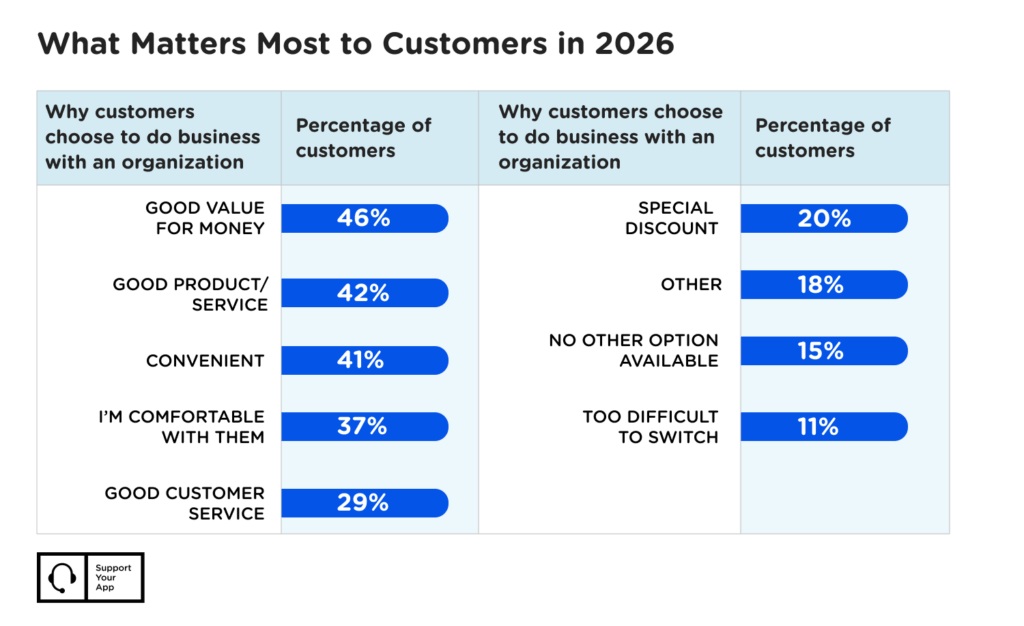
So what do you do? Stay ahead of it. The companies winning in 2026 won’t be the ones reacting to trends. They’ll be the ones who saw them coming and prepared. That’s your competitive advantage.
In this article, we’re breaking down five customer support trends you need to know for 2026. Let’s dive in.

Key Takeaways:
- Memory-rich AI retains context across sessions, eliminating repetitive explanations and delivering faster, more personalized customer support experiences.
- Multimodal support blends text, voice, images, and video, matching how customers naturally communicate with friends and family.
- Explainable AI builds trust by clearly showing customers why decisions were made, not just what the outcome was.
- Data ethics and safety are competitive advantages — transparency about data handling builds customer trust and loyalty in 2026.
- Real-time insights replace periodic reports, enabling companies to adapt support strategies instantly and improve experiences as conversations unfold.
Anticipated Customer Service Trends in 2026
The customer service landscape is undergoing a major transformation in 2026, driven by technological innovations and shifting customer expectations.
Understanding the trends affecting the industry isn’t just about staying current. It’s about making strategic decisions that will define how you connect with and support your customers in the years ahead.
Trend #1: Memory-Rich AI
Artificial intelligence isn’t optional anymore. It’s key to customer support.
AI handles the routine stuff and passes the complex cases to human agents. It’s become one of the defining trends in customer service. Companies serious about improving CSAT have already embraced this human-in-the-loop model.
But customer support automation trends for 2026 are pushing beyond that baseline. Meet memory-rich AI.
This isn’t your standard chatbot. Memory-rich AI remembers. It holds onto information, context, and preferences across every session, making support faster and far more personal. And the importance of personalized customer service can’t be overstated. Over 67% of customers now expect brands to offer more personalization, especially since AI can actually analyze their interactions and deliver on it.
Here’s what that looks like in practice:
A customer reaches out late at night, panicking about a failed payment that might cut off their service right before a product launch. The AI agent pulls up their account history and immediately grants a temporary access extension, while flagging the billing issue for review.
The next morning, a billing specialist picks it up. They don’t start from scratch — they have the full story: the failed payment, the customer’s concern, the temporary fix. They retry the payment securely, confirm it went through, and close the loop with the customer.
No repeating the story. No lost context. Just seamless, intelligent support powered by memory-rich, AI-powered customer service.
Trend #2: Multimodal Support
In 2025, omnichannel support became table stakes, customers expected help across chat, voice, social media, and more. But in 2026, one of the current AI customer support trends is the shift from omnichannel to multimodal.
About 76% of customers say they’d choose a company that lets them drop text, images, and video into the same conversation without restarting. This customer service statistic shows the connection clearly: customers communicate like this with friends already, and now they want businesses to meet them at that same level.
What’s multimodal support? It lets customers mix voice, images, video, and text in one fluid interaction to get the right answer.
Video and voice add clarity. While text and images still dominate, video support is growing fast. Most customers are willing to turn on their camera for return verifications, technical troubleshooting, or product assembly. AI can respond by generating instructional videos or troubleshooting live.
Voice is back in the game. Customers still reach for voice when issues are complex, urgent, or emotional — situations where tone and quick back-and-forth matter. With Voice AI now processing spoken input in real time and pairing it with visual or text context, the voice channel has reclaimed its spot as a fast, high-value path to resolution.
Trend #3: Explaining AI Decisions
Around 84% of customers would trust an AI agent more if they could explore the explanations behind the agent’s decisions. For example, why has AI denied their refund request? Instead of receiving a generic text like this decision was made by our system, they’d be happier to get a you’re trying to return an item outside of our 14-day window message.
Here’s the thing: transparency and explainability aren’t separate — they’re two sides of the same coin. You need to make sure your AI reflects the company’s values, follows internal policies, and meets regulatory requirements. But that’s only half the battle.
On the front lines, support teams are feeling the heat. For agents, explaining AI-driven decisions is one of their toughest challenges. And if they don’t have the right tools to back them up, they can’t deliver those explanations consistently.
As AI handles more and more of your support, seeing how and why it makes certain decisions is a must.
It’s not enough to know that AI made a call. You need to understand why, and you need to explain it clearly when customers ask. It’s one of the CX trends projected to become a norm in 2026.
Trend #4: Data Ethics & Compliance
As more customer service interactions rely on data, customers increasingly expect transparency around how their data is collected, stored, used, and protected. Compliance and transparency should be one of your top customer service priorities in 2026. It’s particularly critical considering over half of customers suspect their personal information is being mishandled.
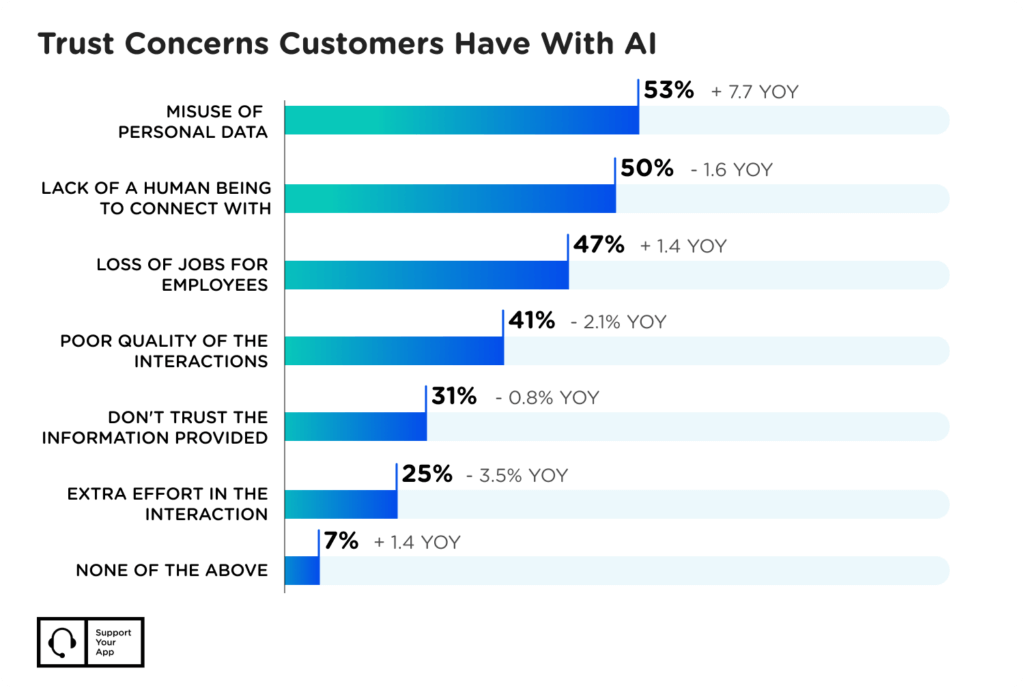
Brands that are open and accountable build trust and foster loyalty more easily than those that don’t. To build trust, you can clearly explain how data will be used and emphasize your commitment to secure transactions and fraud prevention.
Instead of viewing compliance as a hurdle, it should be viewed as a competitive advantage and differentiator.
Trend #5: Real-Time Customer Insights and Feedback
Another one of the new trends in the call center industry is the shift to the use of feedback analysis over periodic reports. About 94% of service leaders say that real-time insights are vital to meeting customer expectations.
Companies are not only using AI to respond to customer queries, but also to collect feedback in real time. Through chatbot surveys and live response tracking, they can instantly adapt their support approach. This enables companies to improve the customer experience as conversations unfold.
What is driving this trend?
- Customer’s need for speed and responsiveness
- Volume and complexity of interactions
- AI adoption and scaling
It is important to align your customer service metrics with real customer experiences gathered through agent and customer feedback and quality assurance to achieve your customer service goals.
By 2026, real-time customer insights and feedback won’t just be nice to have — they’ll be mainstream. They’ll become a core component of customer service, CX strategy, and product development.
Predictions for the Future of Customer Support
We’ve seen that AI is on the rise, rapidly reshaping customer service, particularly in self-service capabilities. Going forward, we’ll see even more intelligent AI assistants and workflows that connect smoothly with your support operations.
Below are some of the future predictions for AI and their anticipated timelines.
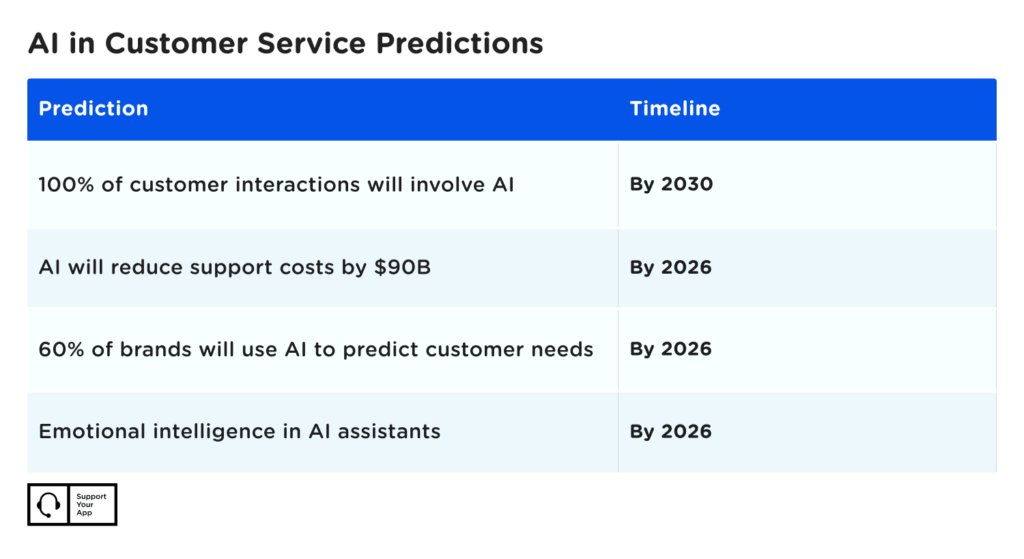
Additionally, customer service technology trends indicate that most medium-to-large companies will integrate feedback pipelines directly with their CRM, AI, and support systems. This will enable support to become more responsive and data-driven.
Moreover, customer feedback and AI insights will be leveraged across departments, driving strategic decisions.
As customer support outsourcing trends evolve, businesses need partners who can adapt quickly. Partnering with a call center can provide the infrastructure and expertise needed to keep pace with industry changes. Customer support outsourcing offers a practical path for companies looking to scale, providing access to trained professionals, custom AI agents, omnichannel support capabilities, and operational efficiency that might take years to develop internally.
Summary
Customer service in 2026 is being reshaped by five major trends. Memory-rich AI goes beyond basic chatbots by retaining context across sessions, enabling personalized support without customers repeating themselves.
Multimodal support lets customers seamlessly blend text, voice, images, and video in single conversations, matching how they naturally communicate. Explainability in AI decisions builds trust, with the majority of customers wanting to understand why AI made specific choices.
Data ethics and compliance have become competitive advantages as customers demand transparency about how their information is handled. Real-time customer insights replace periodic reports, with service leaders calling them vital for meeting expectations.
Looking ahead, AI will continue advancing while human agents focus on complex, emotional interactions. By 2030, virtually all customer interactions will involve AI in some capacity, but the winning approach remains hybrid: technology handling volume while humans deliver empathy and nuanced problem-solving.
Customer Support Trends: Your Questions Answered
1. What will customer service look like in 2026? Expect AI to handle the routine stuff while human agents tackle complex, emotionally charged issues. Support will be seamlessly multimodal, highly personalized, and powered by real-time insights. Context won’t get lost between conversations, and customers won’t need to repeat themselves. It’s faster, smarter, and far more human where it counts.
2. What are the emerging CX trends? The biggest shifts include memory-rich AI that remembers past interactions, multimodal support blending text, voice, and video, explainable AI decisions customers can actually understand, stronger data ethics and transparency, and real-time feedback loops that let companies adapt on the fly. Personalization isn’t optional anymore, it’s expected.
3. Will AI replace customer support agents by 2026? Not a chance. AI excels at speed and routine tasks, but humans own empathy, nuance, and relationship-building. The winning model is hybrid: AI handles volume and repetition, while agents focus on complexity and connection. Think augmentation, not replacement, both working together to deliver better experiences.
4. How can companies prepare for 2026 customer expectations? Start by investing in AI tools that enhance, not replace, your team. Prioritize personalization, nail your data transparency and compliance, and build seamless experiences across channels. Most importantly, tap into real-time insights so you can adapt quickly. The companies that prepare now will lead, not catch up.
5. How will customer service technology trends affect customer support? Technology will supercharge speed, accuracy, and personalization while freeing agents from repetitive work. Real-time insights will help teams pivot faster, and AI will handle the heavy lifting on routine queries. The result? Agents get to focus on what truly matters — solving complex problems and building lasting customer relationships.
❤︎ Like it? — Share: Share on LinkedIn or Share on Facebook

Viktoriia is the PR and Partnerships Director at SupportYourApp. She began her journey with the company as a Customer Care Representative and later progressed into a Business Growth Specialist role, gaining a deep, hands-on understanding of both customer experience and commercial strategy. This cross-functional background enables her to effectively lead PR and partnership initiatives, aligning brand positioning with business growth objectives. Currently, Viktoriia heads the PR and Partnerships team, overseeing strategic communications and partner relationships that support SupportYourApp’s global expansion.
Posted on LinkedIn