

You're running support for a SaaS product, tickets keep climbing, and every vendor demo looks impressive. This guide helps support leads and founders pick the best AI customer support agent for SaaS, whether that's a self-serve platform or a managed service. It explains why AI agents break in production and which option fits your team's size and resources.
Key takeaways
- AI agents usually fail SaaS teams on grounding and handoff more than on the language model itself.
- Self-serve platforms give you full control, but your team owns the setup and the ongoing tuning.
- Managed agents move that work to the provider and usually launch faster.
- The right pick depends on your team's technical capacity and how fast you need to go live.
Why Most AI Customer Support Agents Fail SaaS Teams
Many AI support agents fail SaaS teams when they answer from model memory instead of your product docs. In Qualtrics’ 2026 Consumer Experience Trends Report, nearly one in five said AI customer service gave them no benefit at all. That failure rate is almost four times higher than for AI use in general.
Hallucinations show up first on specific questions. Ask a generic bot about rate limits on your Pro plan or a deprecated API endpoint, and it may invent a confident answer. In SaaS, a wrong answer about billing or permissions creates a second ticket and sometimes a refund request.
Weak knowledge grounding is usually behind those hallucinations. Many agents pull from a general model and treat your help center as a loose suggestion. When the docs change after a release, the agent keeps repeating last quarter's answers until someone retrains it.
Maintenance eats the time AI was supposed to save. Self-built agents need prompt rewrites and new test cases after every product update. Intercom's 2026 survey of 2,470 support professionals found 40% of teams have agents spending more time training and tuning AI systems.
Process complexity breaks agents that only know how to answer questions. Onboarding, account setup, plan changes, and SSO configuration all run in steps, with checks between them. An agent that can't trigger a workflow or read account status stops at "here's a help article," and the customer still needs a person.
When the agent finally escalates, the human often gets no transcript and no summary. The customer explains the problem again, and a fixable ticket turns into a complaint. Someone who was mildly annoyed with a bot is now annoyed with your company.
What Makes an AI Support Agent Work for SaaS
An AI support agent works for SaaS when it answers from your documentation and runs your support processes inside your helpdesk or the platform that replaces it. Grounding comes first. The agent should pull answers from your help center, API docs, and release notes, and say it doesn't know when the docs are silent.
Good AI agents for SaaS customer support teams also act on accounts. They can check a subscription, reset access, or start a refund flow instead of linking to an article. That shift from answering to acting is the core of agentic AI in customer service, and it takes routine tickets fully off your agents' plates.
Helpdesk integration decides whether any of this holds up. The agent needs to read ticket history, tag and route conversations, and pass a full summary to a human when a case gets complicated. Without that link, your team ends up working in two places and losing context between them.
Self-Serve vs Managed AI Agent: What's the Difference?
The difference comes down to who builds and maintains the agent. A self-serve AI agent is software your team configures and tunes. A managed AI agent comes with a provider team that sets it up and keeps it accurate after every release. The table compares the two models on the points that affect a SaaS support team most.
| Factor | Self-serve | Managed |
| Setup | You configure | Done for you |
| Knowledge base | You train | Provider trains |
| Maintenance | Your team | Provider team |
| Integration | You build | Provider integrates |
| Time to launch | Weeks to months | 1 to 4 weeks |
Self serve AI customer support fits teams that have an engineer or ops lead with spare hours for prompt tuning and test cases. You keep full control over every answer and every workflow. The tradeoff is time, because each product release means another round of updates.
Why Growing SaaS Teams Choose Managed AI Agents
Growing SaaS teams choose managed AI agents because the provider absorbs the setup and maintenance work that sinks most self-built agents. A managed provider builds the agent around your docs and support processes instead of handing you a blank configuration screen. You get a custom setup without hiring for it.
Managed AI customer support also removes prompt engineering from your team's to-do list. The provider's specialists tune answers, add new flows after releases, and review escalations. Your support lead checks results and flags problems instead of rewriting prompts at midnight before a launch.
Launch speed is the other reason. Suggested phrasing: Managed setups usually take one to four weeks. SupportResponse’s One Agent + AI setup goes live in about a week. A self-built agent often stalls for weeks while the team writes guardrails and argues over edge cases.
Best AI Customer Support Agents for SaaS in 2026
The best AI digital agents for SaaS customer support split into two camps: managed services and self-serve platforms. All five options below resolve routine tickets on their own. Choosing the best AI customer support agent for SaaS from this list comes down to who does the setup work.
1. SupportResponse by SupportYourApp (Managed)
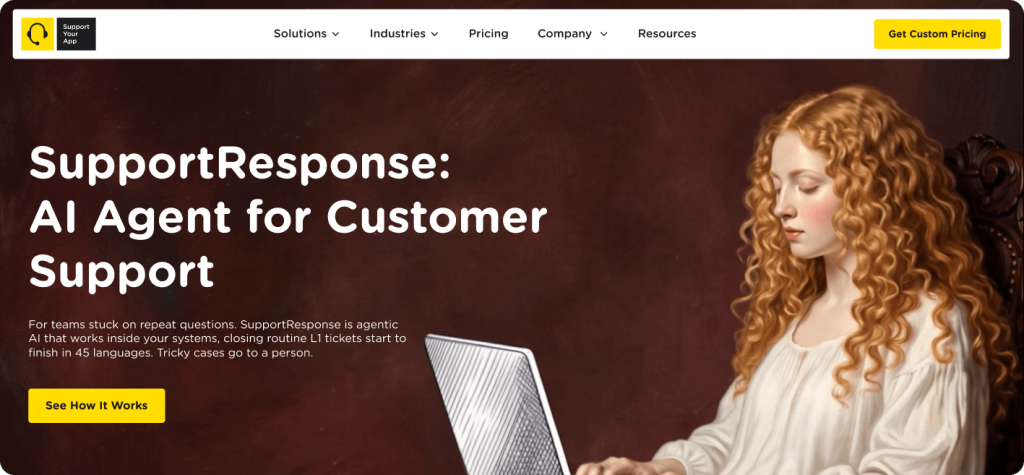
SupportResponse is SupportYourApp's autonomous AI agent for chat, email, and messengers like WhatsApp, Instagram, and Facebook Messenger. It resolves routine L1 tickets end-to-end, runs custom flows built for your product, and escalates complex cases to a human agent. It works 24/7 in 120+ languages. It fits SaaS teams dealing with ticket spikes and repetitive questions.
SupportYourApp manages the full setup. On day one, you agree on channels, languages, and escalation rules. SupportYourApp's specialists then train the agent on your knowledge base and connect it to SupportCRM, Zendesk, Freshdesk, or your CRM through a custom integration. Launch takes about a week. Across clients, up to 80% of routine requests are resolved without a human 90 days after launch.
For phone support, SupportVoice answers inbound and outbound calls 24/7 in 120+ languages and escalates complex calls to a human agent. It runs on SupportCRM, so voice and chat tickets land in one agent workspace. On the security side, SupportYourApp is PCI DSS Level 1 and Level 2 certified, ISO 27001:2022 certified, and GDPR, CCPA, and HIPAA compliant.
2. Crescendo.ai (Managed)
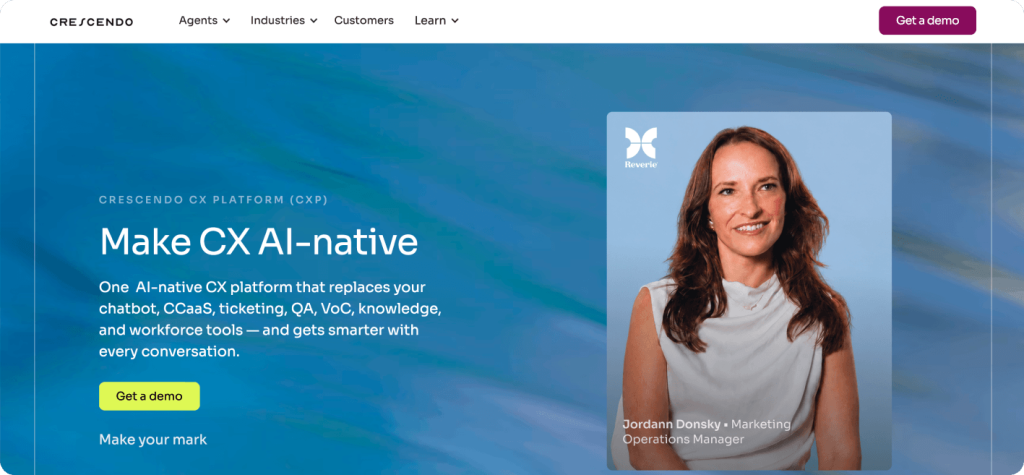
Crescendo, founded in 2024, relaunched as an AI-native CX platform in August 2026, for companies ready to replace their existing support stack. Its AI agents handle voice, chat, email, and text, and pass what they can’t resolve to a person with the full conversation attached. Crescendo also deploys its own team to keep the platform tuned. Pricing is built on outcomes, and its Total Outcome Guarantee promises go-live within 30 days or the implementation is free.
3. Intercom Fin (Self-Serve)
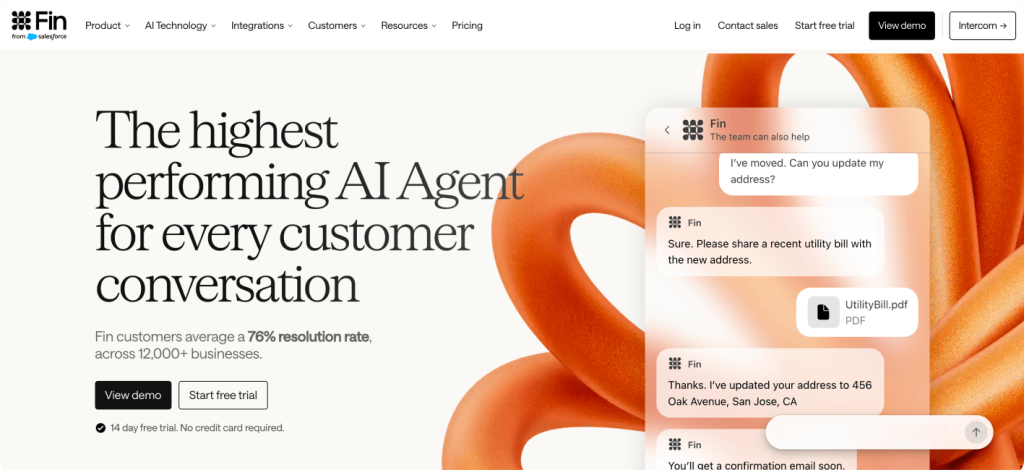
Fin is the AI agent from the company formerly called Intercom, which renamed itself Fin in May 2026 and joined Salesforce in September 2026. Fin runs on Intercom's helpdesk or on top of Zendesk, Salesforce, HubSpot, and Freshdesk. Pricing is $0.99 per outcome (a resolved conversation or a completed Procedure that ends in a handoff). Your team sets up the knowledge sources and behavior rules.
4. Ada (Self-Serve)
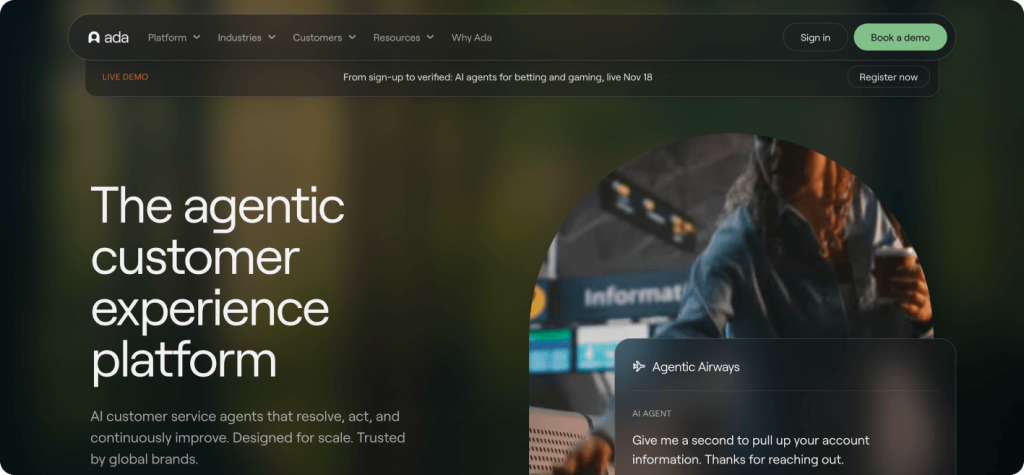
Ada is an enterprise AI agent platform built around its Reasoning Engine, which runs one logic layer across voice, chat, email, and messaging. Your team builds multi-step workflows with Playbooks, corrects answers with Coaching, and tests changes in Simulations before going live. Ada charges per conversation and doesn't publish its prices.
5. Decagon (Self-Serve)
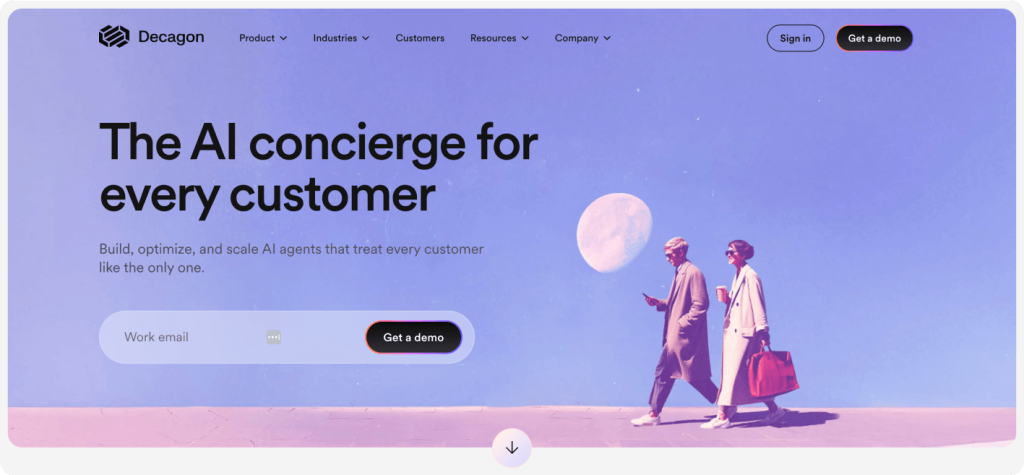
Decagon builds enterprise AI agents for chat, voice, and email. Its main feature is Agent Operating Procedures (AOPs), where support teams write agent workflows in plain English, much like the SOPs used to train human agents. Engineering teams keep version control through Git-based tracking, and pre-built connectors cover Salesforce, Zendesk, and Intercom. It suits larger enterprise teams that want to own their agent’s logic.
How to Choose Between Self-Serve and Managed
Pick by four factors: team size, technical resources, budget, and launch speed. A support team of five with no engineer to spare will struggle to keep a self-serve agent accurate. A larger team with an AI operations lead can own a platform and tune it every week.
Budget works differently in each model. Self-serve tools usually charge per resolution or per conversation, so costs look low until you add the hours your team spends on maintenance. Managed providers often bundle setup and upkeep, which raises the first bill. Usage fees still move with volume.
Launch speed settles most close calls. If you need AI live before a product launch or a seasonal spike, managed gets you there in about a week. Among the best AI agents for B2B SaaS customer support, the right one is the option your team can keep accurate six months after launch.
AI agents still need humans behind them for L2 and L3 tickets. Even strong SaaS AI customer support breaks down when escalations land on an overloaded team. If your team can't absorb escalations, a provider with SaaS customer support and trained human agents can cover the cases your AI escalates.
The Bottom Line
The best AI customer support agent for SaaS is the one your team can keep accurate after every release. Self-serve platforms reward teams that have the time and technical staff to tune them. If you'd rather hand off setup and upkeep, SupportResponse launches in about a week and connects to your helpdesk.