


Your support queue keeps growing, and most chatbots still hand the hard part back to your agents. Agentic AI for customer service works differently: it acts on a request instead of only replying to it. This guide covers how it works, where it helps, and the risks to plan for.
TL;DR
- Agentic AI acts inside your tools, while a chatbot replies from a script.
- It works best on high-volume tasks with clear rules, like refunds.
- Most failed rollouts trace back to messy knowledge bases and unclear handoff rules.
- Hybrid teams, with AI on routine tickets and people on hard ones, get the most predictable results.
What Is Agentic AI in Customer Service?
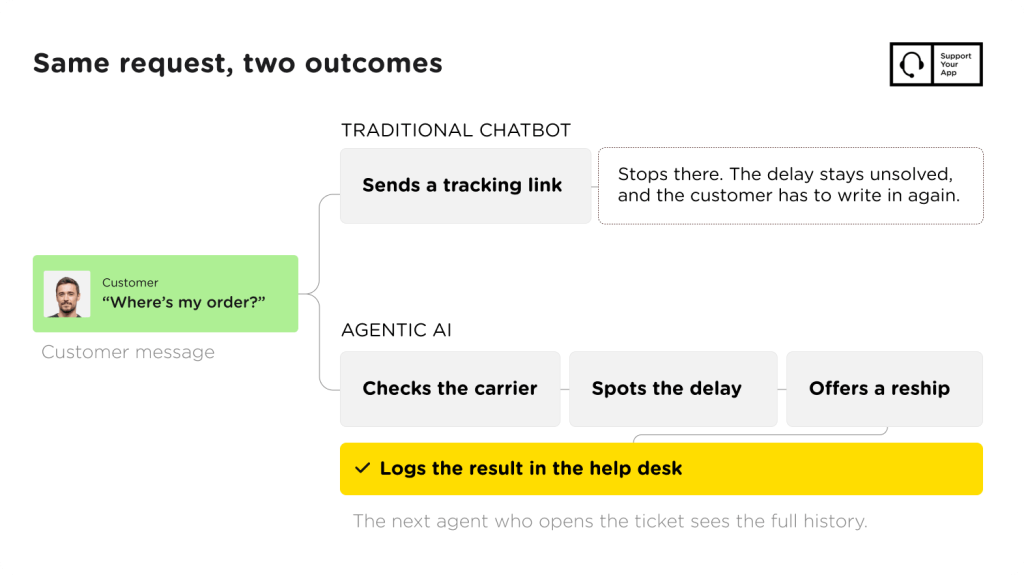
Agentic AI takes action. A traditional bot answers "Where's my order?" with a tracking link and stops. An agentic system checks the carrier, spots the delay, and offers a reship. In agentic customer service, the AI does this through APIs, with permission limits set for each action it can take.
How Agentic AI for Customer Service Works
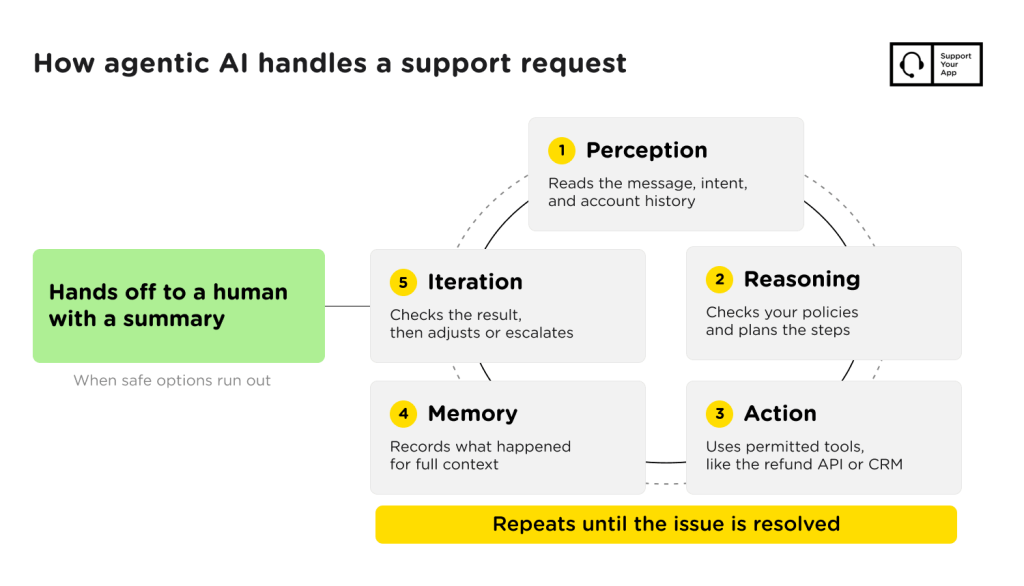
Every request follows one loop. It repeats until the AI closes the issue or hands it to a person. Vendors name the stages differently, but the logic stays the same. Each pass reads the situation, picks an action, and checks the result before the AI decides what to do next.
- Perception: the AI reads the message, detects intent, and pulls the customer's account history.
- Reasoning: it checks the request against your policies and plans the steps.
- Action: it uses the tools it's allowed to touch, like the refund API or CRM.
- Memory: it records what happened, so the next step starts with full context.
- Iteration: it checks whether the action worked, then adjusts the plan or escalates.
Iteration separates agents from bots. A scripted chatbot can't tell when its answer missed the point. The customer ends up typing "agent" three times in a row. An agentic system checks the outcome, tries another route, and hands the case to a person with a summary when options run out.
Agentic AI vs Traditional AI: What's the Difference?
Traditional AI in support answers questions, while agentic AI completes tasks. A rule-based chatbot follows decision trees written in advance, so anything off-script ends in a dead end or a handoff. Agentic systems plan their own steps inside the permissions you set.
Agentic AI vs traditional chatbot
| Factor | Traditional chatbot | Agentic AI |
| How it works | Follows scripted decision trees | Plans steps toward a goal |
| Off-script requests | Dead end or handoff | Reasons through them or escalates with context |
| System access | Read-only or none | Scoped write access through APIs |
| Best fit | Simple, repetitive questions | Multi-step tasks with clear rules |
Agentic AI Use Cases in Customer Service
The strongest candidates have clear rules and a defined finish line. For simpler, assistive tools, see these examples of AI in customer service.
Autonomous ticket resolution
Routine tickets come first. Password resets and plan changes follow the same steps every time. An AI agent verifies the customer and makes the change. It confirms the update in writing and closes the ticket while your team handles the cases that need human judgment.
Proactive outreach
An agentic system can contact customers before they notice a problem. When a payment fails or a shipment stalls, it spots the event. Then it sends the fix, like a card update link or a new delivery date, before the customer writes in to complain.
Order management
Order edits eat support time. Customers want to swap a size or fix an address before shipping. The AI checks the order status in your store platform. If the warehouse hasn't picked the item yet, it makes the edit and emails the customer a confirmation with the new details.
Refund processing
Refunds follow written policy, which makes them easy to automate. The agent checks the purchase date and return window against your rules. It issues refunds under a set limit on its own and sends larger or unusual claims to a person for approval. Every decision gets logged.
Multilingual support
An AI agent detects the customer's language and replies in it. Answers come from the same knowledge base your team already uses. A team that covers two languages by day can answer in many more after hours, while native speakers review sensitive cases.
Complex escalation handling
Disputes and policy exceptions should go to a person, and a well-built agent spots them within the first message or two. The human gets a summary of the issue and the steps already taken. The customer's full history appears right next to it, in one view. Nobody restarts the conversation.
Agentic AI in Contact Center
In a contact center, agentic AI takes routine calls and chats off agents' plates. Voice pays off first, because every minute on hold costs money. Voice agents pick up instantly, resolve calls like order status or appointment changes, and route the rest to the right team by intent. Night shifts stay covered.
SupportYourApp's SupportVoice works this way. It handles inbound and outbound calls 24/7 in 32 languages, looks up account data, and updates records during the call. When a call needs a person, it escalates to a human agent. It runs on SupportCRM, so calls land next to email and chat.
Benefits of Agentic AI for Customer Service
Gartner predicts that by 2029, agentic AI will resolve 80% of common customer service issues without human help, cutting operational costs by 30%. Those gains depend on clean data and policies your AI can follow. How much agentic AI for customer service saves depends on how many tickets follow clear rules.
- Routine tickets close end to end without an agent, at any hour.
- Cost per ticket drops, since volume growth no longer means hiring at the same pace.
- Seasonal spikes stop requiring emergency recruiting.
- Faster answers on simple requests tend to lift CSAT.
- Agents spend their shifts on complex cases instead of pasting the same reply.
- First-contact resolution improves, because agentic AI customer service acts on requests instead of forwarding them.
Challenges and Risks of Agentic AI
The biggest risk is an AI agent confidently taking a wrong action, like refunding the wrong order or quoting a retired policy. The agent acts on whatever your knowledge base says, outdated or not. Old help articles turn into wrong decisions across thousands of tickets. Audit that content before launch.
An agent that edits accounts needs scoped permissions and audit logs. Payment and personal data also need controls such as PCI DSS and GDPR, or one integration bug can expose customer records. Ask every vendor to show how they handle both before you sign.
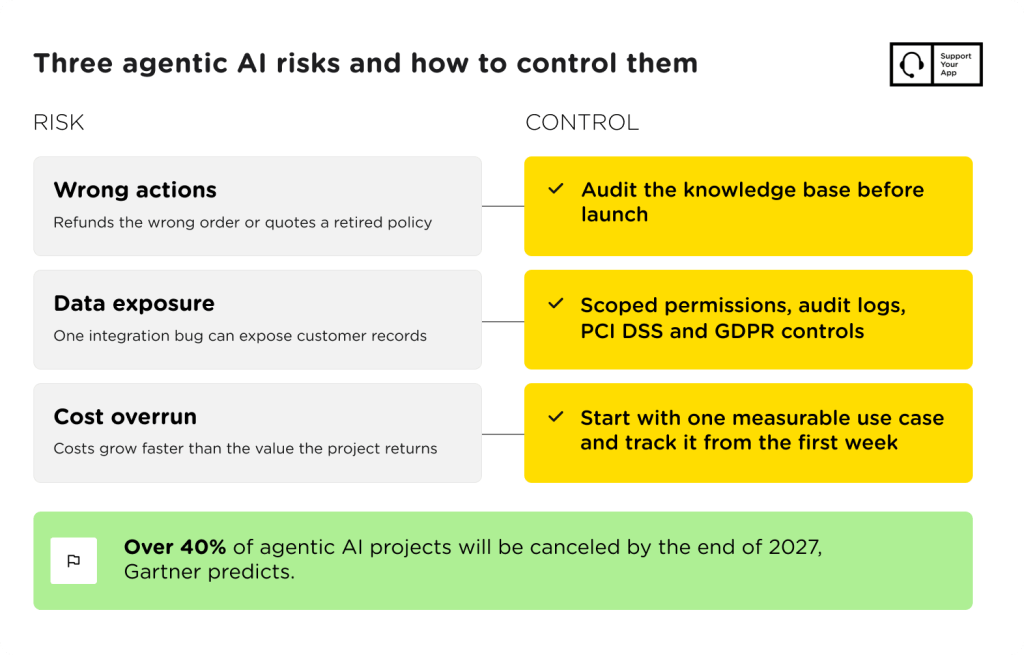
Gartner predicts companies will cancel over 40% of agentic AI projects by the end of 2027 over costs or unclear value. When you compare agentic AI tools for customer service, start with one measurable use case. Track resolution and escalation rates from the first week of the pilot.
How SupportYourApp Approaches Agentic AI
SupportYourApp pairs AI with people. Automation takes the routine volume, and trained agents keep the risky cases. Two client projects show what that split looks like for agentic AI in customer service. In both, SupportYourApp set up the AI agent, prepared the knowledge it learned from, and defined which cases go to people.
Cocoatech. A new partnership flooded this macOS software maker's two-person support team with tickets. SupportYourApp and CoSupport AI trained an AI agent on its Zendesk knowledge base. Within two months, the agent handled 81% of chat volume. Average resolution time fell from 8+ hours to 5 minutes. Read the Cocoatech case study
Welcome to Bob. The UK body wash startup's three co-founders were answering every email themselves. SupportYourApp set up a Gorgias AI Agent on email in the founders' tone of voice. It answered first-line requests and passed 19% of tickets to the founders. Response time fell 99.7% without new hires. Read the Welcome to Bob case study
For agentic AI customer support on chat and email, SupportYourApp offers SupportResponse. This autonomous customer support AI agent resolves routine tickets 24/7 in 45 languages and hands complex cases to a human. Where every reply needs sign-off, SupportBrain drafts answers that agents review and send. That's the human-in-the-loop AI customer support model.
Summary
Start with one ticket type. Agentic AI for customer service earns its place on high-volume tasks with clear rules. Refunds and after-hours calls are where most teams see the first wins. If you're planning a pilot, our team can help you pick the first workflow and set the handoff rules around it.