

Get this: by the end of this year, one in ten support interactions will be automated by generative AI. This aligns with broader 2026 trends showing AI's expanding role across customer support.
But here's what we actually see happening. AI-based call centers aren't eliminating agents — they're transforming the entire nature of support work. And the results? Companies are seeing cost reductions, slashed wait times, and improved customer satisfaction, among other benefits, as shown in the chart below.
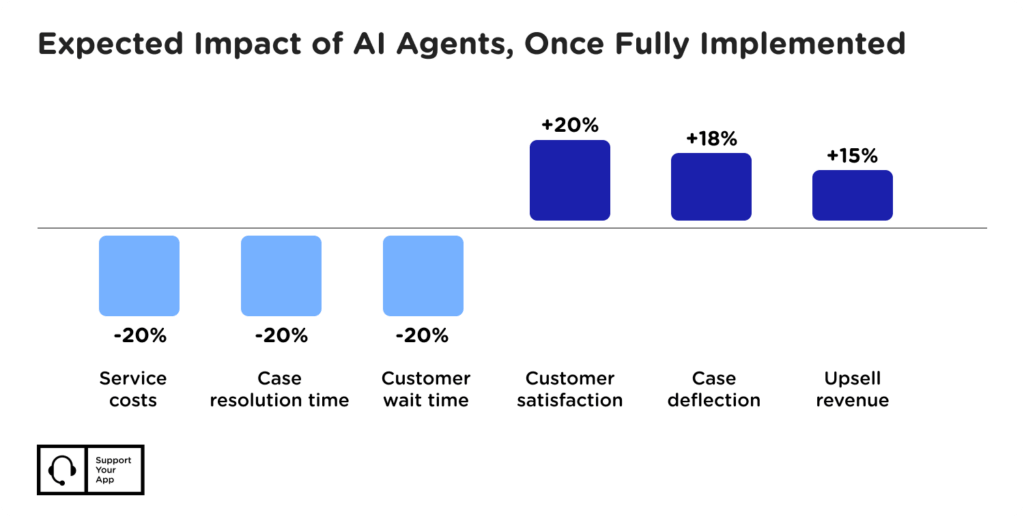
The shift is happening faster than most predicted. AI isn't a someday solution — it's already improving efficiency and driving down costs in contact centers across industries.
So will AI replace call center agents? In this article, we'll explore the answer by examining how exactly it’s transforming customer support departments.
Key Takeaways
- Hybrid AI-human models outperform pure AI by a significant margin, achieving higher resolution rates and customer satisfaction when AI handles routine tasks while humans manage complex, emotional cases.
- AI transforms the entire customer journey — from understanding intent with natural language processing to intelligent routing, real-time agent assistance, automated post-call work, and quality assurance at scale.
- Strategic AI deployment reduces costs by preventing escalations early, optimizing workforce planning, cutting training time, and turning support data into revenue-protecting intelligence rather than just cost savings.
- Advanced AI capabilities like voice biometrics, multilingual support, predictive churn prevention, and dynamic script optimization unlock competitive advantages that seemed impossible just years ago.

How AI Is Changing Call Centers
Is it transforming them entirely or is it just smart augmentation? Let’s find out.
AI for call centers isn't just about automating tasks. It's about reshaping how customer queries get resolved. Chatbots and AI voice agents are leading this shift, handling routine interactions while human agents get involved to solve complex, emotionally nuanced problems. This is a so-called human-in-the-loop approach — a hybrid AI-human model that delivers tangible results.
Companies using it are seeing faster resolution times, consistent performance across all shifts, and the ability to scale operations without sacrificing quality.
Here’s how we can use AI to improve customer experience in more detail:
- Customers receive replies immediately, which reduces their stress and frustration.
- It personalizes interactions based on customer history and preferences
- With AI, we can speak customers’ language 24/7
- Human agents tackle complex cases requiring empathy and judgment
- Real-time agentic AI provides agents with instant information
As CX expert Shep Hyken puts it:
"AI will not replace customer support professionals; it will replace tasks, not people. The future of contact centers is a partnership."
The data backs this up. Research reveals that hybrid models hit an 87% resolution rate with an 8.7 customer satisfaction score. Pure AI? Only 74% resolution with 7.4 satisfaction. Basic chatbots lagged even further behind at 61% resolution.
Those numbers tell the real story about managed AI. When enterprises combine AI efficiency with human expertise, CX improves dramatically. The key is strategic implementation, not blanket automation.
But here's the trap: many businesses automate simply because they can, not because they should. They chase cost reduction and speed while sacrificing quality and context, assuming they can eliminate human interaction entirely. As the research shows, that's exactly the wrong approach.
The winning strategy? Use AI call center automation to enhance your team's capabilities, not replace them. Define clear roles: AI handles scalability and consistency, while humans take care of complexity and connection. That's how you avoid the automation trap while maximizing the value AI brings to your enterprise.
Key Takeaway
AI is transforming call centers through a hybrid model where AI agents handle high-volume routine queries while humans solve complex, emotionally nuanced problems. This approach delivers higher resolution rates and customer satisfaction compared to pure AI or basic chatbots, proving that strategic partnership outperforms automation alone.
How AI Works in Call Centers
Let's get specific about what's happening under the hood.
The question of AI replacing call centers misses the point entirely. The real story isn't about replacement. It's about building a smarter system where artificial intelligence and human expertise work together at every stage of the customer journey.
Here's how that plays out in practice.
First Contact: Understanding What Customers Actually Need
When a customer reaches out, AI uses natural language processing to decode what they're really asking for. It reads between the lines, analyzing intent, detecting frustration or urgency, and assessing complexity. For voice calls, speech-to-text converts everything in real time, so the system can instantly prioritize and route requests to the right place.
No more "press 1 for billing, press 2 for support." AI figures it out.
Building Context: Connecting the Dots
Next, AI pulls together the full picture. It analyzes the customer's wording, tone, and keywords while cross-referencing CRM data, past interactions, account history, and recent transactions.
AI connects patterns across touchpoints to understand not just what the customer is saying, but why they're reaching out in the first place.
Smart Routing: Sending Issues Where They Belong
For straightforward requests like password resets, order tracking, basic troubleshooting, AI resolves them instantly through automated workflows. But when issues get complex, sensitive, or emotionally charged? That's when human oversight becomes critical. AI escalates to a live agent and hands over complete context: conversation summary, relevant data, and suggested solutions. The agent picks up mid-stride, not from scratch.
Real-Time Support: AI as a Copilot
While agents handle interactions, AI assists behind the scenes with:
- Live call transcription that captures every word
- Instant knowledge base searches that surface answers in seconds
- Compliance prompts that prevent costly mistakes
- Sentiment tracking that flags when emotions are escalating
Around 34% of companies already use AI agent assist tools for in-the-moment guidance, with another 44% planning to adopt them soon. This partnership reduces cognitive load on agents while keeping quality high.
After the Call: Learning and Improving
Once the interaction wraps, AI takes care of the administrative heavy lifting. It automatically summarizes conversations, updates CRM records, and schedules follow-ups. Agents can move on to the next customer instead of drowning in data entry, which directly combats burnout.
But here's where it gets really powerful: AI-driven quality assurance. Traditional QA teams review maybe 2-5% of interactions. AI evaluates 100%. It checks every call, chat, and message for tone, compliance, and resolution quality. That means no blind spots and better coaching opportunities across the board.
QA platforms like QEval report that AI-based scoring achieves over 90% consistency, while manual evaluations fluctuate due to human bias and fatigue.
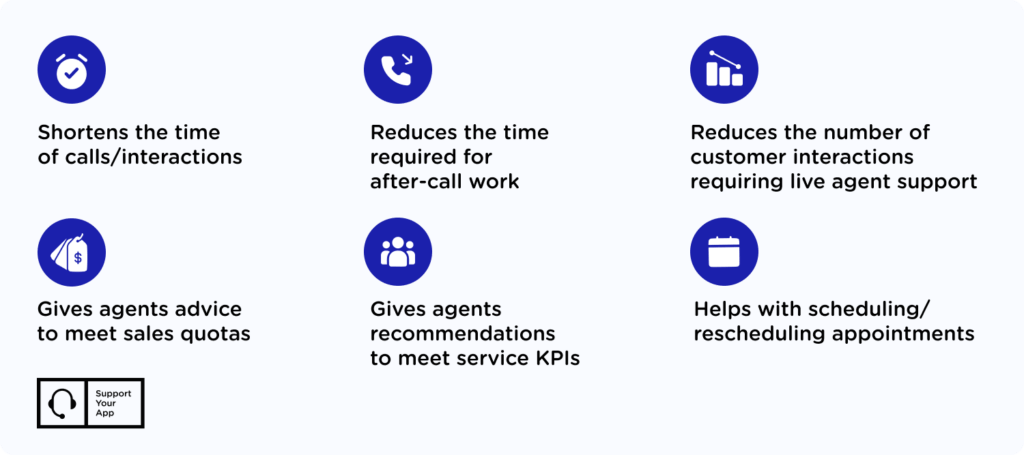
So will AI replace call center agents? Not even close. When you combine AI with human oversight, here's what you actually get:
How does AI augment staffing? Companies say AI:
Key Takeaway
Modern call centers don't choose between AI and humans: they combine them strategically. Artificial intelligence handles volume, speed, and consistency. Humans bring empathy, judgment, and creative problem-solving. Together, they deliver experiences neither could achieve alone.
Additional AI Use Cases in a Contact Center
Beyond the fundamentals, AI is unlocking capabilities that seemed impossible just a few years ago.
1. Voice Biometrics for Frictionless Authentication
Forget long security questions and password resets. AI-powered voice biometrics authenticate customers in seconds based on their unique vocal patterns. This cuts verification time, eliminates friction for legitimate customers, and flags fraudulent callers before they reach an agent. Security meets speed.
2. Multilingual AI-Based Call Center
AI translates conversations in real time across multiple languages, letting a single agent handle customers worldwide without language barriers. But it goes further — AI adapts tone, cultural nuances, and regional preferences automatically. A casual American greeting becomes formal Japanese politeness. This eliminates the need for separate language-specific teams while maintaining cultural authenticity that builds trust.
3. Dynamic Script Optimization
Static call scripts are dead. AI analyzes which phrases, questions, and approaches actually drive resolution and satisfaction, then dynamically adjusts guidance for each agent based on what works. The result? Higher conversion rates, better outcomes, and scripts that evolve with your customers instead of staying frozen in time.
4. Predictive Churn Prevention
AI spots customers who are about to leave before they've even considered it. By analyzing interaction patterns, sentiment shifts, and usage data, machine learning models predict churn risk 40, 60, or 90 days out. Then comes the intervention: targeted retention campaigns, proactive outreach, personalized offers. These are all designed to keep that customer from walking.
Reuters reported that a combined approach of generative AI and predictive churn prevented up to 100,000 customer losses annually at Verizon.
Key Takeaway
Advanced AI capabilities enable instant voice authentication, real-time multilingual support with cultural adaptation, and dynamic scripts that evolve based on performance. Predictive models also identify at-risk customers before they churn, enabling proactive retention interventions.
How Can AI Be Used to Reduce Call Center Costs?
AI slashes call center costs in ways that go beyond just handling more calls faster. The real savings come from eliminating waste, preventing expensive mistakes, and turning data into action.
Preventing Escalations Before They Cost You
AI prevents costly escalations before they happen. When systems catch issues early — a billing error, a shipping delay, a confused customer — they trigger proactive outreach. Fixing problems before customers complain costs a fraction of managing angry callbacks and potential churn.
Optimizing Your Most Expensive Asset
AI optimizes your most expensive asset: people. By forecasting call patterns with precision, you avoid the brutal choice between understaffing (which kills satisfaction) and overstaffing (which kills margins).
Reducing Training Costs Through AI-Powered Onboarding
Finally, AI dramatically cuts training time and costs. New agents get real-time coaching during calls, instant access to answers, and automated performance feedback. What used to take weeks of classroom training now happens on the job. Agents ramp up faster, make fewer mistakes, and need less supervision, all while delivering consistent quality from day one.
In-House vs. Outsourced: The Economics
Consider your infrastructure approach. An in-house AI-powered call center requires significant upfront investment — software licenses, integration work, training, maintenance. You're building and managing everything internally. An outsourced call center with AI, on the other hand, gives you immediate access to proven AI-driven systems, trained agents, and established workflows without the capital expense or ongoing technical overhead.
SupportYourApp has been using AI in customer service for years, offering multilingual voice AI services as well as developing custom chatbots for clients. Our AI agents integrate with your systems, operate across all channels, and seamlessly connect with your knowledge base to deliver accurate, on-brand answers fast.

Summary
Will AI replace call center agents? The answer is no — AI is transforming how support works, not eliminating the people who deliver it. Most support interactions will soon involve AI automation, but the winning approach is a hybrid model where AI handles routine tasks while humans tackle complex, emotional cases.
AI reshapes operations at every stage: using natural language processing to understand customer intent, intelligently routing issues, providing real-time agent assistance, and automating post-call work. Research shows hybrid models achieve significantly higher resolution rates compared to pure AI, proving that combining artificial intelligence with human expertise delivers superior results.
Beyond basic automation, AI unlocks advanced capabilities like voice biometrics, multilingual support, predictive churn prevention, and dynamic script optimization. Companies reduce costs by preventing escalations, optimizing staffing, cutting training time, and turning support data into strategic intelligence.
The question isn't whether AI reduces costs or improves efficiency — it's whether you build that capability in-house or partner with experts who've already mastered AI-powered customer support.
Like it? - Share:


-
How is AI changing call centers?
AI is reshaping call centers by handling high-volume queries through chatbots and voice agents while human agents focus on complex cases. It provides real-time assistance with live transcription, knowledge searches, and sentiment tracking. AI also automates post-call summaries and enables quality assurance at scale, reviewing every interaction instead of small samples.

-
How does AI work in a call center?
AI uses natural language processing to decode customer intent, analyzing tone and urgency in real time. It resolves straightforward requests instantly through automated workflows, routes complex issues to human agents with complete context, assists agents during calls with live information, and automates administrative tasks like CRM updates and conversation summaries afterward.
-
Will AI replace call center agents?
No. AI automates repetitive tasks, but human agents remain essential for emotionally nuanced problems and complex situations requiring empathy and judgment. Research shows hybrid models achieve significantly higher resolution rates than pure AI. The future is a partnership where AI handles scale and consistency while humans deliver connection and creative problem-solving.
-
How does AI reduce call center costs?
AI slashes costs by preventing escalations through early issue detection, optimizing workforce planning with precision forecasting, cutting training time via real-time coaching, and eliminating post-call administrative work. It also reduces agent burnout, lowers turnover rates, and transforms support data into strategic intelligence that identifies upsell opportunities and prevents customer churn.
-
How does AI improve call center automation?
AI improves automation by continuously learning from interactions to refine responses and routing decisions. It understands nuanced customer intent beyond keywords, adapts dynamically to context, and integrates seamlessly with knowledge bases. Advanced capabilities include voice biometrics for instant authentication, real-time multilingual translation, predictive churn detection, and dynamic script optimization based on actual performance.

Yurii Maidan
Chief Customer Officer
Yurii is a Chief Customer Officer at SupportYourApp. He became interested in the world of B2B about 20 years ago, and has since been accumulating diverse experience that helps him provide top-notch services to the SupportYourApp clients as a leader of the Service Delivery department.
Yurii is responsible for creating a proper environment for professional growth of the Service Delivery team members and for effective communication between the Service Deliver and other SupportYourApp departments. Making clients’ experience with SupportYourApp excellent, keeping cooperation effective, and establishing trust-based long-term relationships with our clients are Yurii’s main goals and professional passions.
Posted on January 19, 2026

Support Insights






Customer Support Trends 2026: Are You Ready?
Benchmark your customer support against key 2026 trends.