


Here's the hard truth: one data breach can obliterate your business overnight. Customer trust? Gone. Regulatory fines? Crushing. Brand reputation? Destroyed.
The stakes are higher in fintech and banking, where a single security lapse can put you out of business.
Outsourcing to an experienced PCI-compliant call center provider protects you from that risk while keeping customer interactions smooth. The challenge is knowing which provider can actually deliver on that promise. This guide covers call center PCI compliance requirements, profiles the top five providers, and gives you a checklist for choosing the right one.
Key Takeaways
- PCI DSS Level 1 certification is non-negotiable, backed by quarterly audits and penetration testing.
- Technical controls are half the battle. You also need continuous monitoring, monthly training, and real incident response.
- Provider selection touches multiple frameworks. The best call centers bundle PCI DSS with ISO 27001, GDPR, and HIPAA.
- Advanced features separate leaders from followers, like pause and resume technology and real-time fraud prevention.
- Industry expertise matters. Choose providers who understand your fraud patterns and regulatory nuances.
- Scalability determines long-term success. Providers must scale from 10 to 100 agents in weeks without cutting corners.
What Is PCI Compliance for Call Center Providers?
The Payment Card Industry Data Security Standard (PCI DSS) sets baseline security requirements for organizations that store, process, or transmit cardholder data. Card brands including Visa and Mastercard built it around six objectives, from secure networks to strict access controls.
For call centers, PCI DSS compliance means specialized controls standard operations don't require, so payment data stays protected under PCI security standards.
There are four compliance levels based on transaction volume. Level 1, the highest tier, applies to providers processing over 300,000 transactions annually.
Why this matters: Operating without proper PCI DSS call center compliance is reckless. Non-compliance can bring fines up to $100,000 per month, plus liability for fraud losses and loss of your ability to process card payments.
Why PCI Compliance for Call Centers Matters
Outsourcing customer service means sharing risk as well as work. Any breach at your provider becomes your problem instantly.
Data breaches cost companies an average of $4.99 million in 2026, according to IBM's Cost of a Data Breach Report. In fintech customer service, trust is your most valuable asset, and a single data breach can be enough to drive consumers to switch providers.
Strong contact center PCI compliance also becomes a competitive differentiator. For fintech and banking, compliance rarely stops at PCI DSS. A provider that bundles it with ISO 27001, GDPR, and HIPAA simplifies vendor management significantly.
What Happens if You Don't Comply
| Consequence | Impact |
| Regulatory fines | Up to $100,000 per month until compliance is restored |
| Data breach costs | $4.99 million average per breach as of 2026 |
| Customer attrition | Consumers switch providers after a breach |
| Processing rights | Card brands can revoke your ability to process payments |
| Legal exposure | Forensic investigations, settlements, and card brand liability |
PCI Compliance Requirements for Call Centers
Call center PCI DSS compliance means proving your controls work today, not just on paper. These are mandatory for any PCI-compliant call center worth considering.
- Payment desensitization prevents agents from hearing card numbers as customers enter them.
- Encryption and network segmentation protect data while limiting audit scope.
- Tokenization replaces real card numbers with random tokens.
- Secure call recording with pause and resume technology keeps quality monitoring running without exposing cardholder data.
Operational controls matter just as much: role-based access, multi-factor authentication, monthly security training, background checks, and documented incident response.
What Are the Main PCI Compliance Requirements?
| Requirement | Key Controls |
| Payment desensitization | Blocks agents from hearing card numbers as customers enter them |
| Encryption | End-to-end AES-256 encryption for data in transit, at rest, and in use |
| Network segmentation | Isolates payment systems from general infrastructure |
| Tokenization | Replaces card numbers with random, unusable tokens |
| Secure call recording | Encrypted storage with pause-and-resume during payment capture |
| Access controls | Role-based permissions and multi-factor authentication for admins |
| Continuous monitoring | Real-time detection and SIEM-based threat correlation |
| Security training | Monthly awareness programs with regular comprehension testing |
| Background checks | Criminal history and employment verification for data handlers |
| Incident response | Documented protocols, notification chains, and response timelines |
How We Rank the Top PCI-Compliant Providers
We built this list around criteria that separate a compliant provider on paper from one that protects your payment data day to day.
- PCI DSS Level 1 certification, verified through a current Report on Compliance compiled by an independent, external Qualified Security Assessor (QSA). QSAs are separately authorized and vetted to conduct PCI DSS audits, so it's worth confirming the assessor's credentials rather than assuming any auditor qualifies.
- Independent audits, including annual assessments and quarterly vulnerability scans.
- Agent training, documented and recurring for anyone who handles cardholder data.
- Secure payment handling, including desensitization, tokenization, and encrypted recording.
- Industry fit and scalability, with proven experience in regulated sectors like fintech and healthcare.
We weighed certifications first, then checked how each provider's clients described their day-to-day discipline.
Top Call Centers With PCI Compliance
The following providers maintain verified PCI DSS Level 1 Service Provider certification and demonstrate consistent security excellence.
| Provider | Key Certifications | Best For |
| SupportYourApp | PCI DSS L1, ISO 27001, GDPR, CCPA, HIPAA | Fintech, SaaS, and eCommerce companies wanting security paired with CX |
| Simply Contact | PCI DSS, ISO 27001, ISO 27701, GDPR, HIPAA | Regulated mid-market and enterprise support across aviation, fintech, retail |
| ContactPoint 360 | PCI DSS, ISO 27001, HIPAA, SOC 2, GDPR | Large enterprises needing global, high-volume CX operations |
| Hugo | PCI DSS, ISO 27001, HITRUST, SOC 2, HIPAA, GDPR | Fast-scaling fintech, healthcare, and SaaS brands |
| TTEC | PCI DSS, SOC 2, HIPAA, GDPR | Large enterprises needing in-house fraud prevention and AI |
#1 SupportYourApp

SupportYourApp specializes in secure customer and technical support, with particular strength in fintech customer service, SaaS, and ecommerce. Founded in 2010, it delivers 24/7 AI-powered support to 250+ clients across 30+ countries.
Compliance: PCI DSS Level 1 and Level 2, ISO 27001:2022, GDPR- and CCPA-compliant, HIPAA-compliant, with regular third-party audits.
Best for: Tech startups, fintechs, ecommerce companies, and SaaS businesses needing technical knowledge combined with payment security. Its team, fluent in 60+ languages, keeps standards consistent globally.
Customer Ratings: 4.8/5 stars on Clutch based on 87 verified reviews.
Key Differentiator: SupportYourApp runs on its own SupportCRM or a client's existing CRM, layering AI voice, chat, and human-in-the-loop support on top so every interaction stays under human oversight. Every AI product in the stack meets the same security standards, so the platform is flexible, but the security never is. This is PCI call center outsourcing that never compromises compliance.
#2 Simply Contact
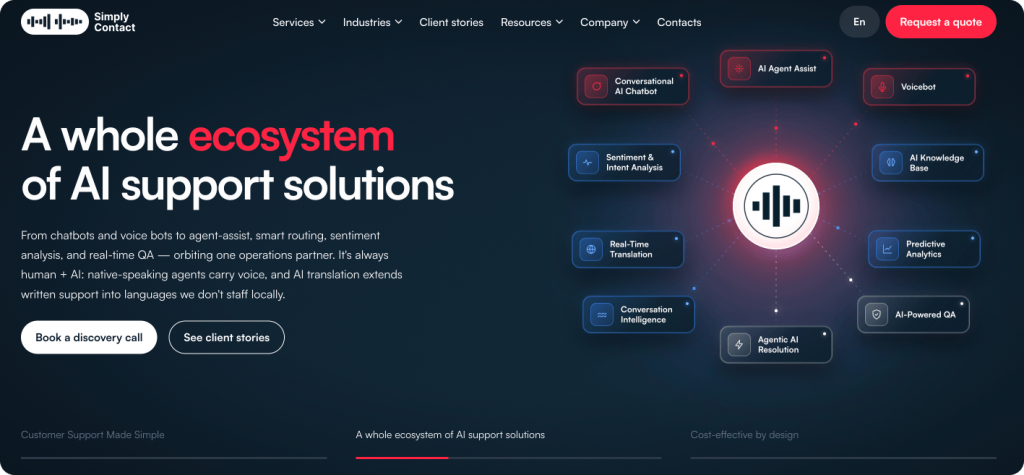
Simply Contact is a customer support partner for regulated industries: aviation, fintech, retail, healthcare, and SaaS. Founded in 2013, it employs 700+ agents across Central and Eastern Europe.
Compliance: PCI DSS certified, ISO 27001 certified, ISO 27701 (PIMS) certified, GDPR-compliant, HIPAA-compliant.
Best for: Mid-market and enterprise companies handling payment, health, or identity data. Customer Ratings: 4.8/5 stars on Clutch based on 27 verified reviews.
Key Differentiator: Simply Contact builds security into daily operations. PII, PCI, and PHI data each follow dedicated handling procedures, and remote access sits behind two-factor authentication.
#3 ContactPoint 360
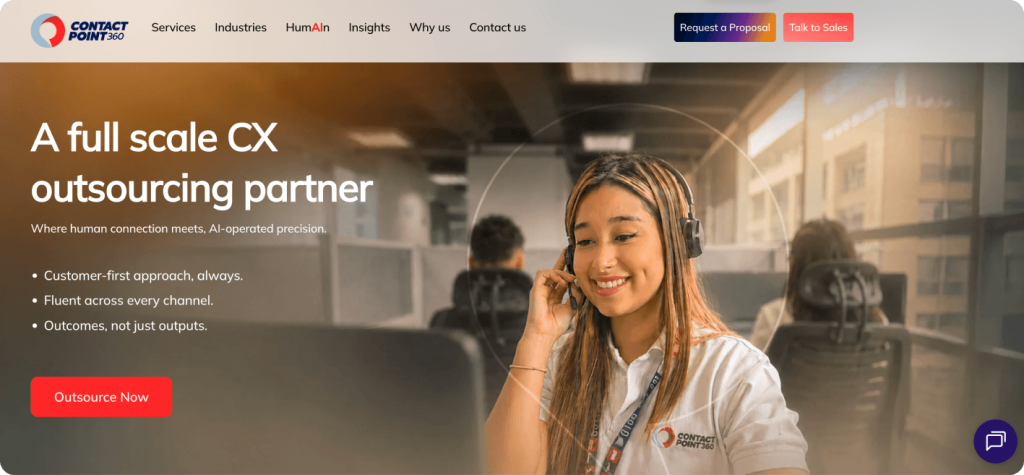
ContactPoint 360 is a global CX partner running PCI-focused operations across 12 delivery hubs with 24/7/365 availability.
Compliance: PCI DSS infrastructure, end-to-end encryption, secure call recording, role-based access with MFA and SIEM monitoring, plus ISO 27001, HIPAA, and SOC 2 Type II.
Best for: Large enterprises in fintech, banking, and healthcare payments needing secure CX at scale.
Customer Ratings: 4.8/5 stars on Clutch, praising project management and cultural fit.
Key Differentiator: ContactPoint 360 pairs AI-operated workflows with PCI-grade controls, keeping every interaction secure and audit-ready without hurting performance.
#4 Hugo
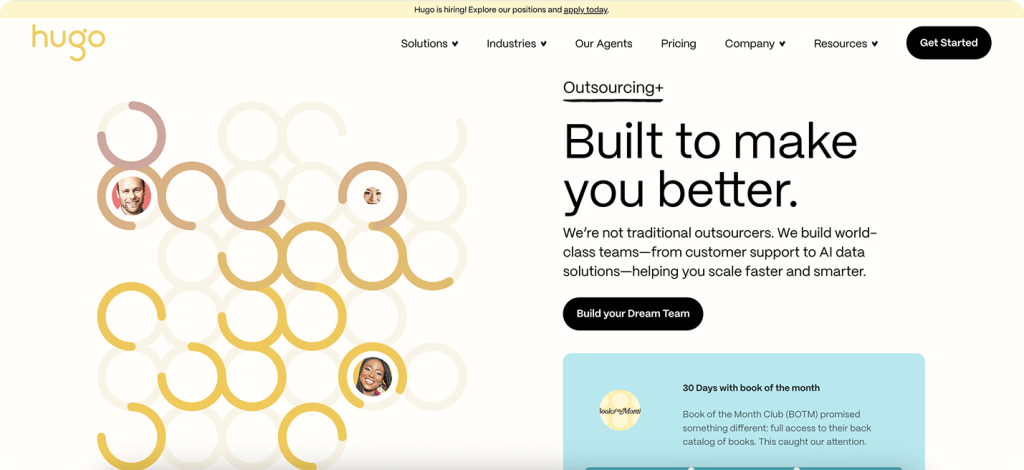
Hugo is a fast-growing BPO built for digital-native brands in fintech, healthcare, and SaaS. Based in Chicago with 1,000+ staff, Hugo pairs AI tools with trained agents.
Compliance: PCI DSS certified, ISO 27001 certified, HITRUST certified, SOC 2 certified, HIPAA- and GDPR-compliant.
Best for: Digital-native and fast-scaling companies juggling overlapping compliance frameworks.
Customer Ratings: Hugo was named Clutch's fastest-growing BPO for customer service outsourcing two years running.
Key Differentiator: Hugo stacks PCI DSS with HITRUST and SOC 2 under one roof, giving fintech and healthcare clients overlapping coverage without managing separate vendors.
#5 TTEC
TTEC is a global CX technology company with over 40 years of experience in customer care and tech support. It serves financial services, healthcare, and retail clients.
Compliance: PCI DSS controls, SOC 2 infrastructure, HIPAA-compliant operations, GDPR-compliant operations, and its own Intelligent Fraud Automation platform.
Best for: Large enterprises needing high-volume operations with fraud prevention built into the workflow.
Customer Ratings: 3.6/5 rating on G2, citing deep experience in regulated industries.
Key Differentiator: TTEC's fraud prevention approach is built on an enterprise partnership with Sift's AI-driven fraud mitigation engine. TTEC layers on its own operational implementation, specialized fraud analysts, model training, and case investigation workflows, tightening the link between security and the customer interaction layer.
Call Centers PCI Compliance Checklist
Weigh your options carefully before you commit. Use this checklist before you sign. Request a provider's Report on Compliance (ROC), reflecting their PCI DSS audit results. It should cover:
- End-to-end encryption, network segmentation, tokenization, and secure call recording
- Multi-factor authentication and automated vulnerability scanning
- Role-based access, background checks, and monthly security training
- Documented incident response and vendor management programs
- Network diagrams, quarterly scan reports, and annual penetration test results
Important Note: PCI DSS never automatically covers an entire company. There's always a defined scope, so confirm exactly what a provider's certification includes.
PCI Compliance for Fintech Call Centers
These environments carry compliance stakes beyond a standard PCI DSS review. Support teams often verify identity and handle KYC checks in the same call where they process a payment.
PCI compliance works best alongside other frameworks, never as a replacement for them. A provider running fintech customer support needs PCI DSS for payment data, plus the controls covered under KYC outsourcing programs.
Separate vendors for payments and identity verification create gaps attackers can exploit.
Common PCI Compliance Pitfalls When Outsourcing
Even certified providers can have compliance gaps. Watch for these traps.
- Assuming certification is a one-time event. PCI DSS compliance must be reverified annually through independent audit to confirm security stays at standard. Request an updated attestation each year and build contract clauses requiring notification if it lapses.
- Shared environments without segmentation. Demand proof of network segmentation before trusting a multi-tenant setup.
- Weak operational discipline. Access creep and skipped training undo strong technical controls. Audit how often a provider reviews permissions.
- Unclear incident ownership. Define response roles in contracts: who investigates, who notifies card brands, who handles customer communication.
Summary
Partnering with a PCI-compliant provider reduces your risk exposure and protects customer trust. The five providers above maintain verified compliance while serving different business needs.
Use the compliance checklist to verify technical controls, procedures, and documentation before you sign. The right PCI compliant contact center doesn't just process calls; it becomes an extension of your team.