


Identity checks keep piling up on your compliance team, and every new market adds another layer of rules to track. This guide is for fintech and banking operators deciding between growing an in-house team or bringing in a partner for KYC outsourcing.
We'll cover what KYC and AML outsourcing includes, when it makes sense, and how to pick a provider you can trust with sensitive customer data.
TL;DR
- KYC and AML outsourcing means handing verification and monitoring work to a specialized team without giving up compliance oversight.
- Managed services and KYC software solve different problems. One gives you trained analysts. The other gives you a tool you still have to run.
- The right time to outsource is before backlog and false positives start costing you customers.
- We’ve compared three providers and are sharing a checklist for picking the one that matches your risk profile.
Financial institutions now spend $72.9 million a year, on average, on AML and KYC operations, per Fenergo's 2025 Financial Crime Industry Trends report. That number keeps climbing even as compliance tools multiply. It's part of why so many teams are looking at outsourcing KYC instead of hiring their way through the backlog.
What is KYC/AML Outsourcing?
In short, a third-party team takes on customer verification and anti-money-laundering (AML) monitoring, so the business doesn't have to build that function internally. If you're still working out what KYC (Know Your Customer) is, you can find details about the process in this article.
Under a KYC AML outsourcing setup, a BPO provider verifies identity documents, screens for sanctions and politically exposed persons, and flags unusual transaction patterns. Your compliance officer still owns the final call and the regulatory relationship. The provider does the labor-intensive review work at scale.
AML process outsourcing on its own usually covers a narrower slice of the job: transaction monitoring, suspicious activity report drafting, and case escalation. Some providers bundle both functions under one team. Others specialize in just one side, so it pays to ask before you sign anything.
Most companies turn to outsourcing for one of three reasons.
- The review backlog outgrew the internal team.
- A new market brought unfamiliar documentation rules.
- Leadership just wants a second set of eyes on a process regulators watch closely.
None of those reasons require giving up control. They just mean the day-to-day review sits with a partner instead of an internal hire.
KYC Managed Services vs KYC Software
It's easy to treat these as interchangeable, but they actually cover different halves of the same problem. Software gives you the engine: document scanning, biometric matching, watchlist screening, all running through an API. Someone still has to review the exceptions.
KYC managed services add the people. A managed provider staffs trained analysts who work inside your case management platform and follow your written procedures. Anything unclear gets escalated straight to your internal team. You get the software layer and the human judgment layer in one contract.
KYC customer service outsourcing tends to make the most sense once your exception volume outgrows what two or three in-house analysts can handle. Below that threshold, software alone might cover it. Above it, you're paying analysts to do repetitive review work that a managed team can do for less.
The honest tradeoff: software is cheaper per check at low volume, but it caps out fast. A managed team costs more per hour but scales without a hiring cycle every time volume spikes.
No payments startup scales into new markets on software alone, and none of them do it with people alone either. The software handles the repeatable part: routing documents, flagging mismatches, tracking status across jurisdictions. The people handle the part that doesn't scale: reading a new regulator's fine print, judging an edge case, catching what the system was never trained to see. Growth like that needs both running at the same time, not a choice between them.
The KYC Process in a BPO Setup
A BPO-run KYC process usually starts the same way an in-house one would. Collect the customer's documents, verify identity, screen against sanctions and PEP lists, then score the risk level. The difference is who does the work, and how fast that team can flex up or down.
In a typical KYC process in BPO, your provider's analysts work inside your platform. The audit trail stays intact, and your compliance officer keeps full visibility. Cases get triaged by risk. Low-risk approvals move fast. Anything ambiguous gets escalated with full context attached.
Customer support and compliance overlap more than most teams expect here. A blocked account during KYC review is still a live KYC onboarding process issue for the customer waiting on an answer. It needs the same speed and tone as any other support ticket.
KYC BPO solutions that separate compliance review from customer communication tend to create gaps. The best setups keep both functions coordinated, so a flagged account doesn't turn into a week of silence for the person on the other end.
When Should You Outsource KYC?
There's no single trigger, but a few patterns show up again and again. If your review backlog keeps growing faster than your headcount, that's usually the first sign. If false positives are eating analyst time faster than real risk cases, that's the second one.
Outsourcing KYC also makes sense when you're expanding into a new jurisdiction and don't have staff who know the local documentation standards yet. Building that expertise in-house for one market rarely pays off compared to renting it from a provider who already has it.
Customer due diligence services are worth outsourcing early if your product involves higher-risk customer segments: crypto, cross-border payments, or high-value transfers. These cases need enhanced due diligence more often, and that work is slow to build internally from scratch.
If none of that applies yet, and your volume is still small, software alone might carry you further before a managed team makes financial sense.
The stakes for getting this wrong keep rising, too. Global penalties for AML, KYC, sanctions, and customer due diligence failures totaled $3.8 billion in 2025, according to Fenergo's annual enforcement report. A thin, understaffed review process is a real financial exposure. It's more than an operational headache.
Best KYC & AML Outsourcing Providers
Picking a provider comes down to matching their strengths to your risk profile and scale. Here's how three options compare on the criteria that truly matter for a compliance-sensitive process.
| Provider | Best for | Compliance stack | Notable strength |
| SupportYourApp | Fintechs that want compliance and customer communication handled by one coordinated team | PCI DSS Level 1 and Level 2, ISO/IEC 27001, GDPR, CCPA, HIPAA | 60+ languages and a support team trained to handle KYC status updates alongside the compliance review itself |
| Hugo | Fast-growing fintech startups needing fraud prevention and KYC built in from day one | SOC 2, PCI DSS, ISO 27001, GDPR | Two-week onboarding and a track record with regulated enterprise clients |
| Digital Minds BPO (DMI) | Lean teams that need document-review capacity at the lowest possible cost | BSA/AML, GDPR/UK GDPR, training mapped to MiCA requirements | Transparent per-analyst pricing |
SupportYourApp
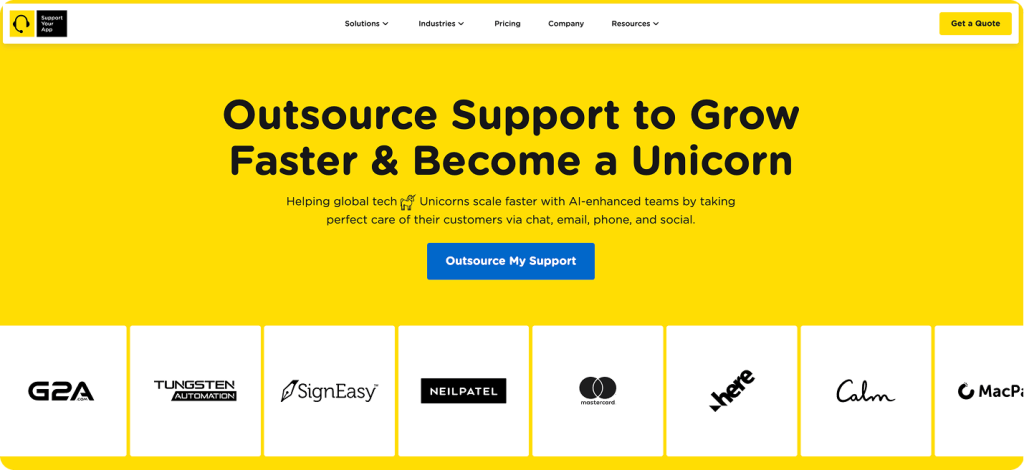
SupportYourApp runs KYC customer service outsourcing as part of a broader fintech customer service practice, not as a bolted-on compliance desk. That matters because a KYC delay is a customer service problem the moment the customer notices it. SupportYourApp trains its teams in KYC, AML, and data protection standards, and holds PCI DSS, ISO 27001, and GDPR certifications across its delivery centers.
Hugo
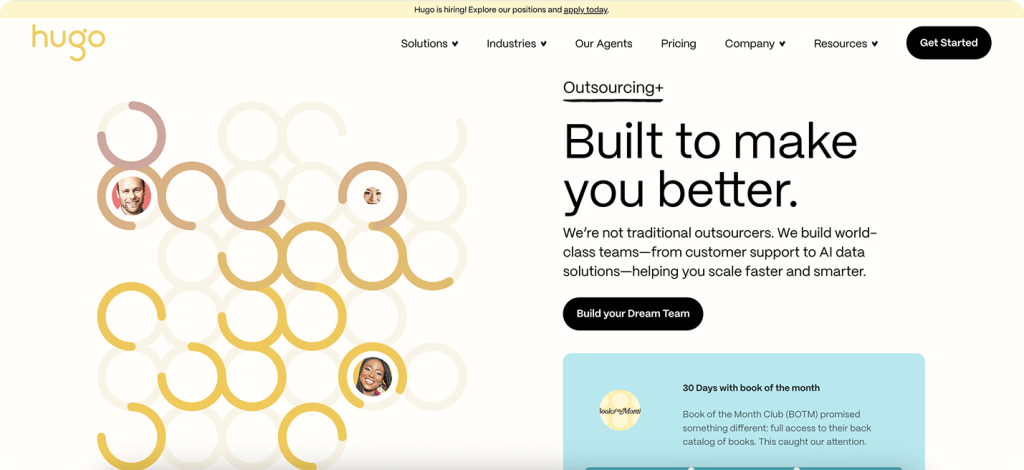
Hugo built its reputation on trust and safety work for tech and media companies, then extended into fintech-specific KYC and AML review. It's a strong fit for startups that need a full compliance stack fast. Reviews note it's less flexible for smaller, less standardized workflows than boutique providers, which is worth weighing if your process is still evolving.
Digital Minds BPO

Digital Minds BPO takes the opposite approach. Published per-analyst rates and a large Philippines-based talent pool, trained against US, UK, EU, and Australian compliance frameworks. It's a solid pick if cost per analyst is your main constraint, and your procedures are already mature enough to hand over directly.
None of these three is automatically the right answer. A team that needs compliance and customer-facing support handled as one function will lean toward SupportYourApp. A startup racing to stand up a compliance stack from zero may prefer Hugo's speed. A mature operation that just needs more hands on document review at a predictable cost will likely land on DMI.
How to Choose a KYC Outsourcing Provider
Start with certifications. Ask for proof of PCI DSS, ISO 27001, and GDPR compliance, backed by audit documentation you can actually review. A provider who can't produce that on request isn't ready for regulated work.
Check how the provider handles escalation. Ask what happens when an analyst hits a case they can't resolve. Does it sit in a queue, or move to a named person on your team within a set time? SupportYourApp, for example, builds escalation paths directly into the client's own case management platform instead of routing through a separate system.
Confirm language and jurisdiction coverage match your customer base. A provider with strong US documentation training won't necessarily know EU identity document formats, and vice versa.
Run a short pilot before signing a long-term contract. A two-to-four-week trial on a limited case volume tells you more about accuracy and turnaround than any sales deck will. Watch how the provider handles a genuinely ambiguous case during that window, beyond the easy approvals. That's where the real difference between providers shows up.
Quick checklist:
- Certifications: PCI DSS, ISO 27001, GDPR, CCPA, HIPAA where relevant
- Escalation path defined in writing, with named owners
- Case management platform compatibility confirmed before onboarding
- Language and jurisdiction coverage matched to your customer base
- Pilot period agreed before any long-term contract
Summary
Outsourcing KYC and AML review isn't a compliance shortcut. It's a way to keep pace with growing volume, so your internal team spends time on judgment calls instead of repetitive document reviews. If you're comparing providers, start with the certifications. Run a small pilot, and watch how they handle a flagged case before you hand over a full queue.
SupportYourApp works this way for fintech clients who want compliance and customer communication handled by one coordinated team. It's worth a look if that's the gap you're trying to close.