


Get KYC and AML wrong and you're looking at fines, blocked accounts, or worse: a shut-down partnership with your banking provider or your business in general. Get it right, and it's the safeguard. This guide covers what each compliance requirement actually demands, and how they work together.
TL;DR
- KYC and AML sound similar but check different things: identity versus the risk of financial crime.
- A working program covers customer due diligence, enhanced checks for higher-risk customers, and ongoing monitoring.
- A slow or confusing onboarding flow can cost you more customers than a strict process saves you in fines.
- Below: the checklist, the process, the difference between the two, and where support fits in.
What is KYC (Know Your Customer)?
Seventy percent of financial institutions lost customers to slow or confusing KYC onboarding in 2025, according to Fenergo's global compliance survey. That number captures the tension in Know Your Customer work. Get it wrong and you either miss real fraud, or you lose good customers at the front door.
KYC is the process banks, fintechs, payment providers, and other regulated industries use to confirm a customer's identity. It happens before an account opens or a transaction goes through. It usually starts with identity verification documents, a selfie match, and a check against sanctions and watchlists.
Know Your Customer compliance isn't a one-time check, either. Regulators expect ongoing monitoring for the life of the relationship, not just a pass or fail at signup. That's the KYC AML meaning teams often miss: KYC is the identity layer, AML is everything built on top of it.
The stakes go both ways. Skip a step and a regulator can fine you or pull your license to operate. Overdo the friction and customers abandon the signup form before they ever become paying users. The whole point of a good KYC program is finding the setting where both risks stay low at the same time.
What Is AML Compliance?
AML stands for anti-money laundering. It's the set of laws, policies, and monitoring systems that stop criminal money from moving through legitimate financial channels undetected.
Ask a compliance officer what is AML in banking, and they'll point past the paperwork straight to the transaction monitoring system. Banks and fintechs have to file suspicious activity reports, screen against sanctions lists, and trace where money came from and where it's going.
AML compliance sits downstream of KYC. Without accurate identity data from onboarding, transaction monitoring has nothing solid to compare new activity against. Weak identity checks at the front door make AML rules far less useful later on.
A typical AML program has four working parts: a written policy, a designated compliance officer, employee training, and independent testing. Regulators tend to fault whichever part is weakest rather than the whole program at once. A gap in any single piece can still trigger an enforcement action.
Picture a mid-size payments company that skips the independent testing piece to save budget. Its transaction monitoring rules go stale for two years while fraud patterns shift around them. When an examiner finally reviews the file, the fine isn't for a single missed transaction. It's for running a program nobody checked was still working.
KYC vs AML: What's the Difference?
People use KYC and AML like they mean the same thing, but the two don't fully overlap. Here's the difference, side by side.
| Aspect | KYC | AML |
| Focus | Confirms customer identity | Prevents and detects money laundering |
| Timing | At onboarding and periodic refresh | Continuous, transaction by transaction |
| Main tools | ID verification, biometric checks | Transaction monitoring, sanctions screening |
| Regulatory driver | Customer identification program rules | Bank Secrecy Act and related AML law |
| Outcome | A verified customer profile | Flagged activity and filed reports |
In short, KYC and AML work together. One confirms who a customer is. The other watches what they do with their money over time.
Think of a new business account. KYC clears the owner's ID and confirms the company is real. AML then watches every deposit and transfer that account makes for years afterward, long after the onboarding team has moved on.
The KYC Process Step by Step
Walking through the full process step by step deserves its own guide, and we've written one. See our KYC onboarding process breakdown for the exact stages, from document capture through risk scoring.
At a high level, the process runs through four stages:
- Collect identity documents
- Verify them against a trusted database
- Screen the customer against watchlists
- Assign a risk score that sets the pace for ongoing monitoring
Most of the friction customers feel happens in the first stage, document capture. A blurry photo, an expired ID, or a mismatched address can send a real customer into a manual review queue meant for actual risk cases. Getting that first stage right does more for conversion than almost anything else in the flow.
Some teams handle this by building the review queue in-house; others turn to KYC outsourcing to keep manual checks fast without pulling staff off other work.
Customer Due Diligence (CDD & EDD)
After identity is confirmed, a deeper background check follows. It looks past the signature on the form to who really owns and controls the business.
So, what are the 4 customer due diligence requirements regulators expect? Most frameworks, including the US CDD Rule, break down into four parts:
- Identify and verify the customer's identity.
- Identify and verify beneficial owners behind any legal entity.
- Understand the nature and purpose of the relationship to build a risk profile.
- Keep monitoring the relationship and update records as circumstances change.
CDD requirements scale with risk. A retail customer opening a checking account gets a lighter check. A customer from a sanctioned country, or one running a cash-heavy business, triggers enhanced customer due diligence. That means deeper document checks, source-of-funds verification, and more frequent reviews.
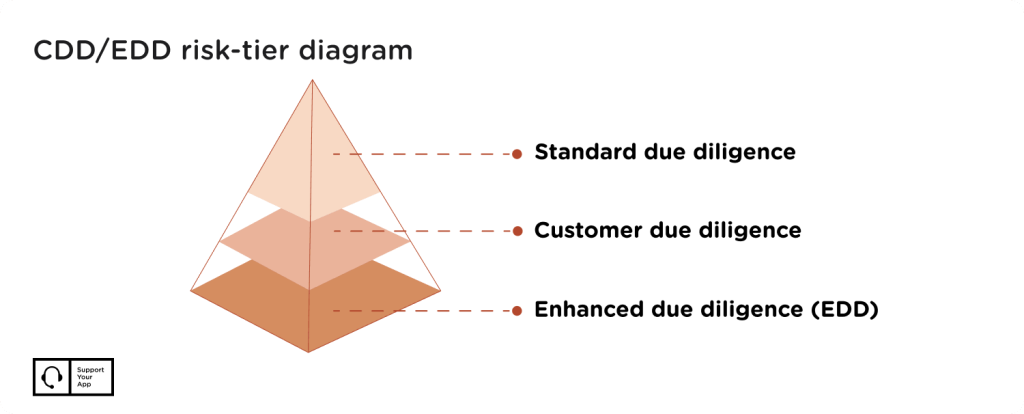
Enhanced CDD also applies to politically exposed persons, people who hold or held a prominent public role. Their accounts carry a higher bribery and corruption risk. Most banks review them at least once a year instead of waiting for the standard refresh cycle.
Know Your Customer Checklist
A practical KYC checklist keeps the process consistent across every new account, instead of leaving it to individual judgment calls.
Use this as your baseline know your customer requirements:
- Collect a valid government-issued ID and confirm it hasn't expired.
- Run a live selfie or video match against the ID photo.
- Screen the customer against sanctions, PEP, and adverse media lists.
- Verify the customer's address through a utility bill or bank statement.
- For businesses, identify beneficial owners with 25% or more ownership.
- Assign a risk score and set a review schedule based on that score.
- Document every check and keep records for the period your regulator requires.
Skip a step here and the risk isn't just a fine. It's a customer file regulators can't reconstruct if something goes wrong later.
Build this checklist into your onboarding software rather than a shared document. A step that lives in a spreadsheet gets skipped under deadline pressure. A step built into the signup flow doesn't let the next screen load until it's done. That keeps every file consistent, no matter who works the queue that day.
A checklist also gives new hires a clear reference point on day one. They aren't stuck learning the process by watching a senior teammate handle edge cases. That matters more than it sounds like it should. Compliance teams turn over staff too, and undocumented judgment calls walk out the door with whoever made them.
AML in Practice: Transaction Monitoring & Sanctions Screening
Two systems do the heavy lifting in daily AML work: transaction monitoring and sanctions screening. Both run continuously, not just at onboarding.
What is AML transaction monitoring in real terms? It's software that watches account activity for patterns that don't match a customer's stated profile. Sudden large transfers, rapid movement across accounts, or deposits structured to stay under reporting thresholds all get flagged.
What is AML sanctions screening, then? It's the automatic check of every customer and transaction against government and international sanctions lists, updated in near real time as those lists change.
Together, these two systems catch what identity verification alone can't. A customer can pass KYC with a clean ID and still turn out to be a front for laundering money. That's why AML compliance treats onboarding as day one, not the finish line. Global AML fines reached $4.6 billion in 2024. The first half of 2025 alone saw $1.23 billion, a 417% jump year over year, per Fenergo's data.
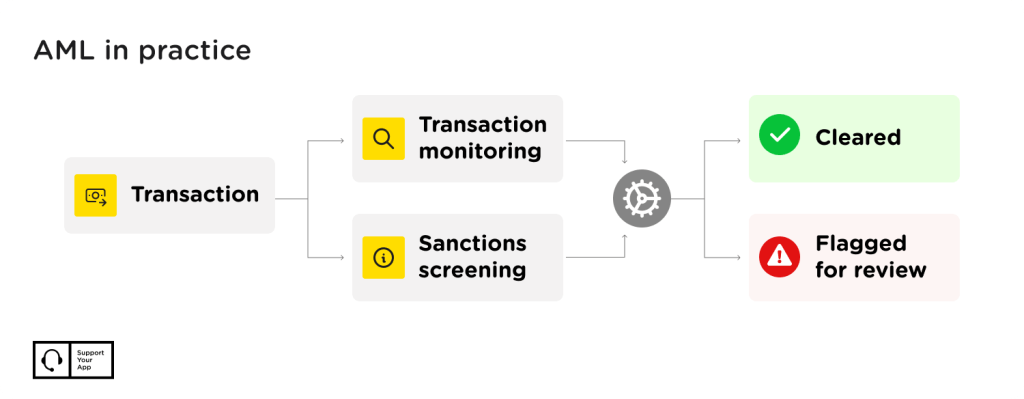
Most flagged transactions turn out to be false positives, a legitimate customer whose spending pattern just changed. That's normal, and it's exactly why a human review step still matters. A well-tuned system narrows the queue down to the cases that genuinely need a person's judgment. That beats drowning the compliance team in alerts nobody has time to check.
KYC/AML in Fintech: Why It Matters for Support
KYC and AML rules don't stay inside the compliance department. Support teams field the calls when a payment gets frozen for review, or when an account gets flagged mid-onboarding and nobody explained why.
That's the moment fintech customer service either builds trust or burns it. A support agent who understands why a document got rejected can explain the next step calmly. That keeps a frustrated customer instead of losing them to a faster-looking competitor.
If your team already handles regulated conversations, in fintech, healthcare, or anywhere compliance shapes every interaction, a trained outside partner is worth a look. SupportYourApp builds support teams for fintech and banking clients on PCI DSS Level 1, ISO 27001, and GDPR-compliant processes already in place. KYC and AML questions land with agents who understand the stakes.
The alternative, routing every compliance-adjacent question straight to the compliance team, doesn't scale past a certain volume. Compliance officers end up answering "why is my account under review" tickets instead of doing the work that actually reduces risk. A trained front line, backed by a clear escalation path for the genuinely complex cases, keeps both teams doing the job they're best at.
Summary
KYC and AML compliance will keep getting more complex as regulators tighten expectations and fraud tactics evolve. Getting the process right, and explaining it well when customers have questions, matters as much as the software behind it. If you're weighing whether to build that support capacity in-house or bring in a trained partner, SupportYourApp is one option worth exploring.