


Here’s the hard truth: one data breach can obliterate your business overnight. Customer trust? Gone. Regulatory fines? Crushing. Brand reputation? Destroyed.
The stakes are even higher in fintech and banking. A single security lapse doesn’t just cost you money, it can put you out of business. Customers expect military-grade protection for their payment data, and regulators are watching every move.
But here’s the good news: outsourcing to an experienced PCI-compliant call center provider protects you from catastrophic financial, operational, and reputational damage while keeping customer interactions smooth. The right outsourcing provider becomes your security partner, not just a vendor.
This guide breaks down everything you need to know about call center PCI compliance in 2026. We’ll cover the requirements, profile the top five providers, and give you a battle-tested checklist for making the right choice.
Key Takeaways
- PCI DSS Level 1 certification is non-negotiable. Any call center handling payment data must maintain verified Level 1 Service Provider status, backed by quarterly audits and penetration testing.
- Technical controls are just half the battle. Beyond encryption and tokenization, you need operational excellence: continuous monitoring, monthly security training, and incident response procedures that actually work when disasters strike.
- Provider selection impacts multiple compliance frameworks. The most reliable call centers bundle PCI DSS with ISO 27001, GDPR, HIPAA, and industry-specific certifications, simplifying your vendor management.
- Advanced features separate leaders from followers. Pause and resume technology, real-time fraud prevention, and omnichannel security consistency aren’t optional extras. They’re competitive necessities that protect both data and customer experience.
- Industry expertise trumps generic capabilities. Healthcare providers face different threats than fintech startups. Choose providers with profound sector experience who understand your specific fraud patterns, regulatory nuances, and business challenges.
- Scalability determines long-term partnership success. Your payment volumes will spike and dip, and so providers must scale from 10 to 100 agents in weeks while maintaining ironclad security standards, or they’ll become your bottleneck.
What Is PCI Compliance for Call Center Providers?
The Payment Card Industry Data Security Standard (PCI DSS) sets baseline security requirements for organizations that store, process, or transmit cardholder data.
Created by major card brands (Visa, Mastercard, American Express, Discover, and JCB), PCI DSS outlines twelve core requirements covering everything from encryption to access controls and grouped around six objectives:
- Keeping networks secure with properly configured firewalls
- Protecting cardholder data through encryption and secure storage
- Regularly testing and managing system vulnerabilities
- Implementing strict access controls to limit data access
- Regularly monitoring and testing networks for security threats
- Maintaining comprehensive information security policies
The goal? Protect cardholder data at every touchpoint.
For call centers, PCI DSS compliance means implementing specialized controls that standard business operations don’t require. When customers share payment information over the phone, through chat, or via any channel you operate, that data must be secured according to PCI security standards.
There are four compliance levels based on transaction volume. Level 1, the highest tier, applies to service providers processing over 300,000 transactions annually.
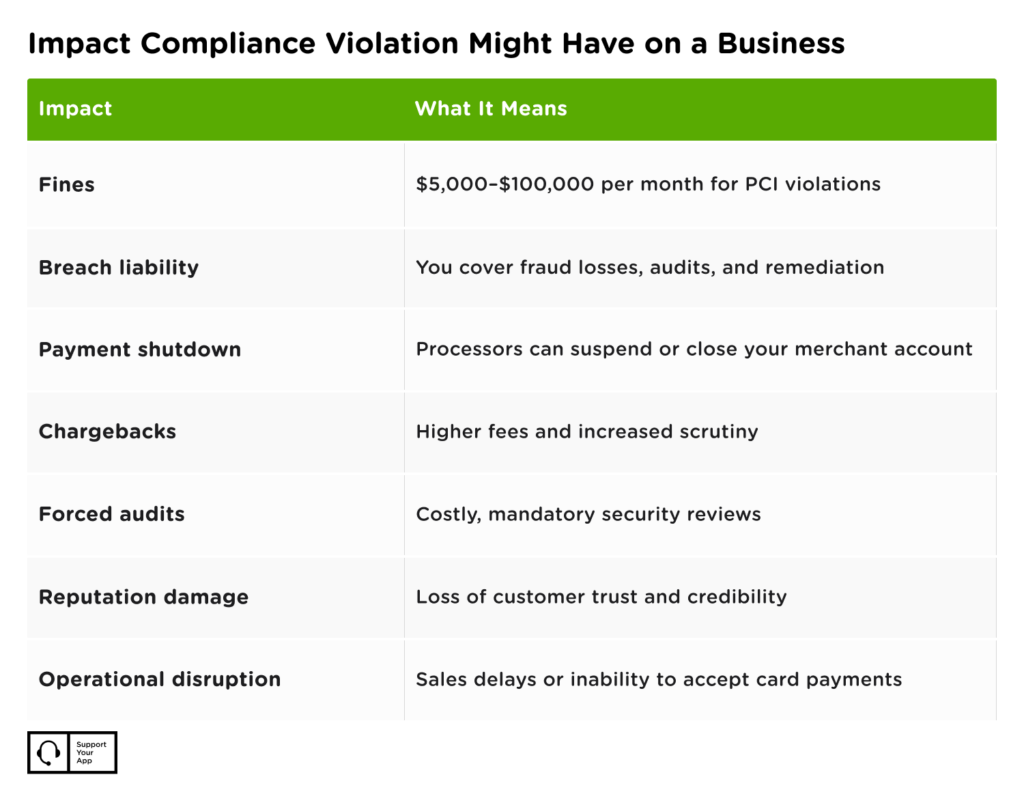
Why this matters: Operating without proper PCI DSS call center compliance isn’t just risky, it’s reckless. Non-compliance can result in fines up to $100,000 per month, plus liability for fraud losses, and potential loss of your ability to process card payments entirely.
Why PCI Compliance for Call Centers Matters
When you outsource customer service to a call center, you’re not outsourcing risk, you’re sharing it. Any security breach at your outsourcing provider becomes your problem instantly.
The Financial Reality
Data breaches cost companies an average of $4.88 million in 2024, according to the latest IBM’s Cost of a Data Breach Report. For small to mid-sized companies, that’s not just a setback — it’s existential. Beyond immediate costs, you’re looking at:
- Forensic investigations
- Legal fees and settlements
- Regulatory fines from card brands
- Customer notification expenses
- Credit monitoring services
- Lost business from damaged reputation
Customer Trust Is Everything
In fintech customer service, customer trust is your most valuable asset. One breach erodes years of relationship-building. Research from PwC shows 65% of consumers will take their business elsewhere after a data breach.
Your customers don’t care that the breach happened at your call center partner. They trusted you with their data, and you failed to protect it. That’s the harsh reality of business process outsourcing.
The Competitive Advantage
Here’s the flip side: robust contact center PCI compliance becomes a competitive differentiator. When prospects compare you against competitors, security can tip the scales. Being able to say “we partner with a PCI DSS Level 1 certified provider” sends a powerful message about your commitment to data protection.
Multi-Framework Complexity
For fintech and banking organizations, compliance extends beyond PCI alone. You’re coordinating adherence to GDPR for European customers, CCPA for California residents, HIPAA if you touch healthcare payments, and industry-specific regulations.
A PCI-compliant call center that also maintains ISO 27001 certification and HIPAA compliance simplifies your vendor management dramatically. Instead of juggling multiple providers with different security frameworks, you get comprehensive coverage in one partnership.
The bottom line: Call center security isn’t optional. It’s the foundation of everything else you’re trying to build.
What Happens if You Don’t Comply
PCI Compliance Requirements for Call Centers
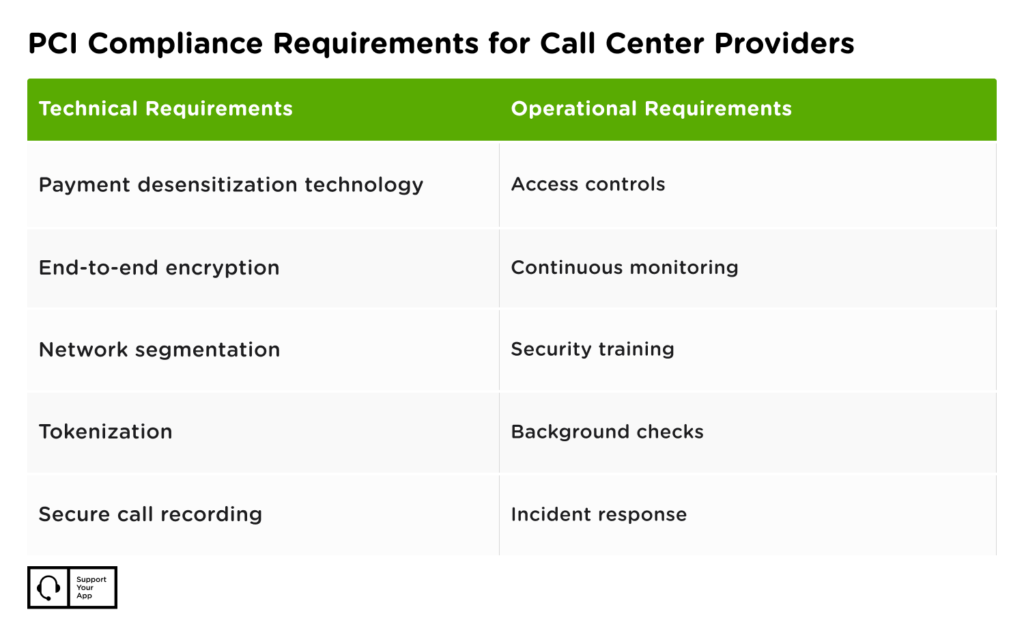
Understanding requirements helps you separate providers who talk a good game from those who actually deliver. These aren’t suggestions. They’re mandatory controls for any PCI-compliant call center worth considering.
Technical Requirements
Payment desensitization technology prevents agents from hearing credit card numbers as customers enter them. No ears, no leaks.
End-to-end encryption protects data in transit, at rest, and in use. AES-256 standards ensure payment information stays locked down, even if intercepted.
Network segmentation isolates payment systems from general infrastructure. This vault-within-a-vault approach limits PCI audit scope and slashes your attack surface.
Tokenization replaces real card numbers with random tokens. Even if breached, attackers get useless character strings instead of payment data.
Secure call recording with encrypted storage maintains quality monitoring without exposing cardholder data. Pause and resume technology stops recordings during payment capture.
Operational Controls You Can’t Skip
Your technical controls are only as strong as your operational procedures.
Access Controls:
- Role-based permissions limiting agent access to essential data only
- Multi-factor authentication for all administrative access
- Strict policies governing who views or processes payment information
Continuous Monitoring:
- Real-time detection of suspicious behavior patterns
- SIEM platforms correlating data across sources to catch threats
- Fraud prevention that’s proactive, not reactive
Security Training:
- Monthly awareness programs on social engineering and data handling
- Regular testing to verify comprehension
- Ongoing commitment, not a one-time checkbox
Background Checks:
- Criminal history screening for all payment data handlers
- Employment verification as standard
- Enhanced checks for healthcare and fintech sectors
Incident Response:
- Clear protocols defining notification chains
- Documented response timelines
- Specific action plans preventing crisis chaos
Reality check: These technical, operational, and documentation requirements create comprehensive security frameworks that protect customer data throughout every interaction.
What Are the Main PCI Compliance Requirements?
Top Call Centers With PCI Compliance
The following providers maintain verified PCI DSS Level 1 Service Provider certification and demonstrate consistent security excellence. Whether you’re in fintech, healthcare, or ecommerce, one of these PCI-compliant call center options will fit your needs.
#1 SupportYourApp
Overview: SupportYourApp specializes in secure customer and technical support for tech companies, with particular strength in fintech customer service and SaaS platforms. Founded in 2010, they’ve built comprehensive security infrastructure and have been delivering 24/7 AI-powered support to 250+ clients across 30+ countries. They understand how to scale support operations while maintaining ironclad security standards.
Compliance:
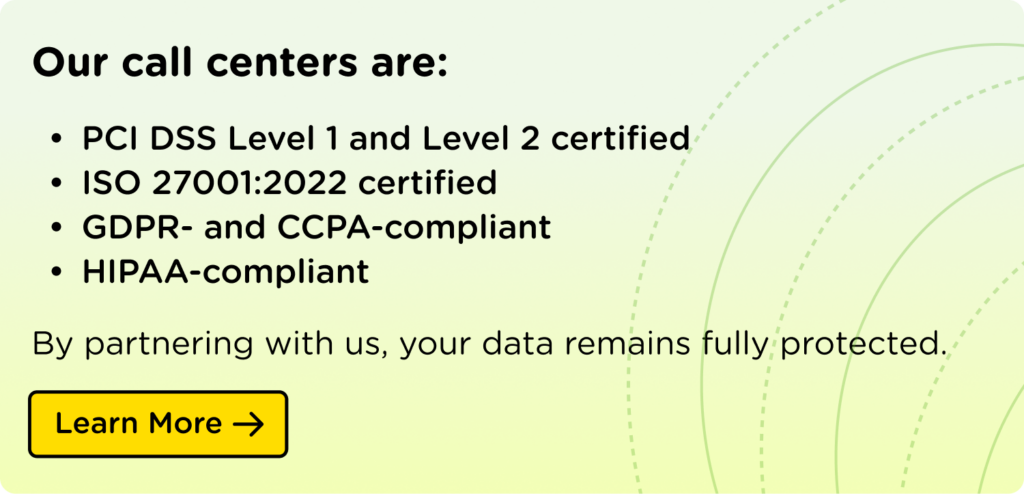
- PCI DSS Level 1 and Level 2 Service Provider certified
- ISO 27001:2022 certified for information security management
- GDPR- and CCPA-compliant for data privacy
- HIPAA-compliant for healthcare clients
- Regular third-party audits verify ongoing compliance
Best for: Tech startups, fintech companies, digital payment platforms, and SaaS businesses needing specialized technical knowledge combined with payment security. Their global team, fluent in 60+ languages, serves global customer bases while maintaining consistent security standards. Perfect for companies prioritizing CX alongside security.
Customer Ratings: 4.9/5 stars on Clutch based on 70+ verified reviews. Clients praise technical expertise, security protocols, and proactive communication.
Key Differentiator: SupportYourApp operates on either its own QCRM platform with built-in payment security or clients’ existing third-party CRMs. The platform choice is flexible — the security standards aren’t. This is PCI call center outsourcing that never compromises compliance, regardless of which system is used.

#2 Teleperformance
Overview: Operating 400+ contact centers across around 100 countries, Teleperformance serves enterprise clients across financial services, healthcare, ecommerce, and automotive industries. Their extensive language coverage and time zone flexibility make them ideal for global operations that need to scale rapidly.
Compliance:
- PCI DSS Level 1 certified
- ISO 37301:2021 and ISO 37001:2016 certified for compliance management and anti-bribery systems
- EU Binding Corporate Rules (BCRs) approved for secure, GDPR-compliant data transfers across global operations
Best For: Large enterprises requiring global scale, extensive language support (300+ languages), and 24/7/365 operations across multiple time zones with high-volume payment processing. Industry leaders in banking and fintech trust them with millions of transactions.
Customer Ratings: Teleperformance has around 4/5 stars on G2, with clients appreciating structured service delivery and operational support, though overall review volume is small.
Key Differentiator: Global footprint enables always-on support with consistent security standards worldwide, providing redundancy and business continuity that small providers can’t match.
#3 Foundever
Overview: Foundever operates 45 locations worldwide, serving mid-market and enterprise clients with an emphasis on digital transformation and omnichannel customer experiences.
Compliance:
- ISO 27001
- PCI Certification
- HITRUST/HIPAA
- SOC Type 1 and 2 Certifications
Best For: Mid-sized to large companies seeking balanced capabilities across customer experience innovation and security compliance. Particularly strong for retail and ecommerce brands that need seamless payment processing across channels.
Customer Ratings: Foundever holds a 4.3/5 star score on Gartner Peer Insights based on a few verified business reviews.
Key Differentiator: Strong digital integration allows seamless payment processing across voice, chat, email, and social channels while maintaining consistent security.
#4 Concentrix
Overview: Concentrix serves enterprise clients from 400+ locations in 70+ countries, handling over 8 billion customer interactions annually. Their particular strength lies in complex technical support and financial services, making them a powerhouse for companies that need to scale without compromising security.
Compliance:
- ISO/IEC 27001 certified
- PCI DSS-compliant controls
- ISO 22301 business continuity
- HITRUST & AI governance standards
Best For: Fortune 500 companies requiring industrial-scale capacity, sophisticated analytics, and integrated fraud prevention.
Customer Ratings: Concentrix has a 4.4/5 star rating on G2 based on a small number of business reviews.
Key Differentiator: Advanced analytics platform provides real-time fraud prevention and customer intelligence while maintaining PCI compliance.
#5 TaskUs
Overview: TaskUs focuses on growing tech companies in fintech, gaming, ecommerce, and social media. Operating from strategic locations with a culture emphasizing flexibility, innovation, and rapid deployment, they speak the language of digital-native companies.
Compliance:
- GDPR-compliant across EU operations
- Security practices aligned with ISO 27001, PCI DSS, and HITRUST CSF
- Certified AI governance and privacy standards for select AI solutions
- Enterprise-grade cybersecurity controls and monitoring
Best For: Fast-growing tech companies needing a PCI-compliant call center that matches their innovation pace.
Customer Ratings: 4.1/5 stars on G2 based on 10 verified business reviews, with clients noting positive service delivery and customer experience support.
Key Differentiator: Tech-first culture and modern technology stack resonate with digital-native companies, combining security expertise with technical depth that traditional call centers lack.
Call Centers PCI Compliance Checklist
When checking a potential provider for PCI DSS compliance, request their Report on Compliance (ROC). This is a comprehensive document that reflects the results of an organization’s PCI DSS audit, conducted by a qualified security assessor (QSA). All of the items below — infrastructure, operational controls, compliance documentation, and many more — are thoroughly reviewed and detailed in the ROC:
Infrastructure and Technology
- End-to-end encryption for all data states
- Network segmentation isolating payment systems from general infrastructure
- Tokenization capabilities that replace card numbers with random tokens
- Secure call recording with encrypted storage
- Intrusion detection and prevention systems monitoring for threats
- Multi-factor authentication for all administrative access
- Automated vulnerability management with regular scanning
Operational Controls
- Role-based access controls limiting data exposure
- Background checks for all payment data handlers
- Monthly security awareness training programs
- Clean desk policies preventing unauthorized data access
- Secure credential management systems
- Visitor management protocols for facility access
- Documented incident response procedures
- Vendor management programs for third-party risk
Compliance Documentation
- Security policies aligned with PCI DSS requirements
- Network diagrams showing complete data flows
- Regular vulnerability scan reports (quarterly minimum)
- Annual penetration test results
- Security training records for all employees
- Audit logs with minimum 1-year retention
Important Note: PCI DSS is not a certification that automatically covers an entire company. There is always a defined scope, which is why it’s important to understand exactly what was included in a provider’s PCI DSS compliance scope.
Common PCI Compliance Pitfalls When Outsourcing (and How to Avoid Them)
Even with a certified provider, compliance disasters happen. Here are the traps that catch businesses off guard and how to dodge them.
Assuming Certification Equals Permanent Compliance
PCI DSS certification isn’t a lifetime achievement award. It expires, and compliance can lapse between audits. Providers must maintain standards daily, not just during assessment periods.
The fix: Request quarterly attestations and audit schedules. Verify their certification is current, not from two years ago. Build contract clauses requiring immediate notification if certification lapses.
Relying on Shared Environments Without Proper Segmentation
Shared infrastructure saves money but creates risk. Without proper network segmentation, one client’s breach becomes everyone’s problem. Your payment data shouldn’t share space with less secure operations.
The fix: Demand proof of network segmentation. Ask for architecture diagrams showing how payment systems are isolated. Multi-tenant environments are fine — if segmentation is bulletproof.
Weak Operational Discipline
Technical controls mean nothing when humans bypass them. Access creep happens when permissions accumulate over time. Undocumented changes create security gaps. Skipped training sessions leave agents vulnerable to social engineering.
The fix: Audit operational procedures during vendor selection. How often do they review access permissions? Do they document every system change? Regular training should be mandatory, not optional.
Overpromising Scalability Without Secure Onboarding
Rapid scaling sounds great until you realize new agents haven’t completed security training. Background checks take time. Rushing onboarding for Black Friday volume creates compliance holes that attackers exploit.
The fix: Discuss scaling timelines upfront. Understand their onboarding process and minimum security training requirements. Build buffer time into peak season planning.
No Clear Incident Ownership
When breaches happen, finger-pointing wastes critical response time. Unclear ownership between you and your provider turns incidents into catastrophes.
The fix: Define incident response roles in contracts. Who investigates? Who notifies card brands? Who handles customer communication? Document everything before you need it.
Bottom line: Outsourcing transfers operations, not accountability. Stay vigilant.
Summary
Partnering with a PCI-compliant provider gives you more confidence that payment data security standards will be met, reducing your risk exposure and protecting customer trust. The five providers profiled maintain verified compliance while offering distinct capabilities suited to different business requirements — from fast-growing startups to Fortune 500 enterprises.
Beyond provider selection, implement proper security through comprehensive due diligence. Use the compliance checklist to verify technical controls, operational procedures, and documentation standards. Don’t skip steps. Every item on that checklist represents a real vulnerability that attackers exploit.
The right outsourcing provider becomes an extension of your team, not just a vendor processing calls. They understand your business, share your values, and protect your customers like they’re their own.
Final thought: In an era where data breaches make headlines daily, security isn’t expensive, it’s priceless. Choose wisely.
Frequently Asked Questions
What Is PCI Compliance for Call Centers?
PCI compliance for call centers means adhering to Payment Card Industry Data Security Standards when handling cardholder information through customer interactions. This requires technical controls like encryption and payment desensitization, operational procedures including access restrictions and security training, plus regular third-party audits validating effectiveness.
Think of it as a comprehensive security framework specifically designed for organizations that handle payment card data. It’s not optional if you process, store, or transmit card information.
What Companies Need PCI Compliance?
Any organization accepting, processing, storing, or transmitting payment card information must maintain PCI compliance. This includes retailers, e-commerce businesses, subscription services, financial institutions, healthcare providers, and any business process outsourcing partner processing customer payments.
If credit cards touch your business in any way, PCI compliance touches you. The only question is what level of compliance you need, which depends on transaction volume.
How to Choose a PCI Compliant Call Center?
Verify current PCI DSS Level 1 certification through their Report on Compliance. Don’t just ask if they’re certified — ask to see proof. Evaluate technical infrastructure including encryption, tokenization, and secure payment capture systems.
Assess operational controls like security training programs and incident response procedures. Consider industry experience, scalability potential, and cultural fit alongside security capabilities. Visit facilities if possible. Review client references from companies similar to yours.
Create a structured evaluation process rather than making decisions based on price alone. The cheapest option often becomes the most expensive when breaches occur.
Can I Switch Providers if My Current Call Center Loses Compliance?
Absolutely. And you should switch providers immediately if they lose certification. Include contract provisions allowing termination without penalty if compliance lapses occur. This isn’t negotiable; it’s essential protection for your business.
Maintain relationships with backup providers, enabling quick transitions during emergencies. Don’t wait until disaster strikes to develop contingency plans. Regular compliance verification through annual audits helps identify problems before they become critical.
If you need to switch providers because of compliance issues, move fast. Every day you remain with a non-compliant provider increases your risk exposure exponentially.
❤︎ Like it? — Share: Share on LinkedIn or Share on Facebook

Vitalii joined SupportYourApp as a System Administrator and later transitioned to lead the Security team, where he oversees the company’s safety by building strong defenses, driving security strategy, and ensuring our data and systems stay protected.
Posted on LinkedIn