


You’ve decided to outsource customer support, and now every provider pitches a different country. This guide compares onshore vs nearshore vs offshore delivery on cost, time zones, language, and risk. It’s for support and operations leaders at SaaS, fintech, and ecommerce companies who want a model they won’t regret in a year.
TL;DR
- Onshore teams work from your own country, which makes them the easiest to manage and the most expensive.
- Nearshore teams work from a nearby country with overlapping hours and lower rates than home.
- Offshore teams cost the least and cover nights naturally, but they ask more of your managers.
- Most growing support operations end up mixing models by channel, tier, or shift.
Most outsourcing talks start with price, but customers judge the outcome. In Deloitte Digital’s 2026 contact center survey, consumers estimated they spend 36% more with companies that give great service. That makes location a revenue decision as much as a budget one. If the setup is new to you, start with what a BPO call center is.
What Is Onshore BPO (Onshore Business Process Outsourcing)?
Onshore outsourcing means hiring a provider in your own country to handle customer support, back-office work, or sales calls. A US software company working with a US contact center is onshore. So is a German retailer using a support partner in Munich.
Onshore business process outsourcing is the closest thing to an in-house team without the recruiting and payroll. Agents know your holidays, consumer habits, and slang. For many buyers, that familiarity is worth a higher invoice, especially when the product is complex or the customers are regulated businesses.
Advantages of Onshore BPO
The biggest advantage is low friction. Agents work your hours, so training, quality reviews, and escalations to your product team happen during the same workday. Nobody waits until tomorrow to hear back about a bug. Site visits take a short flight instead of a long-haul trip.
Language and context come built in. A local agent catches regional phrasing, sarcasm, and the reason behind an angry tone. Compliance is simpler, too, because customer data stays inside one legal system. Some public sector and defense contracts require domestic support outright.
Limitations of Onshore BPO
Cost is the main drawback. Labor in the US, UK, Canada, and Western Europe costs far more per hour than in Latin America or South-East Asia. Tight local job markets push up wages and turnover, which makes sudden ticket spikes hard to staff.
Round-the-clock coverage gets expensive fast. An onshore BPO provider has to pay premiums for night and weekend shifts, and few local candidates want them. Multilingual support is harder, too, since one domestic labor market rarely covers every language your customers speak.
What Is Nearshore BPO?
Nearshore outsourcing places work with a provider in a neighboring or nearby country, usually within a few time zones of your own. For US companies, that often means Mexico, Colombia, or Costa Rica. Western European companies tend to look at Central and Eastern Europe or North Africa.
Nearshore business process outsourcing falls between the other two models on cost, distance, and management effort. You get lower rates than at home while keeping most of the working day in common. That balance makes it a common first step for new outsourcers.
Advantages of Nearshore BPO
Time zone overlap is the headline benefit. Bogotá runs on the same clock as New York for half the year, and Mexico City runs on Central time all year. Your leads can join the provider’s huddles, review calls the same day, and fix process gaps before they turn into a backlog.
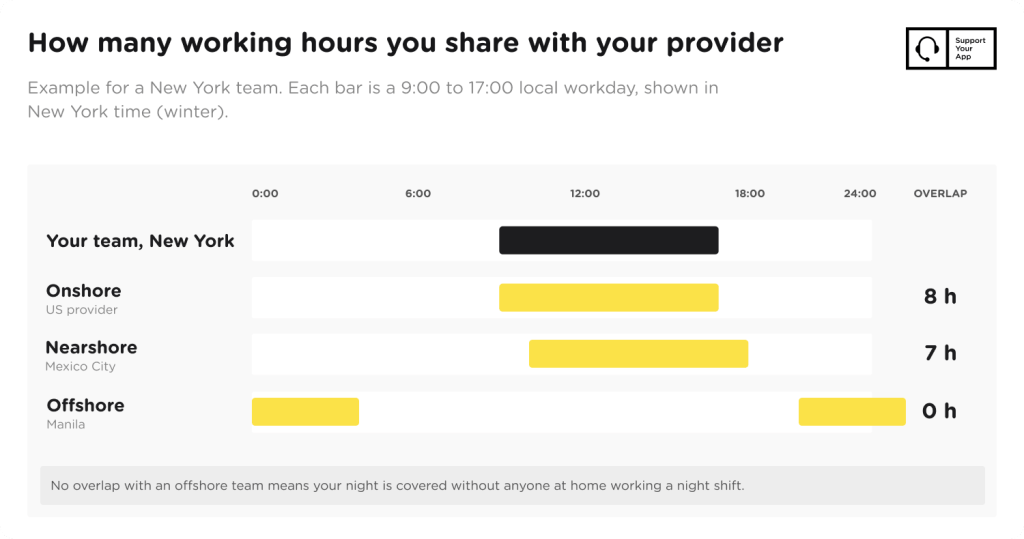
A nearshore BPO partner cuts costs without a big jump in distance. Labor rates in Latin America and Eastern Europe run well below US and Western European levels. Cultural closeness helps as well. Many Latin American agents speak English and Spanish, which suits companies serving bilingual customers across North America.
Limitations of Nearshore BPO
A nearshore team still costs more than an offshore one. Popular hubs also attract many outsourcers, so competition for strong bilingual agents drives up wages and attrition. Currency swings, local labor reforms, and political changes can shift costs mid-contract, so ask how a provider handles them.
Overnight coverage stays a gap, since a nearby country sleeps when you do, so 24/7 support still needs night shifts or a second location. Data protection needs attention, too. An EU company sending customer data to a provider in Morocco needs GDPR transfer safeguards, such as standard contractual clauses.
What Is Offshore BPO?
Offshore outsourcing moves work to a provider in a distant country, often on another continent and many time zones away. The Philippines and India are the best-known destinations for US and UK companies, thanks to large English-speaking workforces. South Africa and Egypt are growing alternatives.
Advantages of Offshore BPO
Offshore providers offer the lowest cost per hour, often a fraction of onshore rates. That gap lets a company fund more agents, longer coverage, or a wider set of channels on the same budget. For high-volume, repeatable work like order tracking or password resets, the savings add up quickly.
Offshore also wins on speed of hiring, since large markets can staff dozens of agents within weeks for a launch or holiday peak. Their workday falls during your night, which gives you follow-the-sun support without asking anyone at home to work graveyard shifts.
Limitations of Offshore BPO
The time difference makes live oversight hard. Your managers may sleep through the provider’s busiest hours, so feedback loops slow down and small problems spread. Accents and idioms can add friction on voice calls, even with fluent agents, especially on emotional issues.
Weak service also costs revenue. Qualtrics XM Institute found that 34% of consumers reduce spending with a company after a negative experience. Data handling needs extra checks as well, so vet a provider’s call center data security practices and certifications before sharing customer records.
What Is the Difference Between Onshore, Nearshore and Offshore BPO?
The difference between onshore nearshore offshore BPO comes down to distance from your customers. Distance sets the hourly rate, the shared working hours, the cultural gap, and the data rules you face. This table compares the three models side by side.
| Criteria | Onshore BPO | Nearshore BPO | Offshore BPO |
| Location | Same country as you | Nearby country, few time zones away | Distant country, often another continent |
| Cost level | Highest | Moderate | Lowest |
| Time zone overlap | Full | Most of the workday | Little or none |
| Language and cultural fit | Native, closest fit | Strong, some regional gaps | Good, wider cultural gap |
| Scalability | Limited by local labor market | Moderate | High, large talent pools |
| Data handling and regulation | Single legal system | Cross-border rules may apply | Cross-border transfer safeguards needed |
| Management effort | Low | Moderate | Highest |
| Best fit | Complex, regulated, or premium support | Live channels needing daytime overlap | High-volume tickets and 24/7 coverage |
Read the table as tradeoffs, not a ranking. Each column wins on some rows and loses on others. Onshore vs nearshore vs offshore comes down to which cost you’d rather absorb: a higher invoice, shift gaps, or extra management time.
How to Choose the Right BPO Model
Start with what your customers need from each conversation, then weigh budget and risk. A model that saves money but slows replies on your busiest channel will cost more in churn than it saves on payroll. Budget matters, but it works best as the tiebreaker.
Treat any offshore vs nearshore vs onshore outsourcing decision as a channel-by-channel choice, not one company-wide verdict. Phone support for anxious banking customers needs different agents than email replies about shipping delays. Map your ticket mix first. For the slices where trust and context matter most, onshore business process outsourcing often earns its higher price.
Questions to Answer Before Choosing
Answer these with your support data in hand:
- Which channels carry most of your volume, and which ones need a live conversation?
- When do your customers contact you, and do you need overnight or weekend coverage?
- Which languages and regional accents do your customers expect to hear?
- Does your industry restrict where customer data can be stored or processed?
- How much time can your managers spend on training, calibration, and quality reviews?
- What budget per resolved ticket can you sustain over the next two years?
Hybrid BPO Models
A hybrid BPO model splits support across two or three delivery locations, each handling the work it suits best. A common setup puts tier 1 chat and email offshore, bilingual voice nearshore, and escalations or regulated accounts with an onshore team.
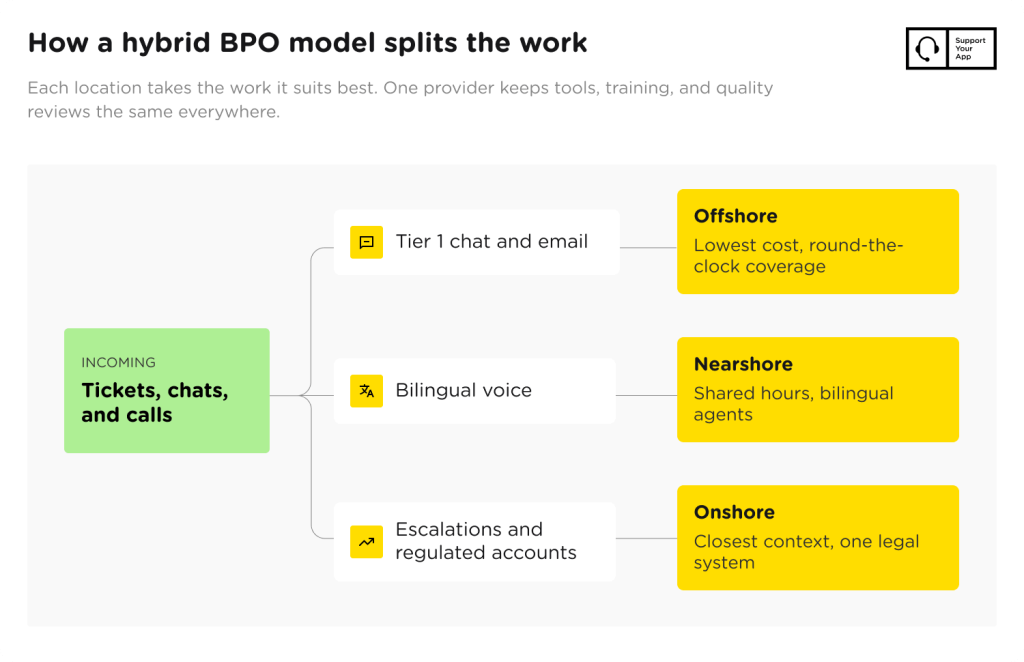
Companies rarely face a clean nearshore/offshore/onshore choice once volume grows. The tradeoff is coordination: separate vendors mean separate tools, reports, and quality standards. Working with one provider that runs several hubs keeps processes, training, and reporting consistent across locations.
Which BPO Model Fits Customer Support?
The best model for customer support depends on channel, complexity, and hours. Voice support for customers in your own market often works best onshore or nearshore, where accents and hours match. Asynchronous channels like email and ticketing tolerate distance well, so offshore teams handle them efficiently.
Regulated industries such as healthcare and fintech often keep sensitive cases onshore or with certified partners. Onshore BPO also suits premium tiers, where a single lost account outweighs the labor savings. For 24/7 coverage on a startup budget, an offshore team with a nearshore or onshore escalation layer usually gives the best balance.
Onshore vs Nearshore vs Offshore: Next Steps for Your Support Team
The right location is the one that matches your customers’ languages, hours, and risk level. SupportYourApp runs support from 8 international hubs across Latin America, Europe, Africa, the Middle East, and South-East Asia. That spread lets one provider staff nearshore and offshore teams under a single set of processes.
Security stays consistent across hubs, backed by PCI DSS and ISO/IEC 27001 certification plus GDPR, CCPA, and HIPAA compliance. If you’re weighing options for call center outsourcing, talk to an expert about which hubs fit your customers and budget.