

eCommerce brands lose customers over slow replies faster than almost any other industry. One bad support ticket can undo months of marketing spend. This guide covers the top 8 ecommerce BPO outsourcing services for 2026, their pricing, and how to match one to your order volume.
TL;DR
- A full ecommerce BPO services contract covers far more than tickets: returns, chargebacks, and catalog work often live under the same roof.
- Pricing swings widely by delivery region, and the best provider depends on your order volume and compliance needs.
- Eight providers stand out in 2026, from enterprise giants to boutique, values-driven teams.
- The comparison table and cost breakdown below help you shortlist a partner in minutes, not weeks.
Nearly one in five online orders comes back to the retailer. The National Retail Federation and Happy Returns put the 2025 online return rate at 19.3 percent, well above the all-channel average of 15.8 percent. That single stat explains why so many ecommerce brands now outsource more than tickets. Returns, refunds, and disputes eat internal bandwidth fast.
What Are eCommerce BPO Outsourcing Services?
eCommerce BPO outsourcing services hand off the operational work behind running an online store to a third-party provider. It is the model that lets brands hand over time-consuming digital operations, like customer support and order fulfillment, to specialized vendor teams. That includes customer support, but it usually goes further into order management, back-office tasks, and marketplace operations.
A dedicated team handles the volume, so your internal staff can focus on merchandising, marketing, and growth. Most providers bill per hour, per agent, or per contract, depending on team size and delivery location. This is what people mean by ecommerce customer service BPO: a full team, built to scale with your order volume.
What eCommerce BPO Covers Beyond Customer Support
Full agreements usually manage order processing, returns, refunds, dispute resolution, and chargeback protection.
A full ecommerce BPO services contract often includes order processing, returns, refunds, and dispute handling, plus chargeback management. Many providers also maintain product catalogs, manage marketplace accounts on Amazon or eBay, run general back-office tasks, and staff trust and safety review.
Top 8 eCommerce BPO Companies in 2026
These eight providers span enterprise-scale BPOs, mid-market specialists, and boutique, values-led teams. When you line up BPO ecommerce providers side by side, pricing, compliance depth, and account size vary enough that the right pick for BPO for ecommerce depends on your monthly order volume and channel mix.
1. SupportYourApp
SupportYourApp provides 24/7 human-led, AI-powered customer support outsourcing for ecommerce, SaaS, and fintech brands, built on native-language coverage. Its SupportResponse and SupportVoice AI agents handle routine tickets and calls while human agents manage escalations.
- Best for: ecommerce brands that need compliance depth plus native-language support without a six-week onboarding cycle
- Locations and headcount: 8 global hubs (Latin America, Central Europe, Eastern Europe, North Africa, West Africa, Southern Africa, Middle East and South-East Asia), 1,500+ team members
- Compliance: PCI DSS Level 1 and Level 2, ISO 27001, GDPR, CCPA, HIPAA
- Pricing model: Custom, based on volume and channel mix
Pros: Native and near-native agents across 60+ languages, an AI-human hybrid model for ticket deflection, compliance built in for regulated niches.
Cons: Not the largest headcount for brands needing 500+ concurrent seats. Custom pricing only.
Verdict: A strong fit for mid-market ecommerce brands that need multilingual coverage and can't compromise on compliance.
2. Teleperformance
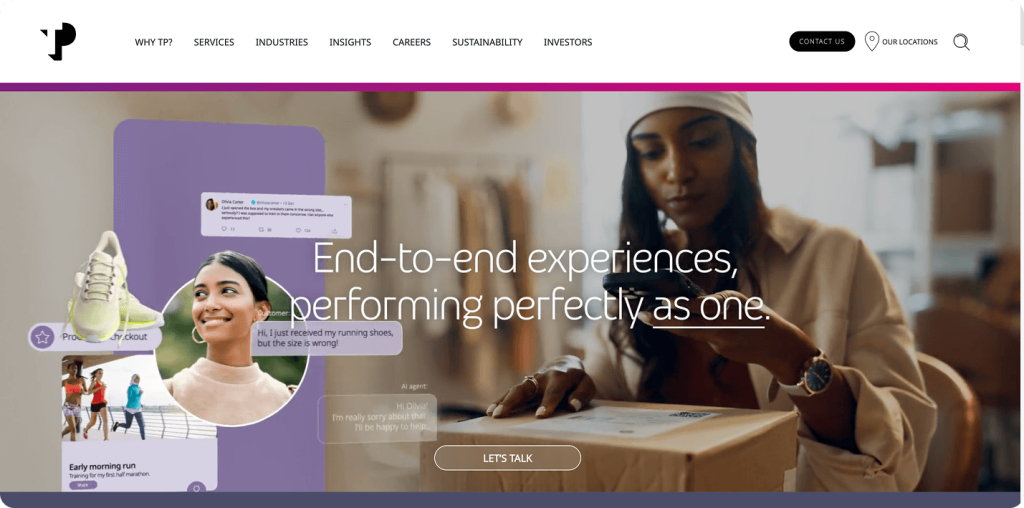
Teleperformance, founded in Paris in 1978 and rebranded TP in 2025, is the largest customer support outsourcing company in the world by headcount. It runs omnichannel support across voice, chat, email, and social from delivery centers spanning nearly 100 countries.
- Best for: Large enterprise retailers with fragmented, multi-region language needs
- Locations and headcount: 95+ countries, roughly 485,000 employees
- Compliance: Enterprise-grade certifications including PCI DSS and ISO 27001, standard across its regulated-industry accounts
- Pricing model: Custom, seat-based contracts, typically 50+ seat minimums and 1 million dollar-plus annual commitments
Pros: Widest language coverage in the industry, a deep bench for holiday surge staffing, decades of retail experience.
Cons: Minimum contract size shuts out smaller stores. Account management can feel distant.
Verdict: Built for enterprise retailers, overkill for a store doing under 50,000 monthly orders.
3. Foundever
Foundever (formerly Sitel Group) founded in 1985, handles more than 9 million customer conversations a day for over 800 brands. Retail and ecommerce sit among its named core verticals, backed by a Global Leader ranking in the Everest Group's 2025 PEAK Matrix.
- Best for: Retailers needing genuine surge capacity during Q4 and other peak periods
- Locations and headcount: 45+ countries, roughly 150,000 associates
- Compliance: PCI DSS, ISO 27001, and standard enterprise data-protection certifications
- Pricing model: Custom, enterprise-tier contracts
Pros: Deep retail vertical expertise, 60+ language coverage, proven scale for seasonal spikes.
Cons: Account responsiveness can vary at this size. Better suited to larger programs.
Verdict: A safe enterprise choice when holiday volume dwarfs your regular-season traffic.
4. Fusion CX
Fusion CX, founded in 2004 and headquartered across Kolkata and the U.S., delivers customer experience and back-office services across telecom, BFSI, healthcare, and retail. Recent acquisitions of Skycom and Sequential Technology expanded its Latin America and U.S. healthcare footprint.
- Best for: Mid-market ecommerce brands wanting a global footprint without enterprise minimums
- Locations and headcount: 40+ delivery centers across 15 countries, roughly 12,500 employees
- Compliance: Standard BFSI-grade data protection and GDPR alignment
- Pricing model: Custom, mid-market contracts
Pros: 28-plus languages, an active acquisition strategy adding nearshore capacity, cross-industry experience.
Cons: Less ecommerce-specific brand recognition than dedicated ecommerce BPOs.
Verdict: Worth a look for brands that want global reach at a mid-market price.
5. Alorica
Alorica, founded in 1999 and headquartered in Irvine, California, blends human agents with its Alorica IQ AI platform across roughly 17 countries. It serves 250-plus brands across retail, financial services, and healthcare.
- Best for: Brands wanting an established BPO with an AI layer already built into the stack
- Locations and headcount: Around 17 countries, headcount reported between 80,000 and 100,000 depending on the source
- Compliance: PCI DSS and standard financial-services-grade certifications
- Pricing model: Custom, enterprise contracts
Pros: A long track record with Fortune 500 retail clients, AI-assisted workflows for high-volume queues.
Cons: Recent headcount decline reported by workforce data providers.
Verdict: Solid for established retailers already running at enterprise scale.
6. PartnerHero
PartnerHero, founded in 2014 in Boise, Idaho and now backed by Crescendo's AI platform, built its reputation staffing startups and scaling DTC brands. It holds B Corp certification and prices per hour or per dedicated agent.
- Best for: Startups and scale-ups that want to start small and expand month over month
- Locations and headcount: 19 hubs worldwide, just over 1,100 employees
- Compliance: SOC 2 and GDPR alignment through the Crescendo AI platform
- Pricing model: Shared teams from $10/hour, dedicated teams around $1,975/month per agent
Pros: A low barrier to entry for smaller stores, B Corp values-based hiring, rolling three-month contracts.
Cons: Smaller scale than the enterprise players on this list.
Verdict: A practical starting point for a DTC brand outsourcing support for the first time.
7. Boldr
Boldr, founded in 2017 and headquartered in Santa Monica, California, is the largest globally distributed B Corp-certified BPO, with a B Impact Score of 97.5. Its ecommerce client roster includes DTC brands like Caraway and UrbanStems.
- Best for: Mission-driven DTC brands that want vendor values to match their own
- Locations and headcount: Philippines, Mexico, South Africa, and Canada, roughly 1,500 team members
- Compliance: B Corp certified governance, SOC 2 alignment
- Pricing model: Custom, based on team size and services
Pros: Verified social and environmental performance, a strong DTC reference list, above-average agent retention.
Cons: A smaller footprint than global enterprise BPOs.
Verdict: The right call for a brand where ESG values genuinely matter to leadership and customers.
8. Peak Support
Peak Support, founded in 2015 and acquired by Ubiquity in September 2025, built its name on quality over lowest cost: 95 percent QA scores and agents averaging eight years of experience. Client tenure averages five years, unusually long for the industry.
- Best for: ecommerce and SaaS brands prioritizing consistency over the cheapest hourly rate
- Locations and headcount: USA, Philippines, Colombia, and Eastern Europe, a headcount in the low thousands
- Compliance: SOC 2 and HIPAA-ready operations for healthcare-adjacent clients
- Pricing model: Custom, quality-tiered contracts
Pros: A long average client tenure that signals genuine partnership, low attrition versus industry norms.
Cons: Smaller scale limits fit for the largest enterprise programs.
Verdict: Good fit for brands that got burned by a cheap, high-turnover provider before.
Full Comparison Table
Use this table to shortlist providers by scale, compliance, and specialty before booking a call with any of them.
| Company | Services Covered | Global Presence | Employees | Compliance | Best For | Year Est. |
| SupportYourApp | Customer support, AI agents, CX, back office | 8 hubs | 1,500+ | PCI DSS, ISO 27001, GDPR, CCPA, HIPAA | Compliance-first eCommerce and SaaS brands | 2010 |
| Teleperformance | Omnichannel support, back office | 95 countries | ~485,000 | PCI DSS, ISO 27001 | Enterprise-scale retailers | 1978 |
| Foundever | CX, retail support, digital operations | 45 countries | ~150,000 | PCI DSS, ISO 27001 | Peak-season surge capacity | 1985 |
| Fusion CX | CX, BPO, back office | 15 countries | ~12,500 | GDPR alignment | Mid-market global reach | 2004 |
| Alorica | CX, AI-assisted support | ~17 countries | 80,000-100,000 | PCI DSS | Established enterprise retail | 1999 |
| PartnerHero | Support, QA, trust and safety | 19 hubs | ~1,100 | SOC 2, GDPR | Startups and DTC scale-ups | 2014 |
| Boldr | Support, back office, data annotation | 4 countries | ~1,500 | B Corp, SOC 2 | Mission-driven DTC brands | 2017 |
| Peak Support | Support, sales ops, BPO | 4 regions | 1,000+ | SOC 2, HIPAA-ready | Quality-first ecommerce and SaaS | 2015 |
These providers split into three groups. Global scale players like Teleperformance, Foundever, and Alorica handle high-volume enterprise retail. Mid-market specialists such as Fusion CX, PartnerHero, Boldr, and Peak Support suit fast-growing DTC brands. SupportYourApp pairs compliance depth with AI-agent capability for stores handling sensitive payment or customer data.
Match your pick to order volume first, then confirm certifications cover your specific compliance needs.
Advantages and Disadvantages of Outsourcing for eCommerce
Outsourcing solves real problems, but every advantage carries a trade-off worth weighing before you sign a contract.
| Advantage | What It Means in Practice | The Trade-Off |
| Lower cost per resolved ticket | Offshore and nearshore rates run well below the fully loaded cost of an in-house hire | Cheaper rates can mean higher agent turnover if the provider underpays |
| 24/7 coverage without night shifts | Global hubs cover time zones your internal team can't staff alone | Coordination across time zones adds a layer of account management |
| Peak-season flexibility | Providers can scale headcount up for Q4 and back down after | Fast-scaled teams need extra QA during ramp-up |
| Built-in compliance infrastructure | Established providers already hold PCI DSS, ISO 27001, and GDPR certifications | Verifying a provider's actual compliance posture takes real due diligence |
| Access to specialized workflows | Returns, chargebacks, and marketplace disputes get handled by trained specialists | Brand voice and product nuance take longer to transfer than basic ticket handling |
Weighing these trade-offs comes down to cost in the end. Before you commit to a provider, it helps to know what these services actually cost and where the pricing models differ.
How Much Do eCommerce BPO Services Cost?
Cost depends almost entirely on delivery location and pricing model. Enterprise contracts and specialized, dedicated-agent setups sit at opposite ends of the range.
Rates shift based on channel mix, language requirements, and coverage hours. SupportYourApp structures pricing by team size and complexity rather than publishing flat rates, so brands request a custom quote before a sales call.
How to Choose an eCommerce BPO Partner
Weigh these factors before signing with any provider on this list.
- Order volume and peak-season swing: A brand doing 10,000 monthly orders needs a different partner than one doing 500,000. The biggest names on this list aren't always the right fit for a smaller program.
- Compliance certifications: Check these before anything else if you handle payment data directly. PCI DSS and GDPR should be table stakes.
- Agent tenure and training time: A provider with 60 percent annual attrition will cost you more in re-training than a slightly pricier partner with agents who stick around for years.
- Pricing model fit: Confirm it matches how your ticket volume actually behaves. Per-hour pricing punishes low-volume months. Per-ticket pricing can get expensive during a viral spike
How SupportYourApp Helps eCommerce Teams
SupportYourApp provides ecommerce customer service outsourcing built around dedicated and shared teams that combine native-language agents with AI tools like SupportResponse for routine tickets. That mix keeps first response times fast without losing the human judgment returns and disputes actually need.
Compliance comes built in for brands handling payment data or operating across the EU and UK. PCI DSS, ISO 27001, and GDPR certification shorten the due diligence conversation.
If your team already researched the best AI customer service agents for ecommerce and wants the human side handled with the same rigor, a good next step would be to connect with us and request a custom quote.

Summary
These providers now cover far more than customer tickets, stretching into returns, chargebacks, and marketplace operations. The right partner depends on your order volume, compliance needs, and how much peak-season flexibility you actually need. Compare these options against your own numbers before signing anything.