


If you run support for an online store, you already know the pattern. A promotion goes live, ticket volume spikes, and hiring can't keep pace. AI for ecommerce customer service exists to close that gap, but not all of it works well.
The difference usually comes down to which tool you choose, since some platforms are built for retail workflows and others just aren't.This article compares the best AI customer service agents for ecommerce so you can pick the one that fits your store.
Full disclosure: SupportResponse is our own product. It's included here because it fits the criteria below. Judge it against the same list of criteria as the other seven.
TL;DR
- Eight AI agents compared: SupportResponse, Zendesk AI, Gorgias, Yuma AI, Ada, Tidio's Lyro, Siena AI, and Netomi.
- They split by fit: Shopify-native tools, helpdesk-agnostic layers, enterprise platforms, and SMB-friendly chatbots.
- Pricing models vary wildly, from per-resolution fees to flat platform costs to sales-gated contracts.
- None of them replace a human team entirely. The question is how much routine load they take off it.
A Gartner survey found that 91% of customer service leaders feel pressure from executive leadership to implement AI in 2026. That pressure is real, but so is the risk of picking a tool built for a different store than yours.
Quick Comparison: Best AI Customer Service Agents for eCommerce
| Tool | Type | Languages | Channels | Existing Helpdesk Integrations | Human Escalation | Compliance | Data Used to Train External Models | Pricing Model | Time to Deploy |
| SupportResponse | Autonomous agent + human backup | 45 | Chat, app, WhatsApp, email, social | Yes | Yes | ISO 27001, PCI DSS L1, GDPR, CCPA, HIPAA | No | Custom quote | Minutes |
| Zendesk AI | Native helpdesk AI | Varies | Chat, email, social | Is the helpdesk | Via handoff | Enterprise-grade | Not disclosed | Seat-based, plus usage fees | Weeks |
| Gorgias | Shopify-native helpdesk + AI | Varies | Chat, email, social | Is the helpdesk | Yes | EU hosting option | Not disclosed | Volume-based | Days to weeks |
| Yuma AI | AI layer on your helpdesk | Varies | Chat, email | Yes | Yes | Not published | Not disclosed | Usage-based | Days |
| Ada | Enterprise AI platform | Multiple | Chat, email, voice, SMS, social | Yes | Yes | SOC 2, enterprise review | Not disclosed | Enterprise contract | 8 to 16 weeks |
| Tidio (Lyro) | SMB AI chatbot | Varies | Chat, email | Yes | Limited | SOC 2 Type II, GDPR | Not disclosed | Tiered plans | Under an hour |
| Siena AI | DTC-focused AI CX layer | Varies | Chat, email, WhatsApp, SMS, social | Yes | Yes | SOC 2 Type II, HIPAA | Uses third-party model providers | Platform fee plus usage | Weeks |
| Netomi | Enterprise agentic AI | 100+ | Voice, chat, email, SMS, social | Yes | Yes | Enterprise-grade | Not disclosed | Custom quote | Months |
What Is an AI Customer Service Agent for eCommerce?
Not every tool that claims this label actually acts on your store's data. The best AI agents for customer service share one trait: they read a message and check the data behind it before responding. It answers or resolves the request without a person typing the reply. It covers order tracking, returns, refunds, shipping questions, and basic product questions. Complex cases still route to a human.
How We Evaluated These AI Agents
We scored each tool against seven criteria that matter for a store, not a generic support team:
- Integration: whether it works inside your current helpdesk or forces a switch
- Order data handling: read-only lookups versus real actions like refunds
- Coverage: languages and channels supported, including WhatsApp and social DMs
- Escalation: whether a human gets full context when a case gets handed off
- Pricing: how transparent the fees stay when per-resolution costs swing with volume
- Compliance: how it handles customer and payment data
- Deployment speed: the real timeline, not the marketing one
SupportYourApp has run ecommerce support for 16 years, working with 250+ companies across SaaS, fintech, and retail. That's the lens behind this list, alongside our own Support Intelligence Hub research into what these platforms deliver.
The 8 Best AI Customer Service Agents for eCommerce in 2026
Here are the best AI agents for ecommerce customer service, ranked by who they actually fit, not by feature count alone.
1. SupportResponse by SupportYourApp - Best for Brands That Need Autonomous AI Plus a Human Escalation Team
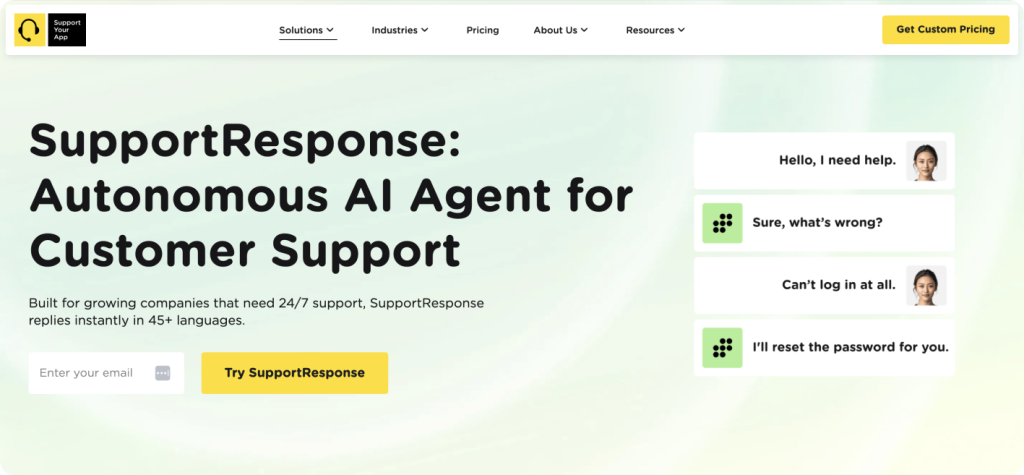
SupportResponse is an AI customer support agent trained on your knowledge base and past tickets. It resolves Tier 1 issues end to end, then hands complex cases to a real support team with full context attached.
Best for: Stores that want AI speed without losing a human safety net.
Key capabilities:
- 45 languages with automatic detection
- Works inside your existing helpdesk or CRM, no migration required
- Average resolution time drops to 5 min, up to 80% ticket deflection reported by ecommerce clients
- Never trains outside models on your customer data
Pros:
- Real human team behind every escalation
- Live in minutes, no developer needed
Cons:
- Pricing is quote-based, so you won't see a number without a call
- Built for real ticket volume, less suited to a handful of tickets a week
Verdict: Works best for teams that want AI handling the routine tickets, with people covering everything else.
2. Zendesk AI - Best for Enterprise Stacks
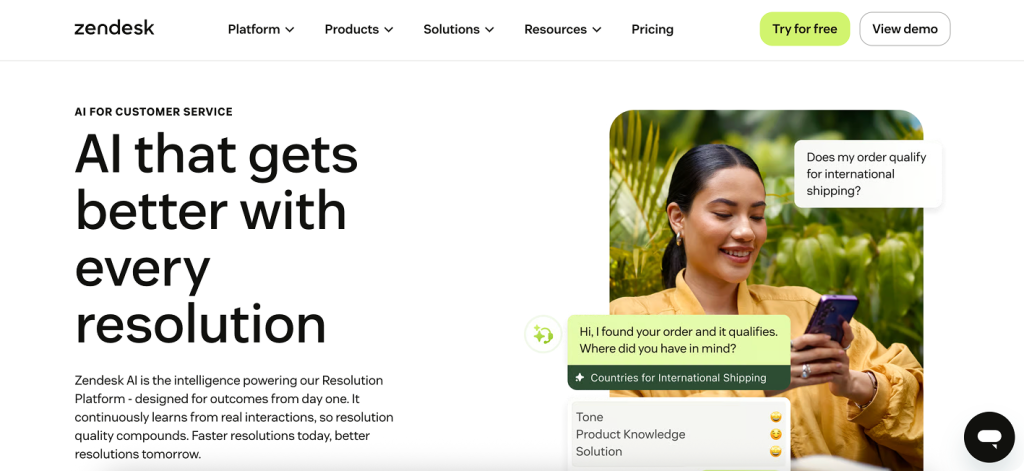
Zendesk's Advanced AI Agents, built on its 2024 Ultimate.ai acquisition, resolve conversations inside Zendesk Suite. Copilot sits alongside as a separate agent-assist add-on.
Best for: Teams already running Zendesk who want AI layered onto the ticketing system they use daily.
Key capabilities:
- Intent detection and automated triage
- Custom flow builder for AI Agent behavior
- Copilot draft replies for human agents
Pros:
- No new platform to learn
- Mature analytics and reporting
Cons:
- Advanced AI adds a per-resolution charge on top of Suite seats and the Copilot fee, with the total varying by usage.
- The included Essential tier acts more like FAQ deflection than real resolution
Verdict: Worth it if Zendesk is already your system of record and the per-resolution cost pencils out.
3. Gorgias - Best for Shopify-Native Support
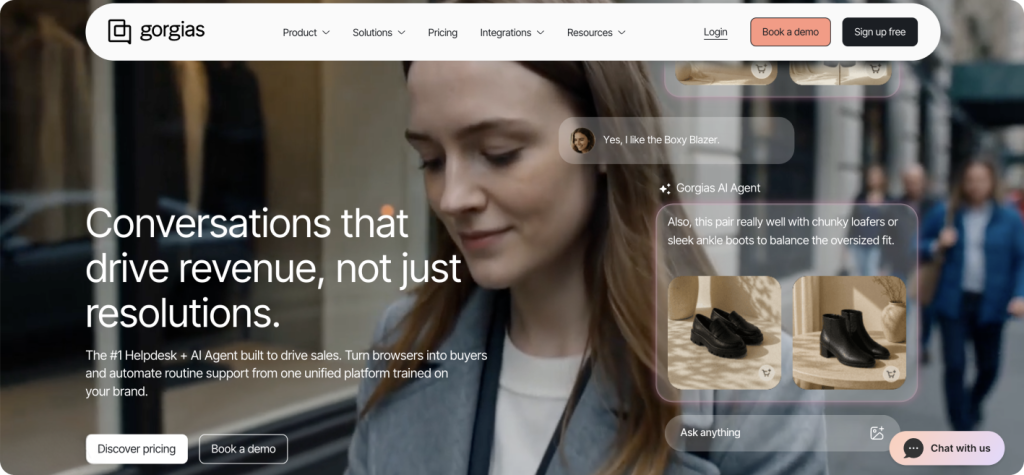
Gorgias is an ecommerce-first helpdesk and Shopify Premier CX Partner. Its AI Agent reads live order data and can refund, cancel, or edit orders directly inside the ticket.
Best for: Shopify stores where a large share of tickets need a real order action instead of a plain answer.
Key capabilities:
- Support Agent and Shopping Assistant modes
- Native cart, order, and customer history in every conversation
- Live chat plus email and social channels
Pros:
- The deepest Shopify order integration in this list
- Can sell as well as resolve
Cons:
- AI Agent resolutions bill separately, and that same resolution also counts as a helpdesk ticket.
- Costs climb fast during high-volume seasons like BFCM
Verdict: Earns its premium once real order actions make up a meaningful share of your ticket mix.
4. Yuma AI - Best as an AI Layer on an Existing Helpdesk
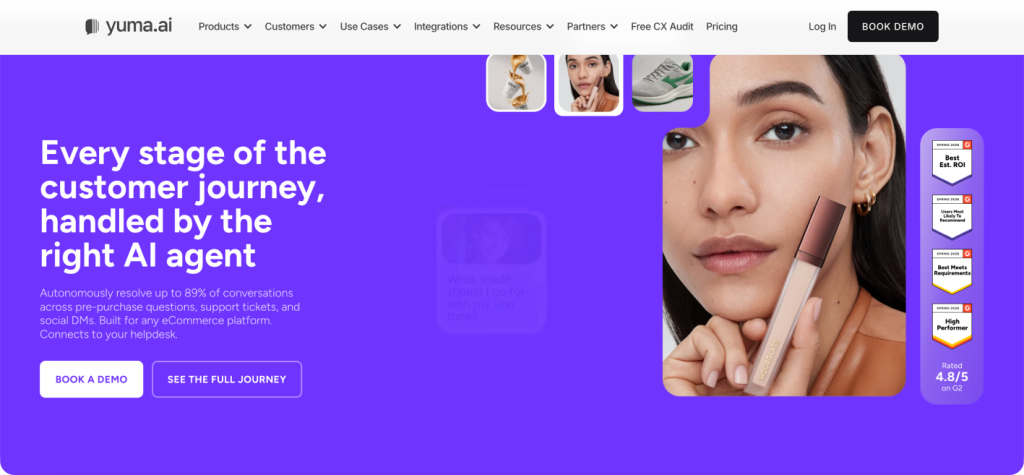
Yuma AI plugs into Gorgias, Zendesk, Kustomer, Gladly, Front, or Re:amaze rather than replacing them. It resolves WISMO, returns, refunds, and address changes from inside your current ticket thread.
Best for: Merchants who like their current helpdesk and just want an AI resolution layer added on top.
Key capabilities:
- Retail-specific defaults for order and returns intents
- Policy guardrails you set by market or product line
- 30-day free trial before committing
Pros:
- No re-platforming required
- Built specifically for retail ticket patterns
Cons:
- Pricing isn't published upfront and needs a sales conversation to confirm
- Narrow focus means less value if most of your tickets aren't order-related
Verdict: A solid fit if you like your helpdesk and only need the resolution layer added on top.
5. Ada - Best for Enterprise Governance
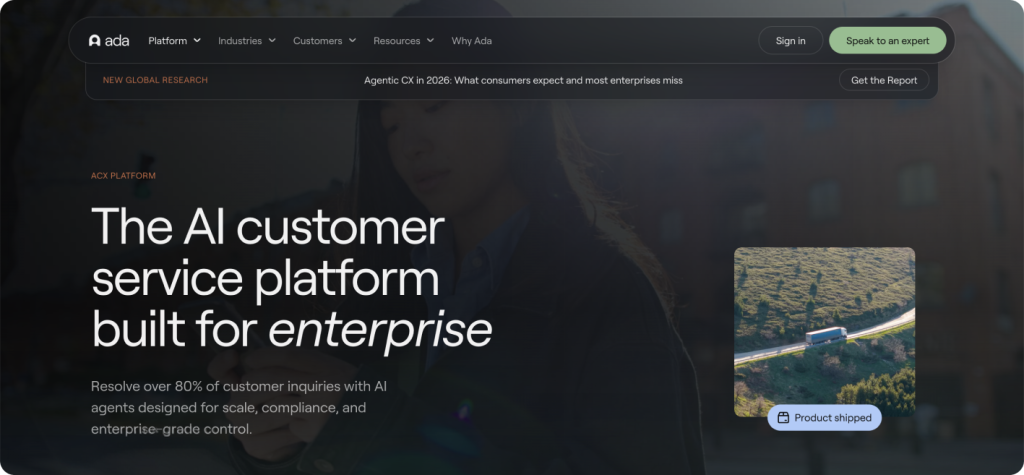
Ada is a Toronto-built "Agentic Customer Experience" platform for large support operations. Its Unified Reasoning Engine runs chat, email, voice, and SMS from one AI layer.
Best for: Large ecommerce and retail brands that need audit-ready governance across many markets.
Key capabilities:
- Omnichannel automation across chat, email, voice, and SMS
- Coaching and feedback tools to refine AI answers over time
- Integrations with Zendesk, Salesforce, and Shopify
Pros:
- Strong reporting and governance for regulated categories
- Proven at very high conversation volume
Cons:
- Entry pricing sits at the higher end for this category, and typical contracts run well beyond that.
- Implementation runs 8 to 16 weeks, too slow if you need coverage this quarter.
Verdict: The right call for a retailer with genuine enterprise volume, not a lean DTC team.
6. Tidio / Lyro - Best for Small Stores
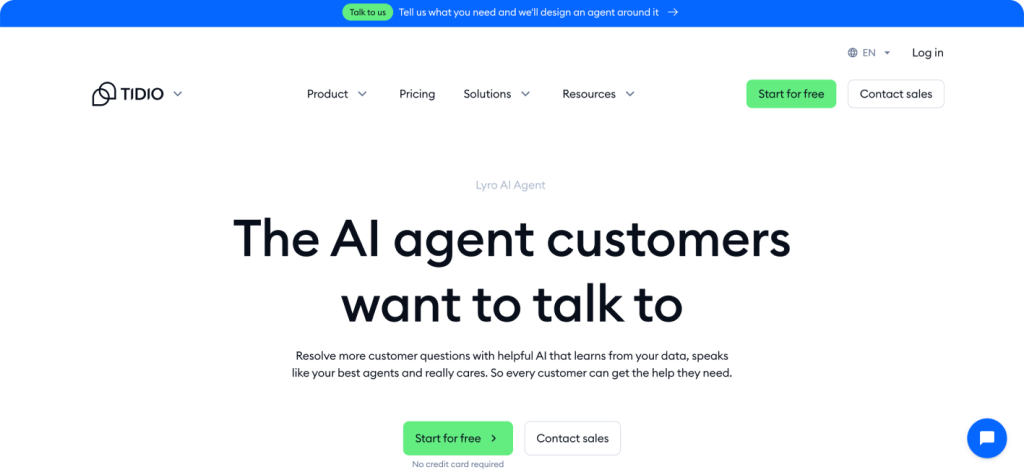
Tidio pairs live chat with Lyro, its AI Agent add-on, plus Flows automation for smaller ecommerce teams. It's self-serve from signup to launch.
Best for: Small stores that want a fast setup without a sales call or an enterprise contract.
Key capabilities:
- Self-serve signup with a free trial of Lyro conversations
- Works on Shopify, WooCommerce, and BigCommerce storefronts
- Reported resolution rates in the high 60s percent range
Pros:
- Cheapest entry point in this comparison
- Live within an hour, no developer needed
Cons:
- Lyro bills separately by conversation, so real monthly cost lands well above the advertised plan
- No native Gorgias integration and no voice channel
Verdict: A practical starting point for a small store, as long as you budget past the sticker price.
7. Siena AI - Best for Brand-Voice-Heavy DTC

Siena AI is purpose-built for DTC ecommerce and layers on top of Gorgias, Zendesk, Kustomer, Gladly, or Dixa. Its AI Personas tune tone to sound like a real member of your team.
Best for: Subscription-heavy DTC brands where matching your brand voice matters as much as speed.
Key capabilities:
- Deep subscription integrations, including Recharge, Skio, and Smartrr
- Agentic actions like refunds, address edits, and order updates
- Coverage for Instagram, TikTok, and other social channels
Pros:
- Strongest brand-voice fidelity in this comparison
- Handles subscription pause, skip, and swap requests natively
Cons:
- The combination of a monthly platform fee and per-ticket pricing gets expensive fast at lower ticket volumes.
- Only integrates with Shopify and Fulfil, no WooCommerce or BigCommerce
Verdict: Earns its price for a high-volume DTC brand on Shopify that treats tone as a real priority.
8. Netomi - Best for Email Deflection at Volume
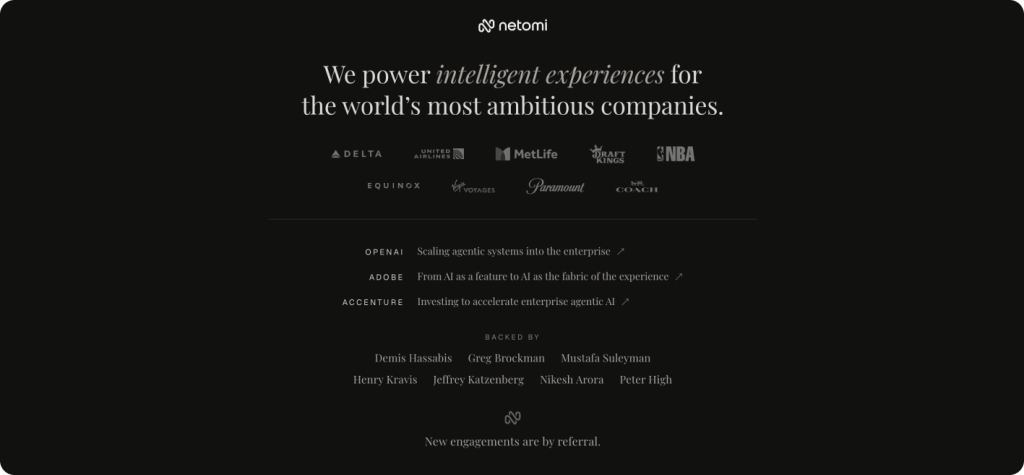
Netomi is an enterprise agentic AI platform built for high-volume classification and deflection, especially on email. Its Brand Telemetry feature exposes the reasoning behind each AI decision.
Best for: Large retailers whose biggest bottleneck is a flooded email queue during peak periods.
Key capabilities:
- Autopilot mode for autonomous resolution, Co-Pilot for agent assist
- Coverage across voice, chat, email, SMS, and social
- 100+ language support
Pros:
- Proven at very large enterprise ticket volume
- Reasoning transparency most competitors don't offer
Cons:
- No public pricing and no self-serve trial, every deal starts with a sales call
- Better suited to classification and deflection than full end-to-end resolution
Verdict: A fit for enterprise retailers drowning in email volume, not a growing brand testing its first agent.
Which AI Agents Are Best for eCommerce Support Tasks?
The right pick often depends on which ticket type dominates your queue. Order tracking, returns, refunds, shipping delays, and product questions each favor different tools, since some handle real actions while others stick to lookups. For a sense of what strong support looks like even before adding AI, see our Kurzgesagt case study.
Here's a fast answer for the five categories that make up most support volume.
WISMO and Order Tracking
Gorgias and Yuma AI lead here, since both pull live order data straight into the reply instead of sending customers to a tracking page. Gorgias fits Shopify-only stores that simply want the AI inside their existing helpdesk. Yuma AI fits stores already on Gorgias, Zendesk, or Kustomer that want the same layer without switching platforms.
Returns, Refunds and Exchanges
Siena AI and SupportResponse both take real action instead of just answering, issuing refunds, canceling orders, and updating subscriptions inside one single conversation quickly. Siena fits DTC brands running on Shopify with loyal recurring subscription products. SupportResponse fits any ecommerce platform and adds a dedicated human team for the edge cases policy alone can't settle.
Pre-Sales and Product Questions
Tidio's Lyro and Ada both handle pre-purchase shopping questions well, though they operate at very different business scales entirely. Lyro suits a small growing store answering everyday sizing or stock questions from a simple help center. Ada suits a much larger enterprise retailer still needing that same coverage across dozens of markets, languages, and brands.
Instagram and WhatsApp
Siena AI and SupportResponse both cover social DMs well, alongside chat and email. A comment under an ad gets the same accurate answer as an email would. Siena leans especially hard into brand voice for social replies. SupportResponse adds WhatsApp and hands off to a human the moment a comment turns into a real complaint.
Peak Season and BFCM Surges
Volume spikes are where these tools tend to earn their keep, since the better ones hold response times steady even under heavy load. Gorgias and SupportResponse both hold response times steady through a full Black Friday surge without hiring anyone new. Pair either one with an AI voice agent, so phone volume never becomes the bottleneck too.
What AI Agents Still Can't Handle in eCommerce Support
AI agents still struggle with fraud and chargeback disputes, where judgment matters more than speed. Angry customers who need to vent before accepting a resolution often disengage from a bot entirely. VIP accounts, ambiguous policy exceptions, and anything touching legal risk still belong with a person.
How to Choose an AI Customer Service Agent for Your Store
Start with your ticket mix. If most of your volume is order status and returns, prioritize tools with real order-data access over ones that just answer FAQs.
Match the pricing model to your volume. Per-resolution fees reward moderate, predictable volume. Flat platform fees make more sense once you're resolving thousands of tickets a month, since the fixed cost dilutes.
Check whether escalations carry full context to your human team. A customer who has to repeat their order number twice will notice, and it undoes the goodwill the AI just built.
Finally, weigh compliance against what you handle. A store processing payment data needs a vendor that can show certifications instead of a promise. Among the best AI customer service agents for ecommerce, the right one matches your ticket volume, platform, and compliance needs, not the longest feature list.

Summary
These eight represent the best AI tools for ecommerce customer support available right now, split into four categories. Shopify-native helpdesks like Gorgias, and helpdesk-agnostic AI layers like Yuma AI and SupportResponse. Enterprise platforms like Ada, Netomi, and Zendesk AI, plus SMB or brand-voice specialists like Tidio's Lyro and Siena AI.
None of them replace your support team. The best AI customer service agents for ecommerce free your team to handle the cases that need a person. AI clears the routine backlog around the clock.
If you're weighing whether to build this in-house or bring in a partner, our AI customer service for ecommerce team can review your ticket volume. We'll recommend a setup, AI included or not.