


When comparing chatbot vendors, you face a crowded market with overlapping claims. This guide breaks down the best conversational AI for customer service platforms available in 2026, so you can match features and pricing to your ticket volume and team size.
TLDR
- How well the AI understands customer intent, and how smoothly it hands off to a human, separates strong platforms from weak ones.
- SupportYourApp, Freshdesk, and Zendesk lead on integration depth and omnichannel reach.
- Pricing models vary widely, from per-seat licensing to per-resolution billing.
- The right pick depends on your ticket volume, team size, and escalation needs.
By 2028, Gartner projects that at least 70% of customers will start their customer service journey through an AI-driven chat or voice interface. That shift is why picking the best conversational AI for customer service now shapes support costs and customer experience for years.
What Makes a Good Conversational AI for Customer Service?
A strong platform starts with natural language understanding, or NLU, accuracy, meaning how well it reads what a customer is actually asking rather than just matching keywords. This is what separates the best AI chatbots for customer service from a conversational AI system built to handle open-ended, multi-step conversations. Weak NLU leads to bad handoffs, and agents end up spending more time fixing those than they save from automation.
Omnichannel support matters too. Customers move between chat, email, and social without warning, and the platform needs to track context across all three. Integration depth with your CRM and helpdesk determines how much manual work stays behind.
Human handoff quality, pricing model, and scalability round out the list. When the AI reaches a question it cannot answer, a clean handoff to a live agent keeps the customer from feeling stuck, which protects their trust in the brand.
How We Evaluated the 7 Best Conversational AI Tools for Customer Service
We scored each platform against six weighted criteria: NLU accuracy (25%), omnichannel support (20%), integration depth (20%), human handoff quality (15%), scalability (10%), and pricing transparency (10%). Higher weight went to criteria that affect day-to-day resolution quality over marketing claims.
This weighting reflects what buyers searching for the best conversational AI tools actually ask about first: will it understand my customers, and will it connect to what I already use. Vendor documentation, public case studies, and published pricing pages informed each score.
Best Conversational AI for Customer Service: Top 7 Platforms in 2026
The seven platforms below cover a range of company sizes, from startups needing a self-serve chatbot to enterprises running multilingual voice support. Each one markets itself as a capable conversational AI for customer service, but the details differ once you look at integration depth and pricing. Every entry lists key features, pros and cons, and the team type it fits best.
1. SupportYourApp
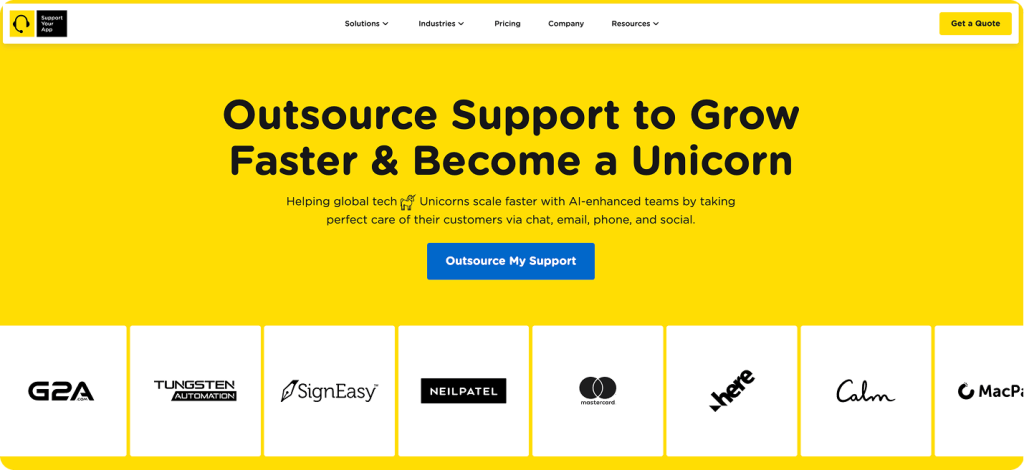
SupportYourApp pairs a conversational AI layer with trained human agents for L1 to L3 tickets. It fits companies that want AI automation without giving up a human safety net for complex or sensitive cases, and it works as one of the more complete AI customer service solutions for teams that don't want to stitch together separate vendors for chat, voice, and human backup. The platform trains its bots on your existing knowledge base, then routes anything outside its confidence threshold to a live agent instead of guessing.
That routing logic matters most for regulated industries like fintech and healthcare, where a wrong answer costs more than a slow one. Teams can adjust the confidence threshold themselves, tightening or loosening automation as trust in the bot grows over time.
Key features: AI customer support agent speaking 45+ languages, AI voice agent speaking over 32 languages, human agent coverage in 60+ languages, AI-assisted SupportCRM; AI plugs into your existing tech stack and is trained on your product and tone; performance analytics.
Pros: Strong hybrid and human-in-the-loop AI customer support model, flexible pricing, dedicated account management during rollout; AI is customized to your company and product.
Cons: Less suited to teams wanting a fully self-serve, no-human-involved setup. Smaller teams may find the onboarding process longer than a pure self-serve tool.
Best for: Growing SaaS, fintech, and eCommerce teams that want AI plus a managed human team behind it.
In one client case, SupportYourApp's AI automated 81% of incoming chats for the client Cocoatech.
Resolution time dropped from 8 hours to 5 minutes after AI deployment.
2. Freshdesk (Freddy AI)
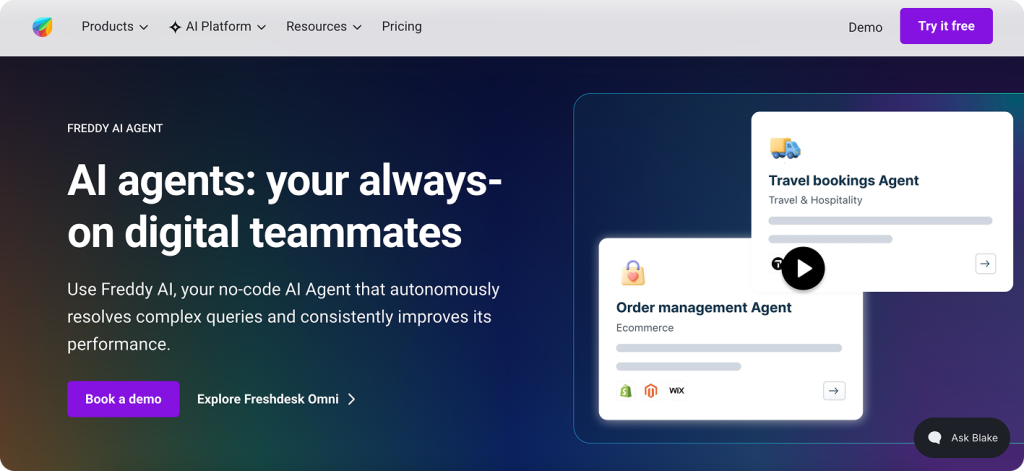
Freshdesk's Freddy AI adds generative responses and ticket triage on top of its existing helpdesk. It works well for teams already using Freshworks products and wanting AI layered on top rather than replacing their current stack. Freddy AI reads incoming tickets, tags them by topic and urgency, and drafts a suggested reply for the agent to approve or edit.
Setup takes hours rather than weeks, since the bot pulls directly from your existing Freshdesk knowledge base articles. That speed comes with a tradeoff: customization options stay simpler than purpose-built conversational AI platforms.
Key features: Auto-triage, suggested replies, Freddy Copilot for agents, self-service bot builder, sentiment tagging on incoming tickets.
Pros: Easy setup inside Freshdesk, solid documentation, mid-market pricing, quick time to first automation.
Cons: Its language understanding is not as deep as vendors that specialize in conversational AI customer support, so it can stumble on complex or unusual questions. Voice support remains limited compared to dedicated voice AI platforms.
Best for: Small to mid-size teams already on Freshworks looking for a light AI customer support automation layer.
3. Zendesk AI
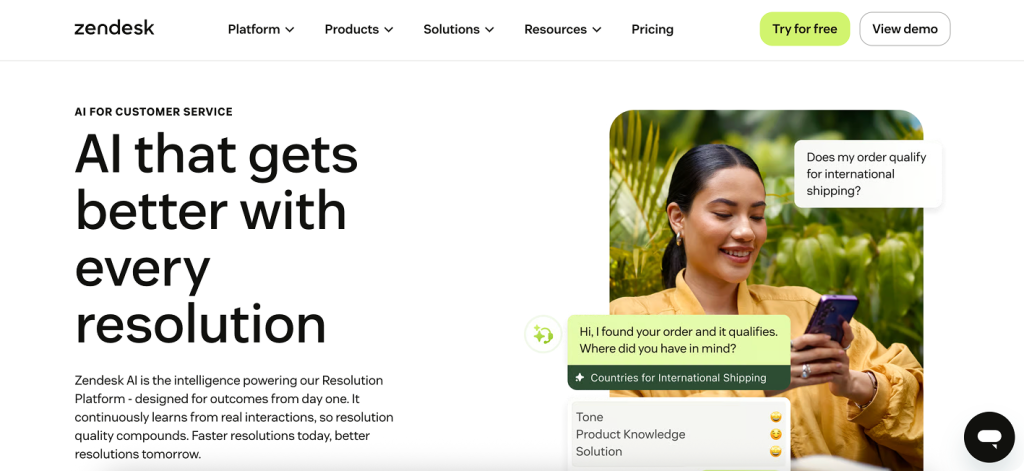
Zendesk AI builds bots and intent detection directly into its ticketing suite. Its strength is data: the platform trains on your own historical tickets to improve accuracy over time, rather than starting from a generic model. The longer a team runs Zendesk AI, the sharper its intent detection becomes for that specific business.
Zendesk also lets admins set up macros and triggers that layer on top of the AI, giving teams fine control over edge cases without waiting on a vendor update.
Key features: Intent and sentiment detection, AI agents for tier-1 tickets, workflow automation, native reporting, custom macros and triggers.
Pros: Deep integration with existing Zendesk workflows, strong reporting, wide app marketplace, reliable uptime at scale.
Cons: Add-on AI pricing can climb quickly at higher ticket volumes. Smaller teams sometimes pay for capacity they do not use.
Best for: Mid-size to enterprise teams already invested in the Zendesk ecosystem of apps.
4. Cognigy
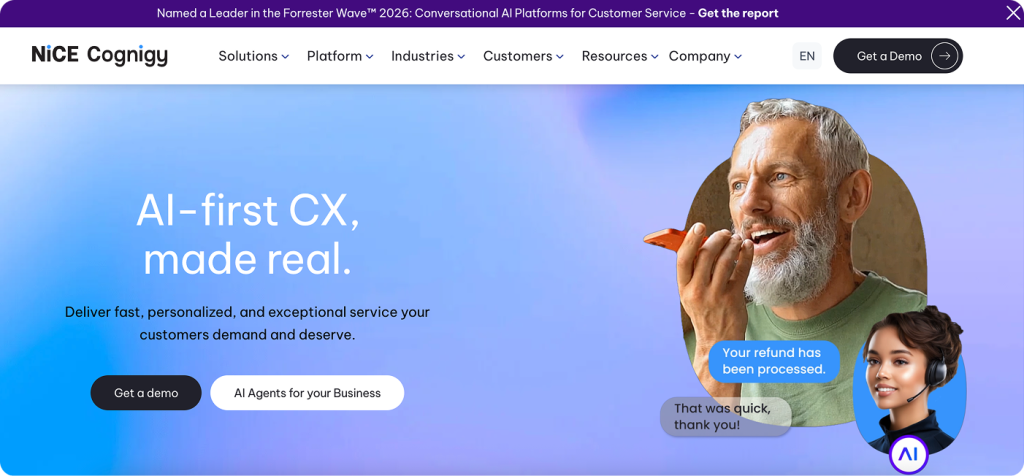
Cognigy targets enterprise contact centers needing conversational AI across voice and chat at scale. It is built for teams with dedicated conversation design resources rather than plug-and-play use, and it shows in the depth of its flow builder. Conversation designers can branch logic across dozens of intents and languages within a single flow.
The platform also supports live agent assist, surfacing suggested responses and customer history mid-call so human agents move faster without switching screens.
Key features: Voice and chat bot builder, low-code flow designer, real-time agent assist, multilingual NLU, detailed analytics on call outcomes.
Pros: Handles high call volume well, strong voice capabilities, flexible deployment options, solid enterprise support contracts.
Cons: Steeper learning curve, better suited to larger implementation budgets. Smaller teams often need outside help to get full value.
Best for: Enterprise contact centers running an AI voice agent program alongside chat.
5. Kore.ai
Kore.ai offers a broad conversational AI customer service platform spanning virtual assistants, voice bots, and agent-facing copilots. It supports both no-code and pro-code building paths, letting business teams build simple flows while developers handle complex integrations. Pre-built templates for common industries cut initial build time for standard use cases.
The agent-facing copilot also works alongside human agents, suggesting next-best actions during live conversations rather than only automating standalone bot interactions.
Key features: No-code bot builder, pre-built industry templates, agent assist copilot, analytics dashboard, support for multiple deployment environments.
Pros: Flexible for both technical and non-technical teams, wide integration library, strong template library for faster starts.
Cons: Pricing structure is less transparent than smaller competitors. Full platform value often needs a longer implementation timeline.
Best for: Enterprises wanting one platform across multiple departments, not just support.
6. Yellow.ai
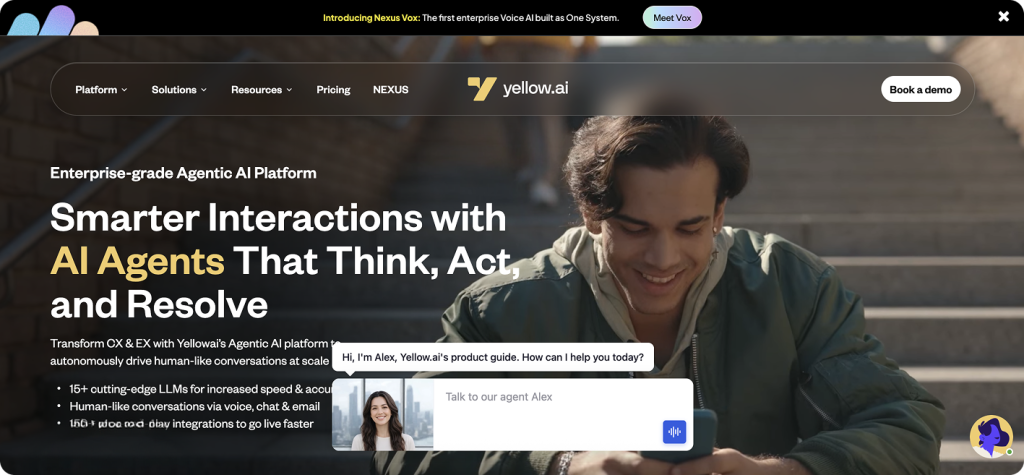
Yellow.ai focuses on multilingual, high-volume deployments, common in retail and telecom. Its generative AI layer handles both structured and open-ended customer questions, switching between scripted flows and open dialogue depending on what the customer needs. Pre-built connectors to common commerce and CRM platforms cut integration time for retail teams.
Yellow.ai also offers dedicated tooling for WhatsApp and other messaging apps, a channel many competitors treat as secondary rather than a primary deployment target.
Key features: Dynamic automation platform, voice and chat bots, over 135 language support, generative AI responses, dedicated messaging app tooling.
Pros: Strong language coverage, quick deployment for common use cases, active enterprise client base, solid messaging app support.
Cons: Advanced customization often needs vendor support involvement. Reporting depth varies by deployment type.
Best for: Global retail and telecom brands needing broad language reach fast.
7. Sierra.ai
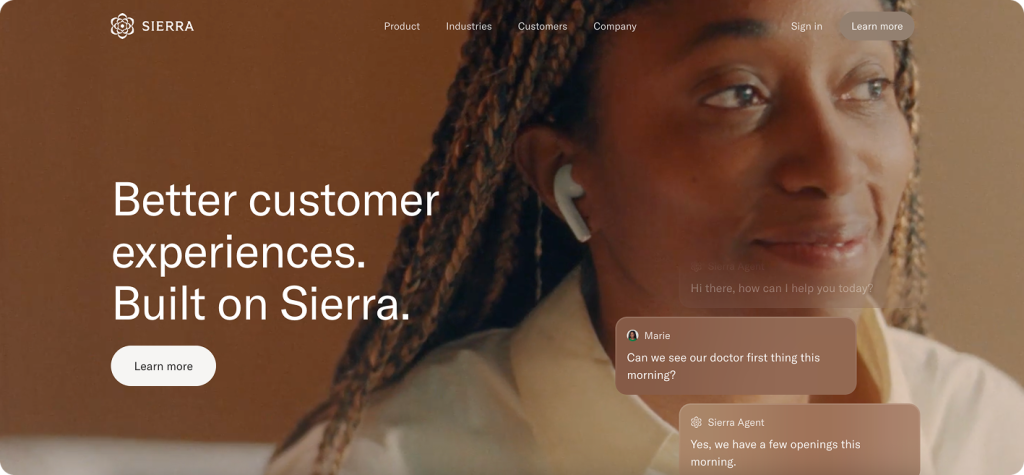
Sierra.ai builds autonomous AI agents meant to resolve full customer journeys, not just answer single questions. It positions itself as a support agent replacement for entire workflows rather than a chatbot add-on, aiming to close tickets end to end without handing every edge case to a human. Brand voice customization lets the AI match a company's tone closely, which matters for consumer brands protecting a distinct identity.
Outcome-based pricing means the vendor gets paid only when the AI actually resolves an issue, which shifts risk away from the buyer compared to flat licensing fees.
Key features: End-to-end conversation ownership, brand voice customization, outcome-based pricing, built-in guardrails, resolution-focused reporting.
Pros: Designed for full resolution rather than deflection, strong for consumer brands, pricing tied to actual outcomes.
Cons: Newer platform with a shorter public track record than legacy vendors. Guardrail configuration takes time to get right.
Best for: Consumer brands wanting AI to own full resolution, not just first response.
Conversational AI Comparison Table
| Platform | Type | Best For | Channels | Pricing Model | Standout Feature |
| SupportYourApp | AI + human hybrid | Growing SaaS, fintech, eCommerce | Chat, email, voice, social | Per-ticket / per-seat | Human-in-the-loop handoff |
| Freshdesk (Freddy AI) | AI helpdesk add-on | Freshworks users | Chat, email | Per-agent tier | Freddy Copilot |
| Zendesk | AI ticketing suite | Zendesk-native teams | Chat, email, social | Per-agent + AI add-on | Historical ticket training |
| Cognigy | Enterprise voice/chat AI | Large contact centers | Voice, chat | Custom enterprise | Low-code flow designer |
| Kore.ai | Multi-department AI platform | Large enterprises | Chat, voice | Custom enterprise | No-code and pro-code builder |
| Yellow.ai | Multilingual automation | Global retail, telecom | Chat, voice, social | Usage-based | 135+ language support |
| Sierra.ai | Autonomous AI agent | Consumer brands | Chat, voice | Outcome-based | Full journey resolution |
How to Choose the Right Conversational AI for Your Customer Service Team
Let’s see. Choosing a conversational AI for customer service starts with ticket volume, not brand recognition. Teams under 500 tickets a month often do fine with a lighter tool like Freshdesk, while high-volume operations need platforms built for scale, like Cognigy or Yellow.ai.
Team size and budget matter next. A small team without a dedicated conversation designer benefits from a hybrid model like SupportYourApp, where AI customer service automation runs alongside trained human agents.
Integration needs and language requirements narrow the list further. A company running on Zendesk gains the most from Zendesk AI, while global brands need wide language coverage from day one.
Here is how that plays out by scenario. A 10-person eCommerce team that wants fast AI setup and human backup fits best with SupportYourApp. A global telecom needing voice AI across dozens of languages should look at Yellow.ai. An enterprise wanting one AI customer service solutions platform across support, sales, and HR fits Kore.ai. A consumer brand wanting AI to fully own resolution, not just deflect tickets, fits Sierra.ai.
Summary
The best conversational AI for customer service depends less on brand recognition and more on your ticket volume, integration stack, and appetite for human oversight. Compare vendors against your actual workflow before committing to a contract. If you want a platform built around human backup rather than pure automation, SupportYourApp is worth a look as your next step.