


At 9:30 p.m. on a Sunday, a renter calls about your new two-bedroom listing, gets voicemail, and has a viewing booked elsewhere by Monday. This guide is for agents and property managers weighing an AI receptionist for real estate, and it shows which calls the AI can handle alone. It also covers the harder part, which is spotting the moment a call needs a person and passing it on without losing context.
"I manage support teams at SupportYourApp, and here's what I've learned: AI is great with routine questions, but the real test is the moment a call stops being routine. That's when a person should step in, and they shouldn't have to ask the caller to start from scratch."
Yelyzaveta Bocharnikova, Key Account Manager at SupportYourApp
TL;DR
- Most after-hours calls to a real estate office follow a script: listing details, viewing slots, pet rules, and repair reports.
- An AI receptionist can answer those calls and book or move viewings while your team is offline.
- Offers, legal questions, emergencies, and upset callers go to a person, with a call summary attached.
- Cost depends mostly on call volume and on who picks up the calls the AI passes on.
In Buildium's 2026 survey of 1,500 U.S. renters, 84% said they expect a property manager to respond within 24 hours. Another 61% expect a reply the same day or faster. A Sunday night voicemail can miss that window before anyone sees it.
Which Calls a Real Estate Office Can Hand Off
A real estate office can hand off any call that follows a script: listing details, viewing bookings, rental eligibility questions, and routine repair reports. Calls that need a licensed agent's judgment or a decision about money stay with people. The table shows where that line usually falls for brokerages and rental portfolios.
| Call type | AI receptionist can | Goes to a person when |
| Listing question | Share price, size, parking, availability | Caller wants to negotiate |
| Viewing request | Book or move a slot | The owner approves each showing |
| Rental eligibility | Explain income, deposit, pet rules | Caller asks for an exception |
| Maintenance report | Log the issue, unit, access details | Leak, no heat, gas smell, lockout |
| Buyer or seller call | Take details, book a consultation | Caller is mid-offer or under contract |
| Existing client, urgent | Transfer with a summary | Every time |
When you set up an AI receptionist for real estate offices, start with the first two rows, because those calls have the most predictable scripts. Rental and maintenance calls can follow once your emergency rules exist in writing.
How an AI Receptionist Handles Common Real Estate Calls
An AI receptionist handles real estate calls by following the scripts and data your team gives it, then logging every call for the agent. Five common calls show how the setup works day to day.
The Late-Night Listing Inquiry
A caller asks about a listing at 11 p.m., and the AI answers from the listing data. It covers price, square footage, HOA fees, and whether the unit is still available. If the caller sounds ready, it books a viewing or a callback. The agent starts the morning with a qualified lead, not a voicemail.
Offices with dozens of listings also need each call to reach the right agent. Vendors list this feature as AI receptionist real estate property routing. The caller names a street or listing number, and the system sends the lead to the agent who holds that listing.
Viewing Requests and Rescheduling
Viewing requests are the easiest place to start with an AI receptionist for real estate agents, because the rules are clear. The AI checks open slots on the agent's calendar and sends a text confirmation once the caller picks one. Rescheduling works the same way, and the freed slot goes back on the calendar.
Rental Questions: Availability, Move-In Date, Pets
Rental callers ask the same things all day: is the unit free, when can I move in, do you take dogs, what's the deposit. An AI receptionist for property management answers from the same written criteria every time. Every caller hears the same income rule and pet policy, which helps with fair housing.
Keep anything that needs a decision out of the script. When a caller asks to waive a pet fee or accept a co-signer, the AI sends a note to the leasing manager. It then tells the caller who will follow up and by when.
Maintenance Requests From Tenants
Tenant repair calls split into two groups. Routine issues like a dripping faucet get logged with the unit number and access details, then go into the work order queue. Floods and no heat in winter go straight to the on-call person. A tenant who smells gas gets told to leave the unit and call 911 before anything else.
Buyer and Seller Calls Outside Office Hours
NAR's 2026 Profile of Home Buyers and Sellers found that 90% of buyers used an agent or broker, and 92% of sellers sold with one. An AI receptionist for realtors takes the property address and the seller's timeline, then books a consultation. Pricing opinions and market advice stay with the licensed agent.
What the Agent Sees After the Call
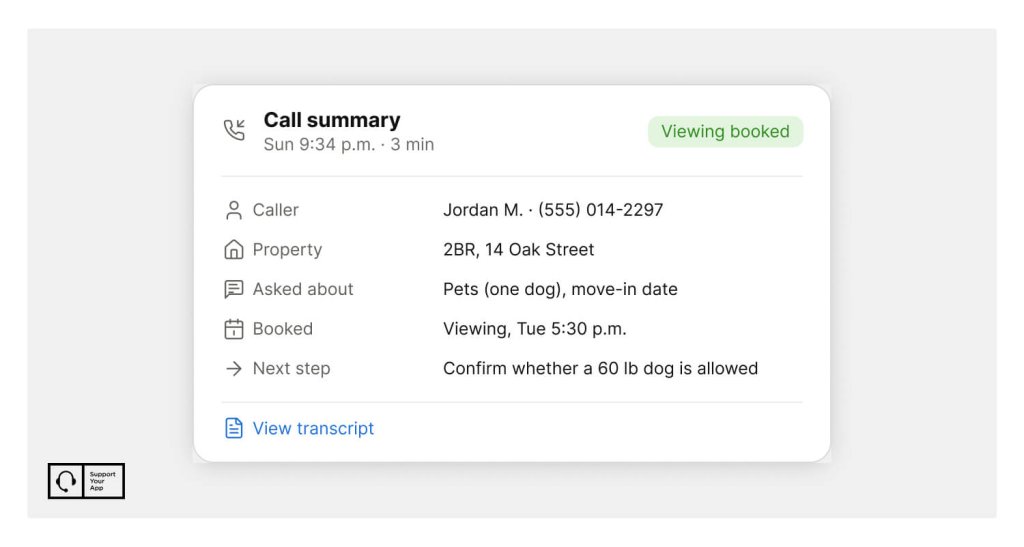
After each call, the agent gets a written summary and the next step, in the CRM or by text. The summary names the caller, the property, what they asked, and what the AI booked or promised. SupportYourApp's SupportCRM brings email, voice, and chat into one agent workspace. A tenant's call summary then appears next to their earlier emails and chats.
Where the AI Hands the Call to a Person
The AI hands the call to a person whenever a call needs a decision the script doesn't cover or can't wait until morning. Those triggers differ by office, so write them down before launch, starting with these:
- Offers, price negotiation, contracts, or eviction questions.
- Maintenance emergencies like flooding, no heat, or a lockout.
- A caller who asks for a human or sounds upset.
- Any complaint about discrimination or fair housing.
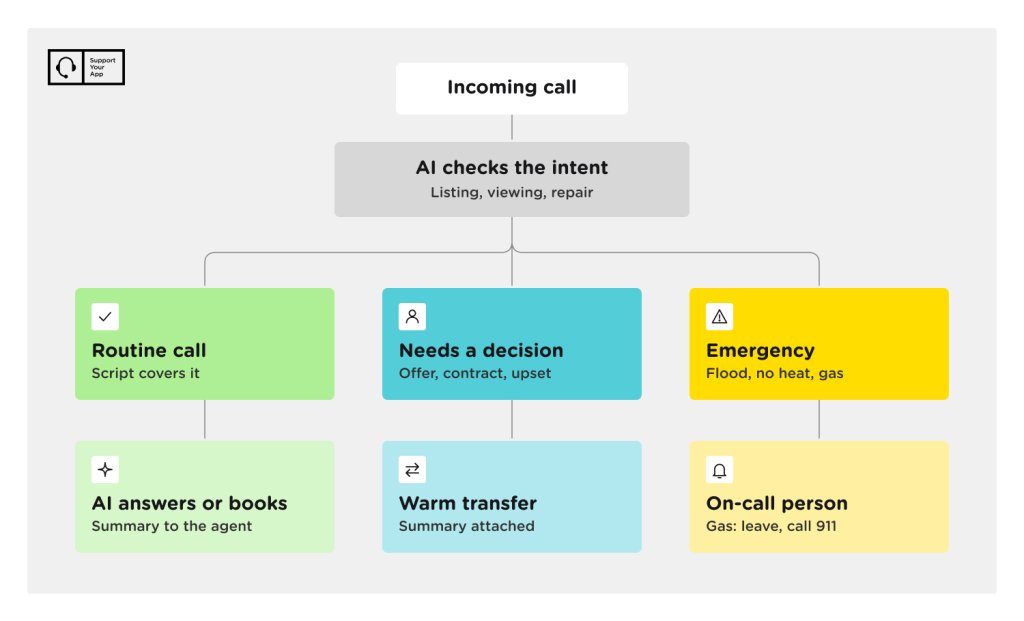
A good handoff is a warm transfer with the summary attached, so the caller doesn't repeat their story. SupportVoice, SupportYourApp's AI voice agent, follows a Human+AI model. It answers routine calls on its own and escalates complex ones to a person.
What CRM and Real Estate Tools Does an AI Receptionist Integrate With
An AI receptionist needs two connections to be useful in real estate: a calendar for viewings and a system that holds caller records. Sales teams often use a CRM like Follow Up Boss or kvCORE, and rental teams use AppFolio or Buildium.
For an AI receptionist for property management, the property management system matters more than the CRM, because unit and lease data live there. Ask the vendor which tools connect natively and which need a custom build. SupportVoice runs on SupportCRM, connects to helpdesks like Zendesk and Freshdesk, and offers custom CRM integration on request.
Before You Launch
A launch goes smoothly when the AI has current data and clear limits from the first call. Finish this prep, then run test calls with your own staff before you forward a single phone line:
- Load current listings, leasing criteria, fees, and pet policies.
- Have someone who knows fair housing rules review every rental script.
- Add a recording disclosure, since states like California require consent from everyone on the call.
- Write down what counts as an emergency and who's on call each night.
Treat the first month as a pilot of your AI receptionist for real estate. Start with listing and viewing calls. Add rentals and maintenance once weekly transcript reviews come back clean and the team trusts the handoffs to the on-call person.
What an AI Receptionist for Real Estate Costs
Self-serve apps publish plans from about $25 a month for a few dozen calls to around $160 for a few hundred. Your own team handles every call the AI passes on. Check the overage price, because one busy listing weekend can blow past a low call cap.
A managed AI answering service for real estate usually charges by call minutes, plus setup for integrations and a human team for escalated calls. SupportVoice scales by call minutes rather than seats and gives you after-hours coverage with no new headcount.
Summary: Choosing an AI Receptionist for Real Estate
The AI works best on scripted calls like listing questions, viewings, rental criteria, and routine repairs. People keep offers, legal questions, emergencies, and upset callers. Write the handoff rules before launch and read transcripts weekly during the first month to catch wrong answers early.

Talk Through Your Call Mix
Before you pick a tool, map which calls your office misses after 6 p.m. and on weekends. SupportYourApp runs an AI receptionist with human support agents behind it for the calls that need a person.