

In 2024, the global EdTech market was worth $185.78 billion. Fast-forward to 2029, and that number is expected to more than double to $434.96 billion.
As the number of EdTech SaaS companies grows increasingly crowded, customer service has become one of the critical differentiators. Why? Because customers remain loyal to companies that support them well.
This is when businesses choose to outsource EdTech customer service. External partners provide 24/7, multilingual support that can scale with your needs. The result? Exceptional service without the hefty price tag.
This article will serve as your guide to identifying when and why you should outsource your e-learning support. We’ll also outline the key criteria of an effective outsourcing partner.
Key Points:
- EdTech support demands are cyclical, making it difficult for small internal teams to manage peak periods, rapid growth, and technical requirements without service quality suffering.
- Outsourcing enables scalable, multilingual, and 24/7 support, ensuring consistent learner and educator experiences across regions, time zones, and academic cycles.
- Partnering with a specialized EdTech support provider improves efficiency and satisfaction, while freeing internal teams to focus on product innovation, course development, and long-term growth.
- Choosing the right partner is critical, with emphasis on EdTech experience, compliance and data security, quality assurance, cultural alignment, and the ability to scale alongside your platform.

When to Outsource EdTech Customer Service
Timing your outsourcing decision right can dramatically improve student retention rates. It's particularly powerful during customer onboarding, since fast, helpful responses turn confused new users into engaged learners.
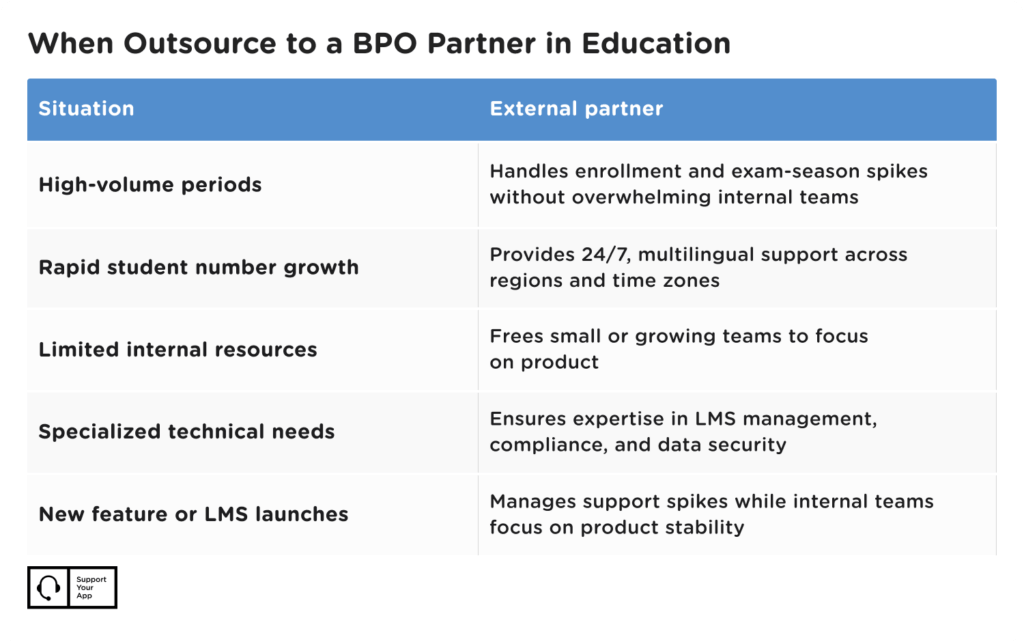
This is when we recommend outsourcing customer support for EdTech companies:
1. High-Volume Periods. Enrollment surges, back-to-school rushes, and exam seasons hit like clockwork. Outsourcing before these peaks prevents your internal team from drowning in tickets and keeps tutors focused on teaching instead of troubleshooting.
2. Rapid Student Growth. Scaling into new regions or time zones? An outsourced partner offering 24/7 multilingual support delivers faster, more efficient service than stretching your internal operations thin across the globe.
3. Limited Internal Resources. Small teams at startups and mid-size EdTech companies get buried under support requests fast. Outsourcing your entire support operation frees your team to focus on what they do best, like creating unique course content.
4. Specialized Technical Expertise Needed. Learning Management System (LMS) administration, compliance requirements, and data security protocols require deep technical knowledge. EdTech help desk support involves handling protected student information, so partnering with a BPO trained in data privacy and compliance often beats building that specialized capability internally.
5. New Feature Launches Rolling out LMS updates or new features? Expect a flood of troubleshooting requests. An outsourced team absorbs the spike while your product stabilizes, freeing your internal team to focus on refining the features instead of firefighting support tickets.
When Outsource to a BPO in Education
Key Takeaway
Smart outsourcing isn't about abandoning customer support — it's about knowing when external expertise can deliver better results while your internal team stays focused on what makes your EdTech platform unique.
Why Outsource Customer Support for Edtech Companies?
EdTech providers operate in an environment defined by rapid growth, seasonal demand, and complex technical products. And so, choosing to outsource edtech customer service becomes a strategic move that lets you focus on business growth while experts handle support.
Here are some additional reasons why you may want to use outsourced support for your EdTech company:
- Reduce Operational Costs
Running a full in-house support operation gets expensive fast. You're looking at hiring costs, infrastructure investments, ongoing training, and CRM systems before you even answer your first ticket.
Outsourcing flips this model entirely. Those hefty fixed costs become flexible, variable expenses, and you get immediate access to trained agents using proven support technology. Companies report saving 15-30% on average by outsourcing compared to building support teams in-house.
The math is simple! Outsourcing lets you invest those savings back into what actually differentiates your platform, which is better courses, smarter features, and stronger product development.
- Deliver 24/7 Multilingual Support
EdTech products are used globally by students, educators, parents, and learners. BPOs run 24/7 across time zones with multilingual support teams. This translates directly into quicker responses, stronger learner outcomes, and increased platform engagement.
Voice AI strengthens this round-the-clock model by answering incoming calls instantly, even outside human agents’ working hours. It handles routine questions, routes complex issues to the right team, and ensures learners always receive immediate assistance, regardless of time zone.
Multilingual availability alone can already have a measurable impact on retention. For example, as Duolingo expanded globally, inquiries came in from different countries, but customers became frustrated because support was primarily in English. After adding Spanish, French, and Portuguese to the list of languages, retention quickly increased, as trust improved and abandonment during onboarding reduced.
When support teams communicate with students in their native language, customer engagement in edtech deepens naturally. Students feel understood, stick around longer, and use platforms more actively.
As per the map below, while the EdTech industry is dominated by the US, there is rapid growth globally, particularly in the Asia Pacific region. Translation: multilingual support isn't a nice-to-have anymore. It's a competitive necessity.

- Improve User Satisfaction and Educator Satisfaction
Students and educators won't tolerate slow, unhelpful support. Poor service directly tanks renewal rates, retention, and institutional trust. One bad experience and they're exploring alternatives.
SupportYourApp's call center outsourcing services include professional support built on proven workflows, strict SLAs, and rigorous QA scoring. You get consistent CSAT tracking, faster response times, and higher first-contact resolution rates, which means students get reliable help when they need it most.
- Access to Advanced Tools and AI Automation
Some businesses might not have the additional budget to purchase the best technology for automation. Meanwhile, an external education call center can provide this technology as a part of their standard package, offering access to:
- AI-driven ticket triage
- Multilingual voice AI support
- Knowledge-base automation
- Chatbots — automated live chat support
- QA analytics
- Real-time performance monitoring
Outsourcing chat support provides EdTech companies with immediate access to these capabilities without upfront costs.
- Mitigate Risk and Support Compliance
EdTech businesses need strong data governance, compliance, and data security.
Outsourced support providers can help with this, as BPOs are often compliant with GDPR and PCI DSS-certified. This means you get enterprise-level security protocols without building an entire compliance infrastructure from scratch.
Key Takeaway
Outsourcing gives you enterprise-level support capabilities at a fraction of the cost and time of building them yourself. In a market growing this fast, that advantage can make the difference between scaling successfully and getting left behind.
Outsourcing Customer Support in Edtech: Process, Scope, and Risks
Outsourcing EdTech support isn't just about finding a vendor and handing over your ticketing system. Done poorly, it creates confusion, frustrates students, and damages your brand. Done right, it becomes a seamless extension of your internal operations that actually improves the student experience. Here's how to outsource effectively while minimizing risks and maximizing results.
- Define Your Scope Before You Start Shopping
The biggest mistake EdTech companies make? Starting vendor conversations without clearly defining what they need. Before reaching out to potential partners, map out exactly what you're outsourcing. Are you handing off Tier 1 support while keeping complex technical issues in-house? Outsourcing everything? Only covering after-hours support? Get specific about volume expectations, response time targets, the types of inquiries you receive most frequently, and any seasonal patterns.
This clarity prevents scope creep, helps vendors provide accurate quotes, and ensures everyone's aligned from day one.
- Build a Comprehensive Onboarding Program
Your outsourced team can't support your platform effectively without deep product knowledge. Plan for robust onboarding that goes beyond a quick product demo. Share your product documentation, common troubleshooting scenarios, brand voice guidelines, and escalation protocols. Create a knowledge base specifically for support agents with FAQs, step-by-step resolution guides, and examples of excellent responses. Budget time for your internal team to train the outsourced agents directly: this investment pays off in faster ramp-up times and fewer escalations.
- Establish Clear Communication and Governance
Outsourcing doesn't mean "set it and forget it." You need structured communication between your internal team and your BPO partner. Set up regular check-ins — weekly at minimum during the first few months, then bi-weekly once things stabilize. Establish escalation paths for urgent issues, technical questions, and edge cases.
Decide who owns what: Who monitors metrics? Who updates the knowledge base? Who makes policy decisions? Create a shared communication hub where both teams can collaborate in real-time.
- Monitor Performance Relentlessly
In the first 90 days, monitor outsourced support performance closely. Track first response time, resolution time, CSAT scores, ticket volume by category, and escalation rates. But don't just look at numbers, review actual conversations. Listen to calls, read chat transcripts, and evaluate email responses. Are agents solving problems correctly? Does their tone match your brand? Spot-check 10-15 interactions weekly and provide feedback immediately. As performance stabilizes, you can reduce monitoring frequency, but never eliminate it entirely.
- Identify and Mitigate Key Risks Upfront
Every outsourcing relationship carries risks. The biggest? Knowledge loss when agents turn over. Mitigate this by requiring detailed documentation and maintaining your own internal knowledge base. Quality degradation over time is another concern — combat this with ongoing QA audits and performance-based contract renewals. For data breaches, ensure your contract includes clear liability provisions, incident response protocols, and regular security audits. Finally, plan for switching providers by including contract exit clauses and maintaining your own records of common issues and resolutions.
What to Look for in an EdTech Support Partner
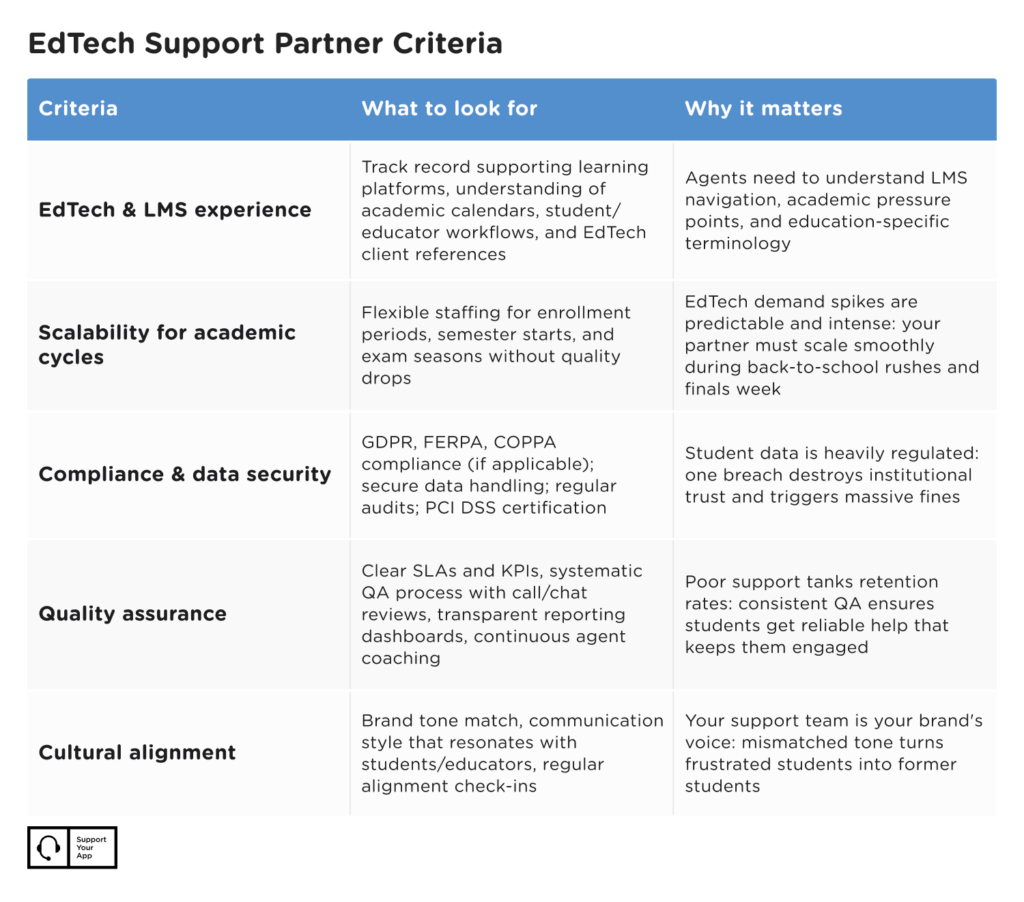
Before choosing to outsource EdTech customer service, it is necessary to know what criteria to look for in the ideal support partner. If you need some additional guidance, we have created this checklist containing evaluation criteria, KPIs, security must-haves, and customization and scalability considerations.
The table below lists some essential criteria, what to look for, and why this is important for EdTech specifically:
EdTech Support Partner Criteria
Summary
Online learning platforms live or die by their support experience. Poor support doesn't just frustrate users — it drives them to competitors.
EdTech companies face relentless support challenges: enrollment spikes, explosive growth, stretched internal teams, and complex compliance demands. When you outsource EdTech customer service, you solve these problems without sacrificing quality. The right BPO partner delivers scalable, multilingual support while your team focuses on building better courses and features.
Beyond basic coverage, outsourced partners provide immediate access to AI tools, automation workflows, and enterprise-grade compliance infrastructure most EdTech companies can't build alone. You get better support faster, at lower cost.
Success requires choosing a partner with genuine EdTech experience, scalability for academic cycles, rigorous QA, airtight compliance, and flexibility to evolve. Get those fundamentals right, and outsourcing becomes your competitive advantage.
Like it? - Share:


-
What is EdTech customer service outsourcing?
EdTech customer service outsourcing is the use of external support providers to handle learner and educator inquiries, delivering scalable, multilingual, and technical assistance for education technology platforms.

-
Is outsourcing customer support safe for EdTech online learning platforms?
Yes. When partnered with compliant providers, outsourcing is safe and offers secure data handling, regulatory compliance, and reliable support processes tailored specifically to EdTech platforms.
-
What tasks can be outsourced in EdTech support?
EdTech support can outsource learner inquiries, technical troubleshooting, LMS administration, onboarding assistance, multilingual help desk services, ticket management, and first-line issue resolution, among others.
-
What is an education call center?
An education call center is a specialized support service that handles student, parent, and educator inquiries for schools, universities, and EdTech platforms across multiple communication channels.

Liubov Tykholoz
Vice CEO
Liubov is the Vice CEO at SupportYourApp. She began her career in customer support, advanced into HRD, and worked closely with several internal teams, building credibility through hands-on experience across key functions. This cross-functional background gives her a full-picture understanding of quality, people, growth, and compliance. Today, she leads internal processes and operational excellence to drive SupportYourApp’s continued global growth.
Posted on December 30, 2025

Support Insights




Customer Support Trends 2026: Are You Ready?
Benchmark your customer support against key 2026 trends.