

Were your response times faster when your internal team managed support? Has there been a customer data leak? Is your provider too slow when scaling support?
These are all red flags pushing for you to change customer service providers. Of course, you’d want to prioritize customer experience, boost KPIs, and maintain business continuity. Considering a transfer to a different BPO that offers a more flexible and efficient support system might be a solution.
However, don’t rush off to start the offboarding process for your current provider. Choose the new one first. In this article, we will cover exactly how to switch customer support providers without risk, so let’s get right into it.
Key Points:
- Know when to switch – Declining quality, low CSAT/FCR, scalability issues, compliance risks, or lack of innovation signal – it may be time to change providers.
- Audit and set goals – Review current support operations, define clear goals and KPIs before selecting a new partner to ensure alignment with business objectives.
- Select the right partner – Evaluate providers based on performance metrics, scalability, technology adoption, compliance, and cultural fit.
- Plan a phased transition – Use a structured approach: pilot stage, old/new provider parallel run, gradual scale-up, and eventual decommission of the old provider.
- Monitor and review post-switch – Track KPIs, SLAs, costs, and customer feedback over 3–6 months to ensure the new provider meets expectations.
When & Why Companies Should Switch a Call Center Provider
Being able to evaluate when to walk away from your current partner is essential for operational success. Here are the red flags to pay attention to:
Decline in Quality
If recent customer feedback or KPI reports show slower response times, inconsistent handling, or poor escalation management, it may be time to address this with your customer support service provider.
Typical accompanying KPI red flags include:
- Lower Customer Satisfaction (CSAT) and Net Promoter (NPS) scores
- Lower First Contact Resolution (FCR)
- High call abandonment rates
Top-performing providers can maintain FCR rates above 70% with Average Handling Time (AHT) of seven to ten minutes; if your provider falls beneath this benchmark, doesn’t meet your other targets, and doesn’t improve over time, it may be time to consider a new contract.
Lapses in the service level agreement (SLA) are another critical warning sign. The SLA defines the service quality and satisfaction levels you should expect from your provider. Consistently missing promised targets, insufficient agent training on current best practices, or failure to meet desired CSAT levels indicate that your investment isn’t bringing the expected value.
Scalability Issues
Your provider should be able to grow alongside your business, and if they are unable to meet you where you are, then it is time to start searching for another vendor.
Key red flags to watch for include:
- Inability to cope with seasonal peaks
- Long onboarding times for new agents
- No multilingual capabilities, needed when expanding to a new region
If you are expecting a seasonal peak, it is recommended to replace your customer support company three to six months in advance, allowing the new team to fall into routine.
Data Security Concerns
Data security is essential for maintaining trust with your customers; a single breach can result in reputational harm for your company.
Immediate switch triggers:
- Non-compliance with ISO 27001, PCI DSS, or GDPR/CCPA
- Poor audit results
- Lapses in data encryption or data access control
Relationship and Communication Problems
Strong collaboration is just as important as meeting KPIs. When communication breaks down, it often reveals deeper operational or interpersonal issues with your provider that can impact long-term success. Watch for these signs:
- Poor communication cadence: Irregular updates and limited transparency make it difficult to stay aligned.
- Defensive approach: The vendor blames your systems or policies instead of offering solutions.
- Unaddressed feedback: Issues raised in QBRs or reports go unresolved despite repeated discussions.
- Erosion of trust: You feel unheard, undervalued, or consistently left out of important decisions.
Lack of Innovation or Technology Adoption
Your BPO vendor should always aim to remain competitive, and one way to do so is by adopting automation, AI, and CRM integrations. Resisting these advancements is a clear indication that you are likely to fall behind the customer support curve.
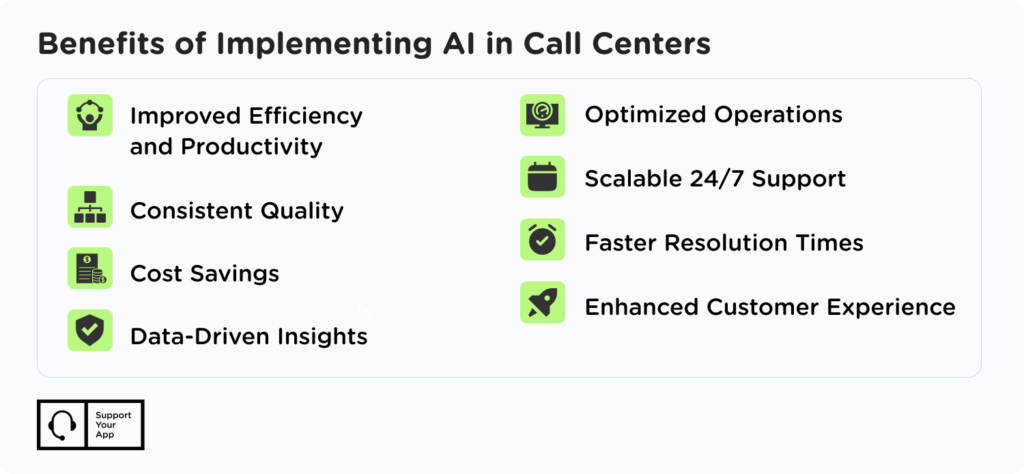
This is further supported by a survey conducted by Vonage in which 70% of respondents stated that AI has improved self-service support options, and 60% agree that AI has made interacting with brands more efficient, suggesting that AI adoption is essential for the CX with benefits like those depicted in the graphic below:
Key Takeaway:
Transition to a new provider if quality declines, KPIs fall, scalability is limited, data security risks exist, SLAs aren’t met, or the vendor resists innovation and technology adoption.
Step-by-Step Guide to Switching a Customer Support Service Provider
Switching your provider is not a decision that should be made without careful consideration. If your current provider is not meeting your requirements, then it is definitely an essential move to make.
To choose the right customer support partner, be sure to use this checklist we developed. It takes into account scalability considerations, quality vs cost comparison, multichannel capabilities, and security must-haves.
- Understand Why You Want to Switch
To successfully switch call center providers, you first need to understand the goals you would like your new vendor to achieve. These can surround quality, cost, technology, scalability, overall customer experience, and more.
Working closely with your QA manager is a good way to ensure that your quality and performance goals are being properly considered when selecting a provider.
- Conduct a Thorough Audit
This goes hand-in-hand with the previous point: mapping your current support environment will enable you to better align with a provider who can meet your current and projected support needs.
Your audit checklist should include baselines on:
- Current communication channels (phone, chat, email, social media)
- Current call volumes (peak hours, agent capacity, seasonal peaks)
- Integrations (CRM, ticketing, knowledge base, analytics)
- Compliance (GDPR, PCI DSS, ISO)
- Define Selection Criteria
Request your potential provider to submit a service proposal that aligns with your strategic goals and baseline criteria by focusing on:
- Performance Metrics: this includes your CSAT, FCR, AHT, and quality standards
- Scalability: important to consider for seasonal capacity, 24/7 support, and multilingual capabilities if necessary
- Technology: CRM integrations, AI readiness, and self-service capabilities
- Compliance: Data protection, ISO certifications
- Cultural Fit: Does the empathy and tone of the provider align with that of your brand?
Develop a calculated evaluation scorecard against which to measure all providers.
- Evaluate and Shortlist
Using the predetermined scorecard, evaluate vendors using these criteria, and be sure to request SLAs and case studies to get the full picture. It is advised to avoid choosing a provider solely based on a lower price, as this can lead you to a vendor that does not meet your volume or quality demands and will likely result in brand damage.
- Plan a Phased Transition
A slow, calculated transition is best when you switch your customer support provider.
The transition can look something like the following:
- Pilot Stage → move up to 20% of your volume to the new provider as a test
- Parallel Run → Run the two providers alongside one another for 4 to 6 weeks
- Scale Operations → Gradually transfer the remaining operations as KPIs stabilize
- Decommission → Shut down the operations of the old provider after you have fully validated the new one

- Training and Communication
When onboarding a new provider, their team should receive thorough training on your dashboards, workflows, tools, escalation procedures, and communication protocols. This helps align everyone involved in the transition and ensures uninterrupted service quality.
- Post-Switch Review
After approximately three to six months, you can begin to evaluate the new provider to determine if the switch was successful by answering the following questions:
- Is the provider meeting SLAs and quality goals?
- Are customers reporting a better experience?
- Are costs in line with the projections?
Key Takeaway:
For a successful switch to a new customer service provider, start with a thorough audit of your current operations. Set clear goals and selection criteria, evaluate vendors carefully, and plan a gradual transition. Support the process with strong communication, team training, and post-switch performance reviews.
Tips to Minimize Risks When Switching Customer Support Providers
There are ways to make the switching to a new provider smoother and mitigate the potential for risks. Here’s what you can do:
- Develop a Plan: outline every step of the migration from data transfer to training and go-live dates
- Train Staff Thoroughly: When the new system is introduced, be sure to train staff on the new systems, processes, and escalation paths, as new teams that are well-trained are less likely to make mistakes.
- Secure Data Transfers: Ensuring all customer data is well protected and fully encrypted during a transition will not only mitigate losses but also put customers at ease.
- Conduct Regular Check-ins Post-Switch: It is important to conduct weekly reviews with a new provider to monitor performance, ensure SLAs are being upheld, and address any challenges.
- Gather Customer Feedback: One of the most effective ways to evaluate the success of any changes made is to survey your customers to identify dips in quality or satisfaction and make adjustments accordingly.
Reasons for Swapping From in-House Support to a Customer Service Outsourcing Partner
Switching from in-house to an outsourced partner can be performed for cost reduction, scalability limitations, or simply gaining access to agents with greater expertise.
As Stephen Covey (author, educator, businessman) said,
“Do what you do best and outsource the rest.”
This quote shows how outsourcing can benefit your company by allowing you to focus on your core operations.
SupportYourApp can be your next customer support outsourcing partner, bringing their 15+ years of experience in providing call center, email, chat, and social media support. Our team will resolve issues of any complexity, delivering Tier 1-3 assistance around the clock. And if necessary, we’ll develop a custom AI live chat or voice agent, addressing your customers’ inquiries with speed and precision.

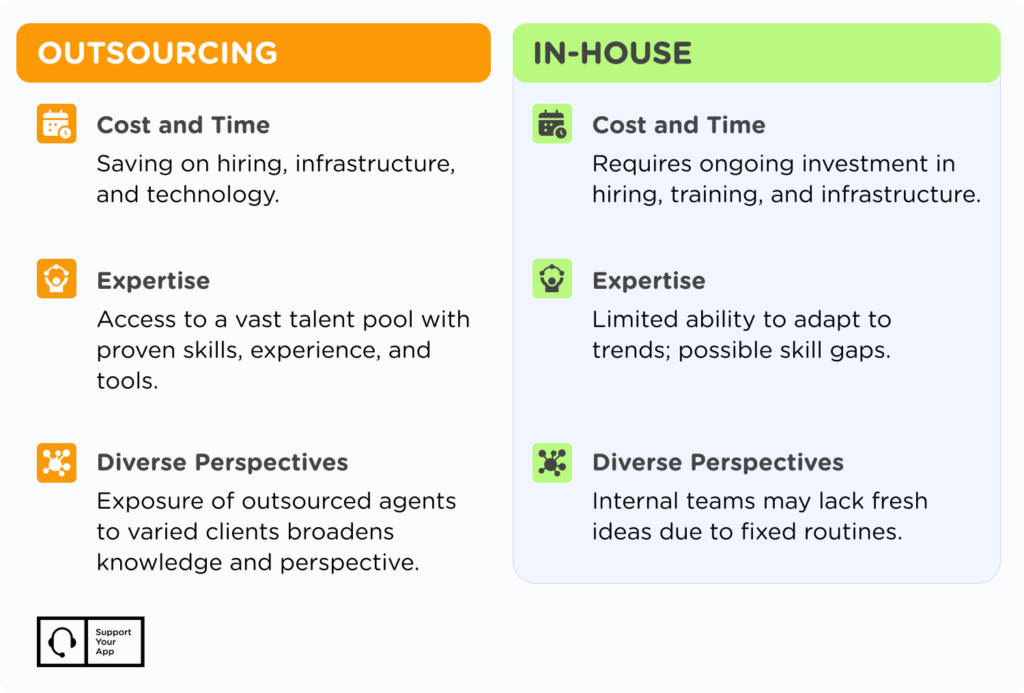
Here are some reasons to switch from an in-house team to one of the customer support providers, as also depicted in the graphic below.
Gain Access to Specialist Knowledge: By outsourcing operations to an external team, the business gains access to insights and expertise that its internal team may not possess, ensuring more effective support efforts.
Versatility: As the business grows, so does the need for support volume, and outsourced vendors are better able to scale their operations up and down according to support demand.
Efficiency and Cost-Effectiveness: Not only is hiring an outsourced team more efficient, as all agents are trained and infrastructure is in place, but it is also more affordable, as the outsourced vendor is responsible for the purchasing, hiring, and training of all agents and equipment.
Improved Protection: Outsourced companies are well-versed in the latest data security methods and up-to-date on the current privacy best practices, ensuring that your customers’ information is well-protected.
Summary
Knowing how to switch customer support providers can significantly improve your service quality, scalability, and overall customer experience, but only if done with careful planning. Recognizing when to make this change is essential. Warning signs for you may include declining service quality even after repeated feedback and corrective actions: slower response times, lower first contact resolution and poor customer satisfaction; limited scalability during busy seasons, or a lack of innovation.
Before making the switch, you should audit your existing setup to understand current gaps, define clear goals, and establish selection criteria. A structured, phased approach, beginning with a pilot program, running both providers in parallel, and then gradually scaling operations, will help you ensure a smooth transition without service disruption.
And if you’re shifting from in-house to outsourced support, the benefits will include access to specialized expertise, greater flexibility, cost efficiency, and enhanced data protection, all of which enable teams to focus on their core business operations while ensuring customers receive high-quality service.
Like it? - Share:



Ilya Patricha
Former Senior Service Delivery Manager
An indispensable member of the SupportYourApp team, Ilya initially majored in French philology before discovering his passion for the customer support industry. As a Senior Service Delivery Manager, he helps support teams deliver exceptional services to clients’ customers. Ilya has developed a unique management approach that combines coaching with transformation management, allowing him to establish clear direction while giving team members the space for personal accountability, skills development, and creativity. In his spare time, he enjoys reading, learning to play the piano, and exploring contemporary philosophy and cognitive and social sciences.
Posted on December 10, 2025

Support Insights




Customer Support Trends 2026: Are You Ready?
Benchmark your customer support against key 2026 trends.