

Every call you handle for a clinic group, health plan, or digital health startup carries protected health information. Choosing a partner for healthcare call center outsourcing means trusting your compliance record to another team. We break down seven leading providers to see who measures up.
TL;DR
- HIPAA has no official certification. A signed BAA and real safeguards matter more than website badges.
- Large BPOs bring scale. Specialists bring focus and faster setup.
- SupportYourApp fits digital health teams that need multilingual, round-the-clock support from humans and AI.
- Compare vendors on equal terms.
Start with the money. According to IBM's 2025 Cost of a Data Breach Report, healthcare breaches cost $7.42 million on average. That's the highest of any industry for 12 years running. Your outsourcing partner sits right inside that risk.
What Makes a HIPAA Compliant Call Center?
It comes down to contracts and daily habits. HIPAA doesn't issue certificates. So "HIPAA certified" is marketing shorthand. What counts is how agents and systems handle protected health information (PHI) on every call.
The stakes are real. In 2025, 35.8% of healthcare data breaches occurred at business associates, according to HIPAA Journal. Any call center outsourcing vendor that touches PHI falls into that group, so the safeguards below aren't optional extras.
| Requirement | What it means in practice |
| Business Associate Agreement (BAA) | Signed before agents see any PHI. It defines permitted uses, safeguards, and breach reporting duties. |
| Encryption | PHI is encrypted in transit and at rest, including call recordings and chat logs. |
| Access controls | Unique logins, multi-factor authentication, role-based permissions, and automatic logoff. |
| Minimum necessary access | Agents only see the patient data a specific call requires. |
| Workforce training | HIPAA training at onboarding, regular refreshers, and documented sanctions. |
| Audit logs | Every record access is logged, so you can see who viewed what and when. |
| Breach notification | The vendor reports incidents to you within the timelines your BAA sets. |
| Risk analysis | Documented security risk assessments, repeated on a regular schedule. |
Quick take: Ask for evidence of each safeguard. A sales deck isn't proof enough.
How We Evaluated These 7 Providers
We scored each company on what buyers ask about most when comparing HIPAA compliant call center outsourcing options. Public information varies a lot. Treat this list as a starting point for your own due diligence.
- Compliance posture: willingness to sign a BAA, plus audited frameworks like HITRUST, ISO/IEC 27001, or SOC 2.
- Healthcare experience: payer, provider, pharmacy, or digital health programs already running.
- Channels: voice, chat, email, SMS, and AI agents.
- Scalability: the ability to add trained agents for open enrollment or flu season spikes.
- Pricing transparency: how clearly the vendor explains what you'll pay for.
Full disclosure here. We're SupportYourApp, and we've listed ourselves first. Judge us the same way.
Best Healthcare Call Center Outsourcing Companies in 2026
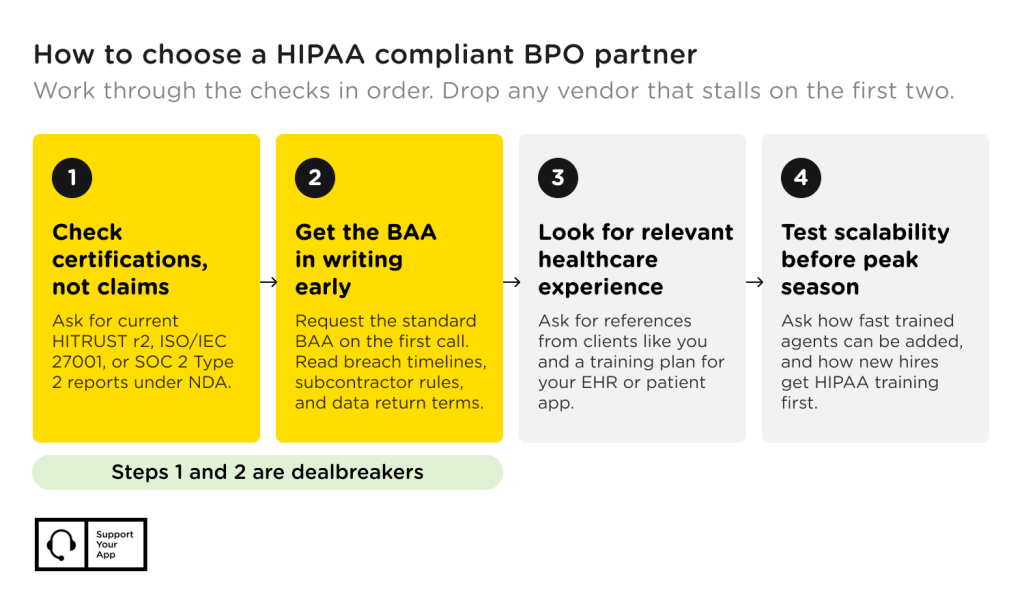
These seven providers serve very different buyers, from independent practices to national health plans. Each profile covers strengths, weak spots, and the ideal client.
1. SupportYourApp
SupportYourApp has run outsourced support since 2010, with 1,500+ professionals across eight international hubs. Its healthcare customer service outsourcing serves digital health, telehealth, and healthtech companies. You can review SupportYourApp's security practices before a first call.
Key services: patient and member support by phone, chat, email, and social media. Tier 1 to Tier 3 technical support for health apps. AI agents like SupportVoice, which answers calls 24/7 in 30+ languages.
Pros:
- HIPAA, GDPR, and CCPA compliant. ISO/IEC 27001 and PCI DSS Level 1 certified.
- 60+ languages, 24/7/365.
- Human plus AI model. AI takes routine requests, and trained agents handle sensitive cases.
Cons:
- No HITRUST certification listed. Some large payers require it.
- Less suited to clinical programs that need licensed nurses or insurance agents.
Best for: digital health startups, telehealth platforms, and healthtech SaaS companies scaling multilingual patient support.
2. Teleperformance
Teleperformance, now branded TP, is one of the world's largest customer experience outsourcers. It supports healthcare and life sciences clients across dozens of countries.
Key services: member services, patient support, pharmacy and benefits calls, and AI-assisted digital care.
Pros:
- Huge global footprint.
- Capacity for big seasonal spikes.
Cons:
- Enterprise-sized contracts. Small programs may get less flexibility.
- Controls can differ by delivery site. Confirm where your program runs.
Best for: large insurers and life sciences companies that need multi-country coverage.
3. TTEC
TTEC has served healthcare payers and providers for more than two decades. Everest Group named it a Major Contender in its 2026 Healthcare CXM assessment.
Key services: member engagement, Medicare enrollment support with licensed agents, revenue cycle management, and provider network management.
Pros:
- Deep payer experience. Licensed agents cover enrollment season.
- AI tools that assist agents during live calls.
Cons:
- Payer-first offering. Small provider groups may find it heavy.
- Enterprise onboarding takes time.
Best for: health plans handling open enrollment and Medicare Advantage volume.
4. Conduent
Conduent provides business process services to health plans, state Medicaid programs, and pharmacy benefit clients. Government health programs make up a large part of its work.
Key services: member contact centers, claims and eligibility support, pharmacy help desks, and public program administration.
Pros:
- Long Medicaid experience.
- Contact center and back-office processing under one roof.
Cons:
- A 2025 cyberattack at Conduent Business Services compromised over 62.2 million records, making it the largest healthcare data breach of the year and the third-largest in U.S. history. Ask what architectural safeguards and network segmentations changed afterward.
Best for: state agencies and health plans running government-funded programs.
5. Foundever
Foundever, formerly Sitel Group, employs about 170,000 associates across 45 countries. It supports healthcare clients with member care, patient access, and telehealth support.
Key services: member care, appointment scheduling, telehealth support, and back-office processing.
Pros:
- Support in 60+ languages.
- Nearshore and offshore delivery options for cost control.
Cons:
- Healthcare is one vertical among many. Smaller accounts may get less attention.
Best for: mid-size and large healthcare organizations that want multilingual coverage at scale.
6. Alorica
Alorica is a healthcare-heavy BPO with 100,000+ employees across 16 countries. Everest Group named it a Leader in its 2026 Healthcare CXM assessment.
Key services: pharmacy services, member support, medical billing, prior authorization, and real-time voice translation.
Pros:
- HITRUST r2 certified. It also holds SOC 2 Type 2 and PCI DSS Level 1 certification.
- Support in 75+ languages.
Cons:
- Built for enterprise volume. Smaller practices may struggle to justify the engagement.
Best for: large payers, provider networks, and pharmacy benefit managers.
7. Neolytix
Neolytix is a Chicago-based management services organization founded in 2012 for independent medical practices. Its virtual medical assistants handle calls, scheduling, and insurance checks alongside billing and credentialing work.
Key services: virtual receptionists, appointment booking, benefit verification, prior authorizations, and revenue cycle management.
Pros:
- Designed for small practices, offering flexible 'Build Your Service' models without long-term enterprise lock-in.
- Backup assistant included for continuity.
Cons:
- Limited to English and Spanish coverage; less suitable for global, multi-region scaling.
Best for: independent physician practices and behavioral health groups.
Side-by-Side Comparison of All 7 Providers
Certifications and language counts change often. Verify every detail. Use this table to shortlist a HIPAA compliant contact center before booking demos.
| Provider | HIPAA Compliance | Certifications | Channels | Languages | Best For | Pricing Model |
| SupportYourApp | HIPAA compliant | ISO/IEC 27001, PCI DSS L1 | Voice, chat, email, social, AI agents | 60+ | Digital health, healthtech | Custom quote |
| Teleperformance | Program-level controls | ISO/IEC 27001, ISO 27701, SOC 1, SOC 2 Type II, PCI DSS L1, COPC; HITRUST r2 | Voice, chat, email, digital | 300+ with dialects | Global insurers, life sciences | Custom enterprise contract |
| TTEC | Program-level controls | HITRUST CSF, FedRAMP Certified, SOC 1, SOC 2 Type II, ISO/IEC 27001, PCI DSS L1, NIST SP 800-53 aligned | Voice, chat, digital, AI | 50+ | Health plans, Medicare | Custom enterprise contract |
| Conduent | Business associate programs | HITRUST CSF / r2, DirectTrust / EHNAC Healthcare Network-EHN Accredited, ISO/IEC 2700, SOC 1 Type II, SOC 2 Type II, PCI DSS L1 | Voice, digital, back office | 23 | Medicaid, public programs | Custom enterprise contract |
| Foundever | Program-level controls | Confirm current certificates | Voice, chat, email, social | 60+ | Mid-size to large health orgs | Custom enterprise contract |
| Alorica | HIPAA compliant | HITRUST r2, SOC 2 Type 2, PCI DSS L1 | Voice, digital, AI translation | 75 | Large payers, PBMs | Custom enterprise contract |
| Neolytix | HIPAA compliant | Follows HIPAA and ISO standards | Voice, email, chat, text | English, Spanish | Independent practices | Custom monthly plan (quote-based) |
Quick take: Size matters here. Match the provider's typical client to your own call volume.
How to Choose a HIPAA Compliant BPO Partner
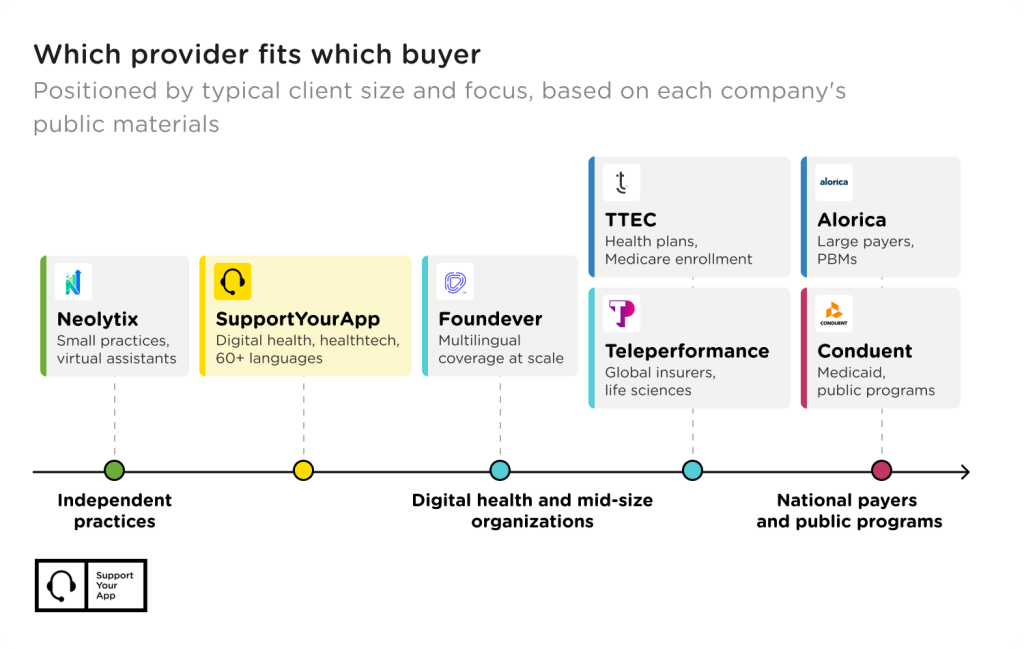
The right partner depends on your patient mix and risk tolerance. Work through these four checks in order. Stalling early disqualifies vendors.
Check Certifications
Ask for current audit reports. HITRUST r2, ISO/IEC 27001, and SOC 2 Type 2 reports show an outside assessor tested real controls. A HIPAA compliant call center should share them under NDA.
Get the BAA in Writing Early
Request the vendor's standard BAA during your first sales call, before any contract discussions move forward. Take time to read through the breach notification timeline, the subcontractor rules, and the data return terms closely. Any delays in producing these documents should be treated as a red flag.
Look for Relevant Healthcare Experience
A payer program and a telehealth app need different skills. Ask for references from clients like you, and ask how agents learn your Electronic Health Record (EHR), scheduling tools, or patient app. Good healthcare call center services come with training plans.
Test Scalability Before Peak Season
Ask how quickly the vendor can bring on trained agents for open enrollment or a product launch. Then ask how new hires get their HIPAA training before they ever take a first shift. That second answer usually tells you more than the first.
Quick take: Paperwork first, scale last.
Choosing Your HIPAA Compliant Call Center
Every provider here can take patient calls, but they serve very different buyers. Big BPOs suit national payers. Specialists suit practices and fast-growing health apps, so pick the partner whose typical client looks like you.
If you're a digital health team weighing healthcare call center outsourcing, SupportYourApp is worth a conversation. We combine human agents and AI tools across 60+ languages, with HIPAA compliance built in.