


If you are in banking or fintech, this article shows where customer service in your industry is heading and how to keep up.
TL;DR
- AI in banking customer service has shifted from a nice-to-have to the backbone of how fintech companies handle customer support today.
- Conversational AI tools, chatbots, and voice assistants are handling routine tasks, so human agents can focus on sensitive, complicated cases.
- The benefits stack up: quicker decisions, lower costs, fewer fraud incidents, and higher CSAT.
- The future is all about autonomous AI agents, hyper-personalized services, and payments that run in the background without any manual input.
By 2032, AI in the fintech industry is projected to grow from $712.4 million to $12.3 billion. That’s not a trend. That’s a shift the entire sector can’t afford to ignore.
In 2026, artificial intelligence is transforming customer support in banking through AI voice assistants, tailored financial services, proactive fraud protection, and predictive support, driving efficiency, security, and personalization at scale.
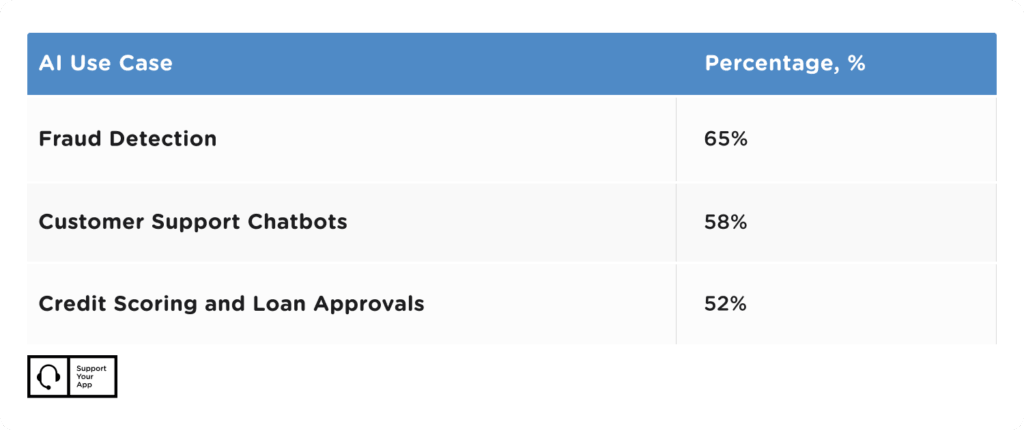
According to Global Growth Insights, these are the AI use cases with the highest adoption in current banking AI strategy:
Fintech customer service with secure PCI DSS-certified coverage is more accessible than you think. Outsourcing your support to SupportYourApp is the smartest way to get top-tier security and compliance while keeping your customer experience goals on track.
In this article, we’ll break down how conversational AI is used in banking support, the most common AI use cases, the real challenges, and the benefits, so you can form your own view on where this is all going.
What Is Conversational AI in Banking Customer Service?
It’s digital banking automation that uses AI chatbots and voice AI agents to process and respond to customer requests through voice or text. It lets customers communicate with banks more naturally and frees up human agents to handle cases that actually need expert attention.
The benefits of using conversational AI in customer service include:
- 24/7 support
- Instant first replies
- Faster resolution
- Lower operational cost
- Increased efficiency
- Improved customer experience
Real-time conversational AI banking support works across mobile apps, websites, and phone systems around the clock. It identifies customer information instantly and gives human agents the context they need during fraud alerts or account issues.
Modern banking customer service runs on omnichannel communication. Customers interact through mobile apps, websites, messaging platforms, and call centers, and AI keeps the experience consistent across all of them by maintaining conversation history and context.
That means a customer can start with a chatbot, switch to WhatsApp, and wrap up with a human agent — all without repeating themselves.

Use Cases of AI in Banking Customer Support
AI has become a staple of banking automation in 2026. Its role in improving both banking operations and customer experience is hard to overstate — from loan applications to KYC data and everything in between.
But not all support requests are the same. Here’s how AI handles each type.
Everyday Customer Questions
This is where AI chatbots for banking do their heavy lifting. Found across websites, apps, WhatsApp, and SMS, chatbots handle the high-volume, repeat requests: balance and transaction checks, service explanations, and FAQs. The average banking chatbot manages up to 40,000 interactions per month, serving approximately 3.1 billion customers globally.
Voice is part of this picture too. With voice AI applications in banking customer service, customers check bills, get financial advice, and transfer money using just their voice. Studies show this can increase customer satisfaction by up to 21%, thanks to faster response times.
Complex Financial Requests
Some requests go beyond a quick answer. AI customer service tools in banking handle loan processing, credit scoring, and personalized investment recommendations.
AI reviews applications, analyzes credit reports, calculates interest rates, and makes loan decisions in under sixty seconds. On the investment side, it generates recommendations based on current market trends and each customer’s financial goals, helping people make smarter decisions without waiting for an advisor.
Security and Compliance Requests
Fraud alerts, identity verification, account protection — these are the requests where getting it wrong costs the most. AI handles them with impressive precision.
For KYC, AI analyzes ID documents, facial recognition data, and customer information during onboarding. Checks that used to take hours or days now take minutes. For fraud, AI monitors transaction patterns in real time and flags unusual behavior instantly. According to Mastercard’s research, 83% of respondents say AI has significantly sped up their process for fraud investigation and case resolution.
Self-Service Requests
Not every customer wants to talk to either a human or AI. Self-service systems let customers solve common issues on their own: password resets, updating personal information, tracking applications. Bank of America’s virtual assistant Erica is a solid example: customers type or speak a request, and it’s handled immediately.
Challenges and Benefits of AI in Banking
AI brings a lot to the table. But it also introduces technical, operational, and ethical challenges that banks need to work through to keep things secure, reliable, and trustworthy.
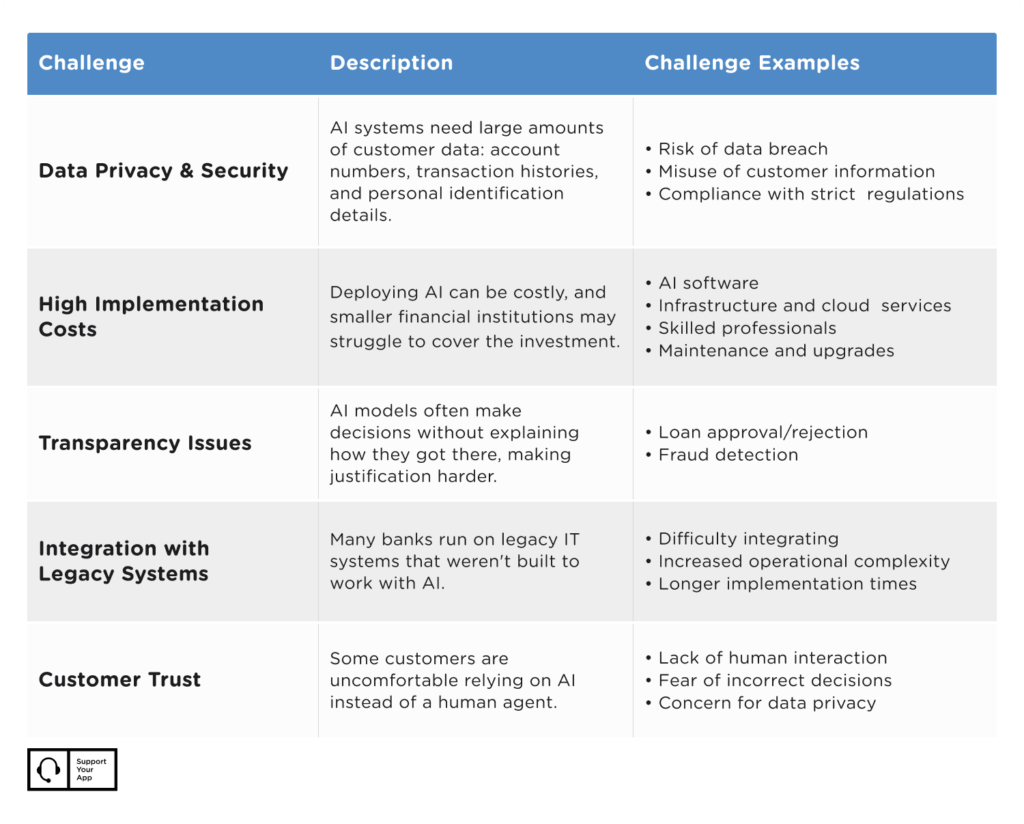
On the flip side, AI puts the financial services customer experience front and center. The benefits:
- Instant responses and faster problem resolution
- Faster decision-making
- Cost reduction
- High personalization
- Better risk management
- Stronger compliance and regulation
The Future of AI in Banking
The future of AI customer support automation in banking hasn’t hit its ceiling. This space will keep growing and reshaping financial services for years ahead.
As technology advances, banks will lean harder into automation, predictive analytics, and intelligent digital services. Here’s what’s coming.
Improved Autonomous AI
Fully autonomous AI agents that need no supervision are one of the most anticipated upcoming trends. These systems will monitor accounts and transactions, run financial workflows, and detect fraud, all while delivering real-time financial recommendations without any human in the loop.
Think of them as digital relationship managers that learn from customer behavior and adjust banking services on the fly.
Hyper-Personalized Banking Services
Banks will use AI to dig into vast amounts of customer data and create financial products that actually fit each person: personalized loan offers, custom savings plans, real-time spending insights, all built around individual needs.
That level of personalization is expected to increase customer lifetime value by up to 50% by 2027.
Voice AI in banking and finance customer service is also playing a big role in personalization. Some banking systems already use voice biometrics to recognize a customer’s voice and serve up relevant account info and services right away.
Intelligent and Invisible Payments
Future banking is moving toward embedded and invisible payments powered by AI. Automatic payments through digital platforms, AI-driven payment decisions, and tight integration with digital wallets mean transactions can happen in the background without anyone pressing a button.
According to Backbase, digital wallet users already represent 53% of the global population, with instant payment volumes growing from 16% in 2023 to a projected 22% by 2028. With this technology, those numbers could climb even higher.
Open Banking and AI Ecosystems
Open banking started as a compliance exercise. In 2026, it’s becoming a real revenue driver.
The open banking model lets banks share customer financial data with third-party companies through APIs, so customers can connect their information with other authorized apps and services.
Embedded finance was valued at $104.8 billion in 2024 and is projected to reach over $834 billion by 2034. By investing in this API structure, financial institutions are turning regulatory infrastructure into a competitive advantage.
The future of AI in customer service for banking is already underway. SupportYourApp’s AI customer service solutions can help you get there, with full AI setup, continuous monitoring, 24/7 availability, and compliance you can count on.
Summary
AI is rapidly changing customer service in banking. Efficiency, security, and personalization are all getting a serious upgrade. Modern banking support now integrates technologies like conversational AI, voice assistants, and predictive analytics to deliver faster, more convenient customer experiences.
Conversational AI for banking sits at the center of this shift. Customers interact with banks through chatbots and voice assistants available around the clock, with faster response times than any human team and lower operational costs. These tools run across mobile apps, websites, messaging services, and call centers through omnichannel systems.
AI is active across multiple banking support functions: chatbots and messaging platforms handle routine questions and account requests, while voice assistants let customers get things done by speaking. AI also supports loan processing, KYC verification, fraud detection, and personalized investment guidance. Self-service tools let customers handle password resets, personal information updates, and application tracking on their own.
Despite its advantages, AI in banking customer service brings real challenges. Data privacy, security, high implementation costs, transparency of AI decisions, and integration with older systems are all issues banks need to work through. Customer trust is also a factor — some users aren’t ready to fully rely on automated systems.
Looking ahead, banking will keep shifting through smarter automation and more intelligent services. Autonomous AI agents, hyper-personalized financial products, invisible payment systems, and open banking models are all on the horizon.
These developments will let banks offer more secure, customer-focused financial services and stay competitive in a fast-moving digital landscape.
FAQs
How Safe Is AI in Customer Service for Banking?
AI in banking customer service is safe when paired with strong security, encryption, and compliance measures. These protect customer data while detecting fraud and keeping support reliable and efficient.
What Are the Benefits of AI in Banking?
AI makes banking faster and smarter by speeding up customer support, cutting operational costs, improving fraud detection, making financial services personal, and automating processes like loan approvals and customer onboarding.
How Can Banks Use AI to Improve Customer Service?
Banks deploy chatbots, voice assistants, and self-service systems to give customers instant support, personalized recommendations, faster issue resolution, fraud alerts, and consistent experiences across every channel.
❤︎ Like it? — Share: Share on LinkedIn or Share on Facebook

Having been one of the core parts of SupportYourApp, Nick helped to support 50+ products before realizing his vocation of building support processes and integrating all the necessary tools. During the last 5 years he worked with various companies from all around the world, helping them launch their service with SupportYourApp.
Posted on LinkedIn